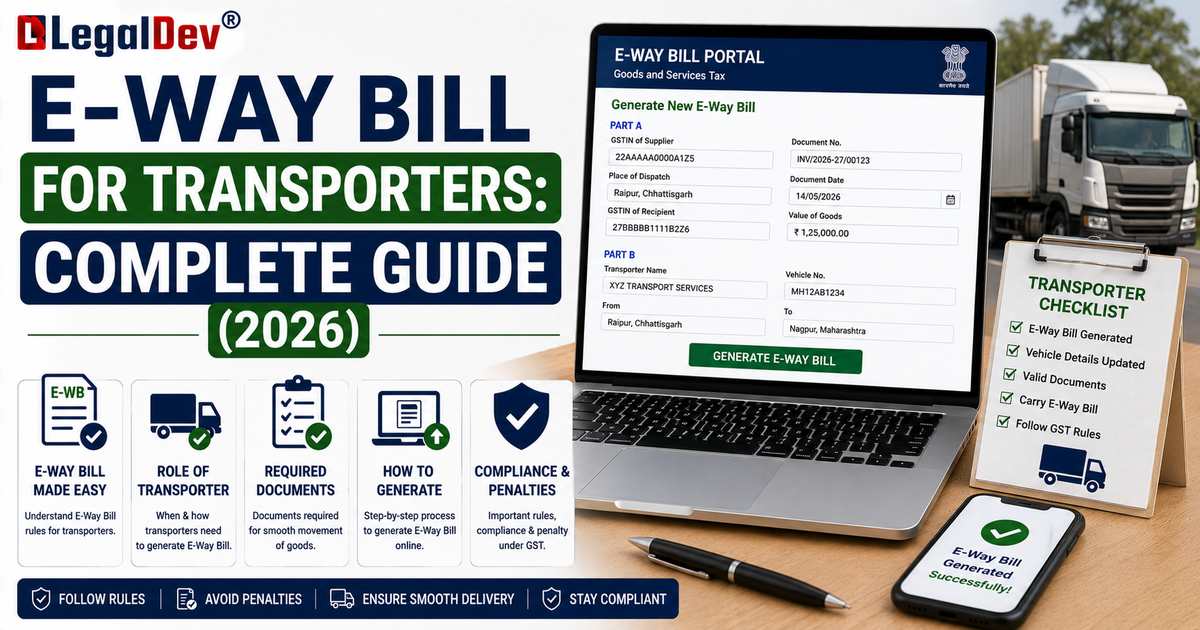
E-Way Bill for Transporters: Complete Guide
The supplier fills in most of an e-way bill. The transporter is usually the one standing next to the truck when an officer asks to see it. That gap, between who creates the document and who answers for it, is exactly why transporters need to understand this system well enough to catch a problem before a checkpoint does. This guide pulls together everything relevant to a transport business, from first enrolment to handling a mid-route breakdown.
Registered or Not, You Can Still Use the System
If your transport business already has a GSTIN, registering on the e-way bill portal works the same way it does for any other registered business.
If you don't have a GSTIN, and a lot of smaller fleet owners and individual truckers don't, you can still get in through a separate enrolment process. You'll come out of it with a TRANS ID, You receive a 15-digit TRANSIN (Transporter ID), which identifies you as an enrolled transporter on the e-way bill system. Our E-Way Bill Registration page walks through both paths in full.
Logging In
Nothing special here: User ID, password, captcha, and an OTP for two-factor authentication, same as any other user. If you hit a snag, E-Way Bill Login covers the common fixes.
How an E-Way Bill Ends Up in Your Hands
A supplier fills Part A but doesn't yet know which vehicle will carry the shipment, so they assign it to your GSTIN or TRANS ID instead. It shows up on your dashboard, and from there, you complete Part B with the real vehicle number and transport document details. E-Way Bill Part B has the full field-by-field rundown.
Carrying Several Consignments in One Vehicle
Got multiple separate shipments, each with its own e-way bill already generated, going out on the same truck? You don't need to juggle them individually at a checkpoint. Group them under a Consolidated E-Way Bill (Form EWB-02), which bundles all the individual e-way bill numbers into one reference document.
When the Vehicle Changes Mid-Route
Breakdowns happen. Trans-shipments happen. A different vehicle gets swapped in at the last minute more often than anyone would like. None of that requires cancelling the e-way bill, the vehicle number can just be updated on the existing one. Full steps are on our Vehicle Number Update page.
Running Late? Extend Before It Expires
If a delay looks likely and the e-way bill is getting close to its expiry, you (or whoever generated it) can extend the validity, but only within an 8-hour window on either side of that expiry. E-Way Bill Extension covers the process and what counts as an acceptable reason.
What Should Be in the Cab
A copy of the e-way bill, printed or on a phone, with the EBN and QR code visible. The invoice, bill of supply, or delivery challan it's built on. And the usual Motor Vehicles Act paperwork: licence, registration, insurance. For the complete rundown, see E-Way Bill Documents Required.
What Actually Happens at a Checkpoint
An officer stops the vehicle and checks the e-way bill against what's physically being carried. Match, and you're back on the road. Mismatch, missing document, or expired e-way bill, and the goods and vehicle can be detained under Section 129 of the CGST Act. Our E-Way Bill Penalty page has the exact numbers involved in getting released.
What This Boils Down To for a Transporter
Double-check Part B before the truck leaves. Keep the e-way bill accessible for the whole journey. Update the vehicle number the moment something changes. Extend validity before it runs out, not after. And when an officer wants to check the paperwork, hand it over without turning it into a longer conversation than it needs to be.
Frequently Asked Questions
Do transporters need their own GST registration?
No. Without a GSTIN, you can still enrol separately and get a TRANS ID, which works the same way for e-way bill purposes.
Can a transporter generate the whole e-way bill without the supplier's involvement?
Yes, if neither the supplier nor recipient has done it. Given the invoice or delivery challan, the transporter can fill both Part A and Part B themselves.
Who's on the hook if the e-way bill expires while goods are still on the road?
Whoever's carrying the goods faces the immediate risk if they get checked. But responsibility for the underlying compliance is usually shared between supplier, recipient, and transporter, depending on who generated and controlled the document.
Can one transporter pick up and update an e-way bill assigned to a different transporter?
Yes, an e-way bill can be assigned to another transporter for further transportation. Once assigned, the latest/current transporter can update Part B.
Read Next
Haven't enrolled yet? Start with E-Way Bill Registration. Once you're in, E-Way Bill Login covers day-to-day access, and E-Way Bill Part B covers exactly what you'll be filling in most of the time.