E-Way Bill Penalty: Fines and Consequences Under GST
A truck stopped at a checkpoint without a valid e-way bill isn't just an inconvenience. It can mean paying twice the tax you owed, or losing the goods to detention until you settle up. Section 129 of the CGST Act, 2017, is the provision that gives GST officers this power, and the numbers behind it are worth knowing before you're standing at the roadside working them out for the first time.
What the Penalty Actually Costs
If goods are moving without a valid e-way bill, or the details on it don't match what's in the vehicle, an officer can detain both the goods and the vehicle. What happens next depends on who shows up to claim them.
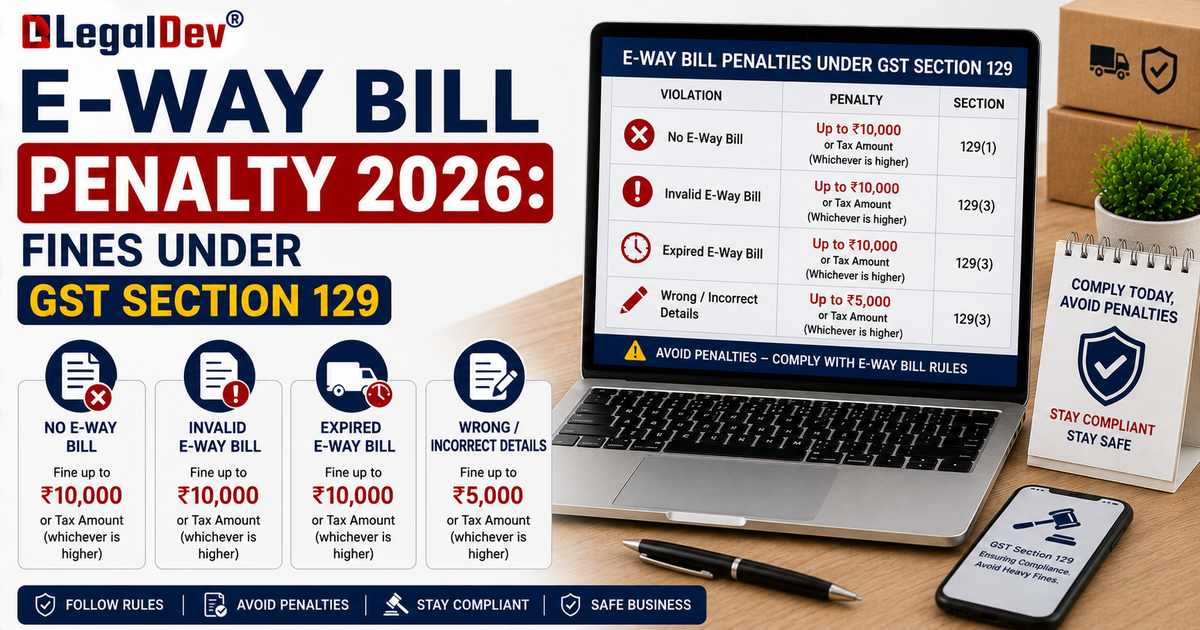
If the owner comes forward, the penalty is 200% of the tax payable on the goods, or ₹10,000, whichever is higher. If nobody comes forward to claim the shipment, the department treats that as a red flag for tax evasion, and the penalty jumps to 50% of the value of the goods, on top of the applicable tax.
Exempted goods get a lighter touch. If the shipment was carrying goods that don't attract GST but still needed documentation that was missing, the penalty is capped at 2% of the value of the goods, or ₹25,000, whichever is lower.
Not every slip-up gets the full treatment. A typo in the vehicle number, or a PIN code that doesn't quite match, is usually treated as a minor error and fined at a flat ₹1,000, rather than the 200% penalty reserved for genuine non-compliance.
Three Ways This Plays Out
A grocery wholesaler ships ₹85,000 worth of goods with 5% GST, so ₹4,250 in tax. No e-way bill was generated. The penalty here is ₹10,000, since that's higher than the tax itself.
A hardware distributor moves ₹2,40,000 worth of stock at 18% GST, meaning ₹43,200 in tax. The vehicle gets stopped without a valid e-way bill. Penalty: 200% of ₹43,200, or ₹86,400, and the vehicle may sit at the checkpoint until it's paid.
A garment shipment worth ₹6,00,000 is moving on an e-way bill that expired fifteen hours earlier. Legally, an expired e-way bill counts the same as no e-way bill at all, tax officers don't distinguish between the two when calculating the penalty.
Detention, Seizure, Confiscation: Not the Same Thing
These three words get used loosely, but they mark different stages.
Detention is the first step, where goods and the vehicle are held at the checkpoint while the matter gets sorted out. Seizure comes next if things aren't resolved quickly; the department formally takes custody rather than just holding the shipment in place. Confiscation, under Section 130 of the CGST Act, is reserved for cases with clear intent to evade tax, or where the person simply doesn't pay what's demanded within the given timeframe. Confiscated goods can eventually be auctioned off if the fine goes unpaid.
Getting Your Goods Back
Paying the tax and penalty demanded is the fastest route to release. Some cases allow furnishing a bond and security instead of immediate payment. If you think the detention was wrongful, you can contest it through the GST appeals process, though this usually takes longer than paying now and disputing later through a refund claim.
Keeping This From Happening to You
Generate the e-way bill before the goods leave, not after. Cross-check Part A and Part B against the actual invoice before submitting. Track validity and extend it early if a delay looks likely, using the extension process, rather than waiting until the clock has already run out. Update vehicle details the moment transport changes, through the vehicle number update feature. And keep GSTR-3B filings current: two missed returns in a row will block e-way bill generation for that GSTIN entirely.
Frequently Asked Questions
What's the penalty for using an expired e-way bill?
The system treats it exactly like having no e-way bill at all. That means 200% of tax, or ₹10,000, whichever is higher, under Section 129.
Can the penalty be waived for a genuinely unavoidable delay, like a breakdown?
Sometimes, but not automatically. Courts have ruled against the harshest penalty in specific cases where no tax was actually payable, such as zero-rated exports, and the delay was clearly procedural. Getting that relief usually means a legal appeal, not a discount at the checkpoint.
Who actually pays: the supplier, the recipient, or the transporter?
Whoever is holding the goods when they're detained deals with it in the moment, typically the transporter. But liability for the tax and penalty can extend back to the supplier or recipient, depending on who was responsible for the compliance in the first place.
Is there a penalty for simply forgetting to cancel an e-way bill that was never used?
The rules don't spell out a specific fine for this. But an e-way bill sitting on record that doesn't match any actual movement is the kind of loose end that draws attention during a GST audit.
Read Next
Understanding when an e-way bill is required in the first place is the best way to avoid these penalties. Once you're generating one correctly, follow the generation process closely, and if a bill is close to expiry, extend it using our E-Way Bill Extension guide.