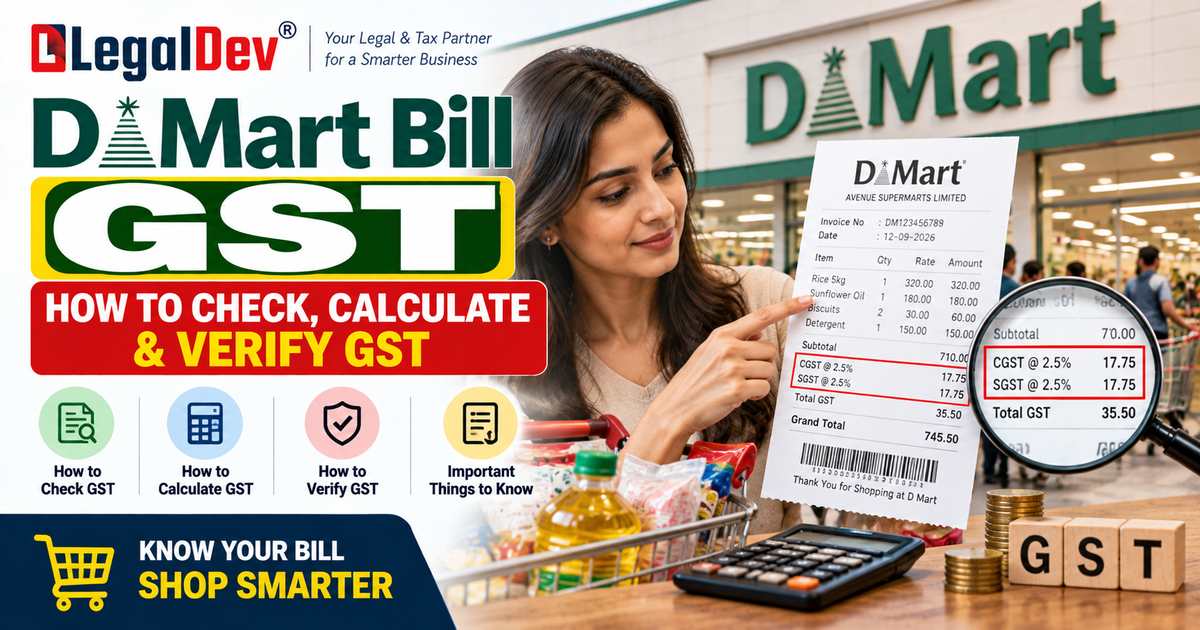
D Mart Bill GST: How to Read, Check and Calculate GST on Your Shopping Bill
Everything below reflects the GST 2.0 rate structure that took effect on 22 September 2025, following the 56th GST Council meeting. Wherever a rate depends on packaging, branding, or product classification, that is stated explicitly — GST on a D Mart bill is never a single flat rate for the whole store.
The GST shown on your D Mart bill is not one flat tax on your total spend — it is calculated separately for each product, using the GST rate that applies to that product's category under India's GST law, and it is split into CGST (central tax) and SGST (state tax) for purchases made within your own state.
Key Takeaways
-
D Mart bill GST is charged per product, not on the total bill amount — a myth claiming otherwise has circulated on WhatsApp for years and was directly denied by the company.
-
Since 22 September 2025, GST in India mainly runs on 0%, 5%, 18%, and 40% slabs, replacing the earlier 5/12/18/28% structure.
-
Everyday items like soap, shampoo, toothpaste, and many packaged foods now attract 5% GST, down from higher slabs before the reform.
-
On an intra-state bill, GST is split equally into CGST and SGST (for example, 5% GST = 2.5% CGST + 2.5% SGST).
-
You can verify any GSTIN printed on your bill for free on the government's GST portal.
What GST on a D Mart Bill Actually Means
Every product D Mart sells falls under a GST rate fixed by the GST Council, based on the product's HSN (Harmonised System of Nomenclature) code — not on which store sells it or how much your total bill comes to. So two different items on the same receipt — say, a packet of biscuits and a bottle of shampoo — can legally carry different GST rates, and that is expected, not an error.
This is worth stating plainly because it is the single most searched-for confusion around D Mart bills.
Does D Mart Charge GST on the Total Bill Value?
No. This is a long-running myth, and it is worth addressing directly because it keeps resurfacing.
A WhatsApp forward that has circulated since 2017 claims D Mart (and other large stores) apply an escalating GST rate once your bill crosses ₹1,000, and recommends splitting a single purchase into multiple smaller bills to avoid it. Fact-checkers who examined actual D Mart receipts found the message circulated as a hoax and prescribed made-up GST rates for purchases above Rs. 1000, including a suggestion to split bills into Rs. 1000 chunks to avoid paying GST. Avenue Supermarts, the company that runs D Mart, responded to the hoax on its Facebook page, clarifying that GST rates are unrelated to the total bill value and instead depend on the specific product purchased, at rates set by the government
A published breakdown of an actual D Mart receipt confirmed this: a single bill showed products across multiple different GST slabs, with GST applied item by item rather than on the bill as a whole.
If you ever see a forwarded message suggesting you should split your D Mart bill to "avoid GST," it is not accurate. GST is fixed by product category, and splitting a bill changes nothing about the tax owed.
Current GST Rates on Products Commonly Bought at D Mart
India's GST structure changed significantly on 22 September 2025, when the 56th GST Council meeting's decisions took effect through CBIC Notification No. 9/2025-Central Tax (Rate). The reform simplified the previous five-slab structure (0%, 5%, 12%, 18%, 28%) into a primarily two-rate system of 5% and 18%, with a special 40% rate reserved for select luxury and sin goods.
This matters directly for your D Mart bill: many everyday products that used to sit at 12% or 18% GST moved down, mostly to 5%.
Important: Not every category moved the same way, and D Mart does not set these rates — it applies whatever rate the government has fixed for each HSN code. The table below reflects general GST classifications, not D Mart-specific pricing or policy.
Household, personal care, and daily-use items
|
Product category
|
Typical current GST rate
|
Note
|
|
Soap, shampoo, toothpaste, toothbrush, shaving items, talcum powder
|
5%
|
Reduced from the earlier 12–18% range as part of the September 2025 reform
|
|
Hair oil
|
5%
|
Same reform batch
|
|
Candles, matches
|
5%
|
Same reform batch
|
|
Most home appliances and electronics
|
18%
|
Items earlier taxed at higher rates, such as consumer electronics, were moved to the 18% standard rate
|
Packaged food and groceries
|
Product category
|
Typical current GST rate
|
Note
|
|
UHT milk, pre-packaged paneer, packaged roti/chapati/paratha/parotta
|
Nil
|
Fully exempted from GST under the reform
|
|
Butter, ghee, cheese, jams, sauces, soups, pasta, namkeens, confectionery
|
5%
|
Reduced from the earlier 12–18% range
|
|
Dry fruits (almonds, pistachios, cashews), dates, citrus fruits
|
5%
|
Same reform batch
|
|
Unbranded, loose staples (rice, wheat, pulses, unpackaged)
|
Nil
|
Generally exempt as basic food grain
|
|
Pre-packaged and labelled versions of the same staples
|
5% (typically)
|
Rate depends on packaging and labelling status under GST rules, not the product name alone
|
|
Carbonated soft drinks
|
40%
|
Classified as a sin/luxury item under the special rate
|
What this means practically
Don't assume every packet on a D Mart shelf carries the same rate just because it is "food" or "grocery." Two nearly identical products — one branded and pre-packaged, one loose — can be taxed differently. This is a GST packaging/branding rule, not a D Mart-specific pricing decision.
How GST Is Shown on Your D Mart Bill
A GST-compliant retail invoice, including a D Mart bill, is generally expected to show:
-
The seller's GSTIN (a 15-character GST registration number)
-
An invoice or bill number and date
-
Each product with its HSN code
-
The quantity and price per item
-
The GST rate applied to that item
-
The tax split as CGST and SGST (for purchases within your state) or IGST (for certain inter-state supply scenarios)
-
The final payable amount, inclusive of GST
If your state and D Mart's registered state are the same — which is the case for almost all in-store purchases — the GST on each item is split equally between CGST (central government) and SGST (state government). For example, a product taxed at 5% GST shows as 2.5% CGST + 2.5% SGST on the line item, not as a single combined 5% figure, though some receipts do print the combined rate for simplicity.
How to Calculate GST on a D Mart Bill
You can check the GST math on any item yourself using this formula:
GST amount = Taxable value of the item × (GST rate ÷ 100)
Worked example:
Suppose you buy a shampoo bottle priced at ₹200 (this is the taxable value, i.e., the price before GST), and it falls under the 5% GST slab.
-
GST amount = ₹200 × 5% = ₹10
-
Split as CGST + SGST = ₹5 + ₹5
-
Final price you pay = ₹200 + ₹10 = ₹210
If your bill lists the price as GST-inclusive (common on MRP-tagged items), you can work backward to find the GST component:
GST amount = MRP × [GST rate ÷ (100 + GST rate)]
Using the same shampoo priced at ₹210 (GST-inclusive):
-
GST amount = ₹210 × (5 ÷ 105) = ₹10
-
Base price before GST = ₹210 − ₹10 = ₹200
This second formula is the one you'll actually need most often at D Mart, since shelf prices are usually MRP (tax-inclusive), and the printed bill breaks that MRP back down into base price and GST.
How to Verify the GST Charged on Your D Mart Bill
Step 1: Check the GSTIN is valid
Every GST-registered seller must print a valid GSTIN on the bill. You can confirm it is real, free of cost, on the government's own portal: visit the search page on the GST portal at gst.gov.in, enter the GSTIN shown on your invoice along with the captcha code, and search — a valid GSTIN will display the registered business's legal name, jurisdiction, registration date, and current status.
Step 2: Cross-check the HSN code and rate
Each product on your bill should carry an HSN code. If you want to independently confirm the GST rate for a specific HSN code, you can check the official GST website, which lists applicable rates for goods and services along with items that are exempt. The GST Council also maintains a public rate finder for this purpose.
Step 3: Recalculate the tax yourself
Use the formulas above on two or three line items. If your manual calculation doesn't match the printed CGST/SGST figures, the mismatch is usually one of:
-
A rounding difference (normal, and usually a few paise)
-
The item genuinely falling under a different HSN classification than you expected
-
A billing entry error, which is rare but does happen
What to Do If You Think GST Has Been Wrongly Charged
If, after recalculating, you still believe the GST on your D Mart bill is incorrect:
-
Recheck the product category first. Many disputes come from assuming a product is "food" or "grocery" when its actual GST classification (based on packaging, branding, or ingredient composition) differs from the everyday name of the product.
-
Raise it with the store directly, quoting the specific line item, HSN code, and rate shown.
-
Escalate to the GST helpdesk if the store cannot resolve it, since incorrect GST classification by a retailer is a compliance matter the tax department can look into.
-
Watch for signs of a fake bill. A fraudulent GST invoice can be identified by checking for a valid GSTIN, correct invoice number and date, HSN code, applicable tax rate, and quantity and amount details — a bill missing a valid GSTIN, or one where the GST breakdown doesn't add up, is a warning sign.
Getting or Downloading Your D Mart Bill
For in-store purchases, the primary record is the printed receipt handed to you at checkout — this already contains the full GST breakdown described above. If you've lost it, the practical route is to contact the specific store with your purchase date and approximate amount, since walk-in retail purchases are not automatically linked to an online account unless you provided one at checkout.
For online orders through D Mart's e-commerce channel, invoices are typically generated per order and made accessible through your account order history once the order is delivered or dispatched, in line with standard e-commerce invoicing practice in India. Exact steps can vary by app version, so if you can't locate an invoice for an online order, checking the order history section of your account or contacting customer support directly is the most reliable path — this is a detail specific to D Mart's own platform and worth confirming there rather than assuming.
Frequently Asked Questions
Does D Mart charge higher GST if my total bill is large?
No. GST is calculated per product based on its GST rate, not on the total value of your shopping bill. The idea that bills above a certain amount attract extra tax is a documented hoax that D Mart has publicly denied.
Why do some items on my D Mart bill show 0% GST?
Certain essential and unbranded food items — such as loosegrains, and specific dairy and bread products under the current reform — are classified as nil-rated or exempt under GST law. Not every grocery item carries a tax.
What is the difference between CGST and SGST on my bill?
For purchases made within your own state, the total GST rate on a product is split equally into CGST (collected by the central government) and SGST (collected by the state government). If you buy from a seller registered in a different state, IGST may apply instead, though this is uncommon for in-store retail purchases.
Can I claim input tax credit (ITC) on a D Mart shopping bill?
Input tax credit is available to GST-registered businesses purchasing for business use, not to individual consumers buying for personal use. A regular household shopping bill from D Mart is not eligible for ITC claims by the consumer.
Why does the GST rate on a product seem different from what I remember a year ago?
GST rates changed nationwide on 22 September 2025 under the GST 2.0 reform. Many items that were previously taxed at 12% or 18% moved to 5%, and the 12% and 28% slabs were largely phased out. If a rate looks different from what you recall, this reform is the most likely reason.
Is the GST rate on a product the same across all D Mart stores in India?
GST rates are set nationally by the GST Council and apply uniformly across the country for the same HSN classification, regardless of which store or state you buy from. What can differ by state is not the rate itself but occasionally the tax split shown (CGST+SGST for intra-state, IGST for inter-state).
How do I know if my D Mart bill is a genuine GST invoice?
Check that it carries a valid GSTIN (verifiable free on the GST portal), a proper invoice number and date, HSN codes for each product, and a GST breakdown that mathematically matches the listed rate and taxable value.
Is GST calculated before or after a discount is applied?
GST is charged on the taxable value of the product after any discount has been deducted, not on the original MRP before discount. This is why a discounted item's GST amount is usually smaller than what a simple MRP-based calculation would suggest.
Can D Mart choose to not charge GST at all on a product?
Only if that specific product is classified as GST-exempt under law. A GST-registered business cannot simply decide to skip charging GST on a taxable item — the rate is determined by the product's classification, not the retailer's discretion.
What should I do if the GST math on my bill doesn't add up?
Recalculate using the taxable value and printed rate first, since small rounding differences are normal. If the discrepancy is larger than rounding, raise it with the store with the specific line item referenced, and escalate to the GST helpdesk if it isn't resolved.