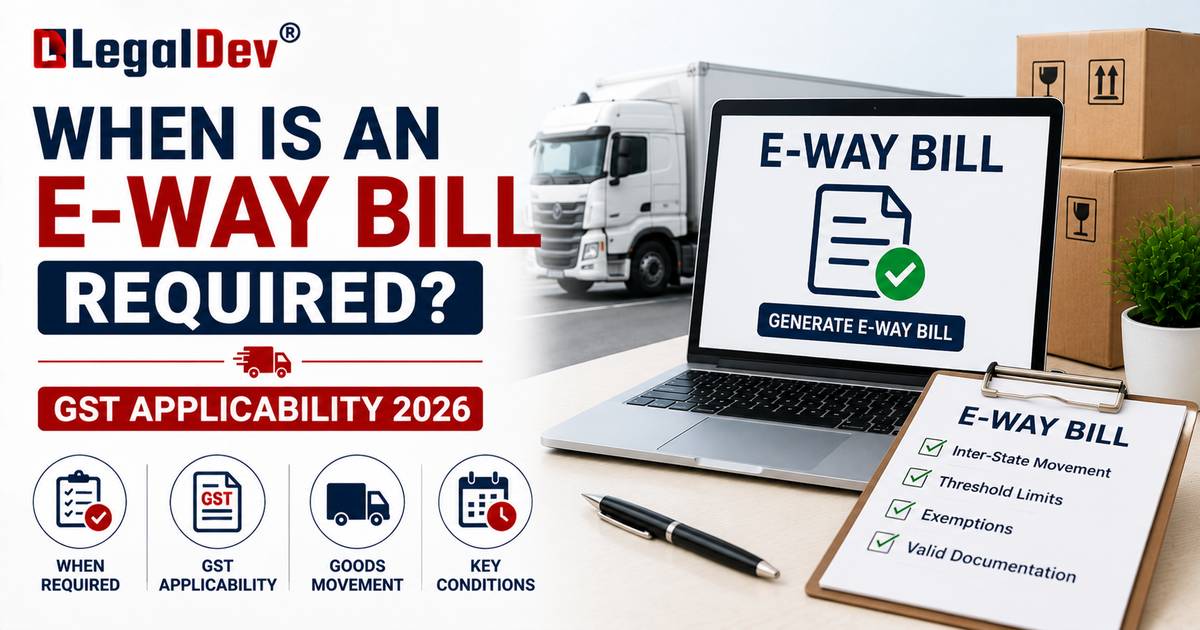
When Is an E-Way Bill Required? Applicability and Conditions
The short answer: you need an e-way bill any time you move goods worth more than the applicable threshold, unless those goods sit on the exemption list. But the real-world situations that trigger this requirement are more varied than most people expect. This page walks through them with examples.
The Basic Trigger
An e-way bill is required when three things are true together:
-
Goods are physically moving, by road, rail, air, or ship.
-
The consignment value crosses ₹50,000 for inter-state movement (or the applicable state limit for intra-state movement).
-
The goods aren't covered by a Rule 138(14) exemption.
If even one of these conditions isn't met, you generally don't need an e-way bill. For the exact value thresholds by state, check our E-Way Bill Limit page.
Situations Where an E-Way Bill Is Required
Regular sale of goods The most common case. A registered business sells goods above the threshold and ships them to a buyer, whether in the same state or a different one.
Sale to an unregistered person If a registered supplier sells to someone without a GSTIN, an e-way bill is still required if the value crosses the threshold. The supplier typically generates it.
Purchase from an unregistered supplier If an unregistered person supplies goods to a registered business, the registered recipient becomes responsible for generating the e-way bill, since they're the one legally "causing" the movement for GST purposes.
Stock transfer between branches Moving goods from one branch or warehouse to another, even without a sale, requires an e-way bill if the value crosses the threshold and the movement is inter-state, or crosses the state's intra-state limit.
Job work Sending raw materials or semi-finished goods to a job worker, and receiving finished goods back, both require an e-way bill if the value threshold is met, since GST treats this as taxable movement even without a sale.
Goods sent for exhibition or on approval Moving goods for a trade show, exhibition, or "sale on approval" basis needs an e-way bill, even though ownership hasn't transferred yet.
Sales returns Returning goods to the original supplier, because of a rejection or a quality issue, also needs an e-way bill for the return leg of the journey.
E-commerce shipments Goods dispatched through an e-commerce operator follow the same rule as a regular sale: if the value crosses the threshold, an e-way bill is required, and the operator or supplier must ensure it's generated.
Situations Where an E-Way Bill Is Not Required
-
Consignment value below the threshold. If the value doesn't cross ₹50,000 (or your state's limit for intra-state movement), you don't need one, though you can still generate one voluntarily.
-
Exempt goods under Rule 138(14). Fresh produce, certain agricultural products, LPG for household use, and a defined list of other goods don't need an e-way bill regardless of value.
-
Non-motorised transport. Movement using handcarts or similar non-motorised conveyance is exempt.
-
Short-distance weighbridge trips. Moving goods to a weighbridge and back, within 20 km, accompanied by a delivery challan, doesn't need an e-way bill.
-
Goods under customs supervision. Movement to or from a customs port, airport, or land customs station under customs control is exempt.
-
Certain non-supply transactions. Movements that fall under Schedule III of the CGST Act, which lists activities not treated as a "supply" at all, don't attract GST or the e-way bill requirement.
How Inter-State and Intra-State Rules Differ
Inter-state movement follows one uniform ₹50,000 threshold across India. Intra-state movement is where things vary: some states stick to ₹50,000, while others, including Maharashtra, Delhi, Bihar, Punjab, Tamil Nadu, Jharkhand, and Madhya Pradesh, allow a higher local threshold, often ₹1,00,000. A few states apply special rules for specific goods, such as Kerala's ₹10 lakh threshold for gold and precious stones moved between branches.
Because these numbers change by notification, always confirm your state's current limit before assuming a shipment is exempt. See our detailed E-Way Bill Limit page for the current state-wise figures.
Real-World Example
A Bengaluru-based trader sells goods worth ₹90,000 to a buyer in Mysuru, within Karnataka. Since Karnataka follows the standard ₹50,000 intra-state threshold, and the value crosses that limit, an e-way bill is required, even though the sale is entirely within the state.
Now compare this to a Mumbai business transferring goods worth ₹90,000 between its own two branches, both within Maharashtra. Since Maharashtra's intra-state threshold is ₹1,00,000, this specific transfer would not require an e-way bill, though the business should still keep a delivery challan for the movement.
Frequently Asked Questions
1. Do I need an e-way bill for goods moved by hand or personal vehicle? Yes, if the value crosses the threshold and the goods aren't exempt. The mode of transport doesn't remove the requirement, unless it's non-motorised conveyance.
2. Is an e-way bill required for services? No. E-way bills apply only to the physical movement of goods, not to services.
3. What if I split one large consignment into smaller invoices to stay under the limit? This is treated as an attempt to evade the requirement, and tax authorities can club the invoices back together during an inspection, exposing the business to penalties.
4. Do I need an e-way bill within the same city? Yes, if the consignment value crosses the applicable state threshold and no specific local exemption applies. Some states offer limited relief for short intra-city distances, but the general rule still applies.
5. When Do I Need an E-Way Bill for My Business?
The moment you move goods worth more than ₹50,000 in a single consignment, whether that's inter-state or within your own state under your state's specific limit. Rule 138 of the CGST Rules is what triggers it, and it applies whether you're the supplier, the recipient, or the transporter arranging the movement.
6. Is an E-Way Bill Required for Orders Under ₹50,000?
Generally no. Below the threshold, you're not required to generate one for standard goods. The exception is items on the Rule 138(14) exemption list or the handicraft-registration-exemption category, where different rules apply regardless of the order value.
7. What Happens if I Don't File an E-Way Bill When Required?
Your shipment can get detained at a checkpoint, and the goods along with the vehicle can be seized under Section 129 of the CGST Act. The penalty runs to ₹10,000 or the tax you were trying to evade, whichever is higher, and it climbs if the goods sit unclaimed past the notice period.
8. Do I Need an E-Way Bill for Handicraft Products?
If you're exempt from GST registration as a handicraft seller and moving goods inter-state, yes, an e-way bill is still required regardless of the consignment's value, even for shipments well under ₹50,000. The registration exemption doesn't extend to this requirement.
9. How Much Does It Cost to Generate an E-Way Bill?
Nothing on the official government portal. There's no statutory fee for generating, updating, or cancelling one. Costs only show up if you're paying for third-party billing software that automates the process alongside your invoicing.
10. Can I Transport Goods Without an E-Way Bill?
Yes, if your consignment stays under ₹50,000 or falls under a specific Rule 138(14) exemption, such as fresh produce or non-motorised transport. Above the threshold with no applicable exemption, moving goods without one is a compliance violation.
11. What's the Difference Between an Invoice and an E-Way Bill?
An invoice documents the sale itself: value, tax, and the parties involved. An e-way bill authorizes and tracks the physical movement of the goods named in that invoice. They work together, referencing each other, but neither replaces the other.
12. Do Small Businesses Need E-Way Bills?
Yes, whenever a shipment crosses the threshold, regardless of the business's size. Small businesses can register for free using their existing GSTIN, and even unregistered small sellers can generate one through the portal's citizen enrolment option when needed.
13. How Long Does It Take to Generate an E-Way Bill?
With your invoice details ready, generation itself takes just a few minutes once you're logged into the portal. The bigger time factor is usually gathering the right HSN codes and vehicle information beforehand, not the actual submission.
14. What Information Do I Need to Create an E-Way Bill?
Your tax invoice or delivery challan, supplier and recipient GSTIN, HSN code and description of goods, taxable value and applicable GST rate, plus either the vehicle number or transporter ID. Having these on hand makes the process fast and error-free.
15. Is an E-Way Bill Required for Local Deliveries?
It depends on your state's rules and the distance involved. Many states exempt very short-distance intra-state movement, often under 50 km between consignor and transporter, from needing Part B, though Part A generation may still apply above the value threshold.
16. Can I Use Horse Carts to Avoid E-Way Bill Requirements?
Goods moved by non-motorised conveyance, like handcarts or bullock carts, genuinely are exempt from e-way bill requirements under Rule 138(14), regardless of value. This exists for legitimate small-scale local transport, not as a loophole for larger commercial shipments routed through unconventional means.
17. What Goods Are Exempt from E-Way Bill Requirements?
Around 150 categories are exempt under Rule 138(14), including fresh fruits and vegetables, meat, LPG for household use, kerosene under the public distribution system, jewellery under Chapter 71, and goods moved by non-motorised transport. These exemptions apply regardless of consignment value.
18. How Do I Know If My Invoice Needs an E-Way Bill?
Check two things: does the invoice value exceed ₹50,000 (or your state's specific intra-state limit), and does the item fall outside the Rule 138(14) exemption list. If both point to yes, you need one before the goods move.
19. Can I Generate Multiple E-Way Bills at Once?
Yes, through the portal's bulk generation feature, where you upload a JSON file with details of multiple consignments in one go, either using the provided template or an export from your accounting software. This saves significant time for businesses dispatching many shipments daily.
20. What Happens if I File an E-Way Bill Wrong?
If caught within 24 hours, cancel the incorrect bill and generate a fresh one with the right details, since Part A can't be directly edited. If the error is spotted during transit and it's a genuine minor mistake, like a spelling error, authorities sometimes waive the standard penalty; substantive mismatches don't get that leeway.
21. Do Retail Stores Need E-Way Bills?
Individual retail sales rarely cross the threshold, so day-to-day customer transactions typically don't need one. Bulk stock transfers between store locations or from a warehouse, however, often do exceed ₹50,000 and follow the same rules as any other business-to-business shipment.
22. How Long Is an E-Way Bill Valid For?
Validity is distance-based: one day per 200 km for regular cargo, one day per 20 km for over-dimensional cargo, starting from when Part B is entered. Extensions are possible within 8 hours before or after expiry, capped at 360 days from the original generation date.
23. Can I Transport Goods While Waiting for My E-Way Bill?
No. The bill needs to exist and Part B needs to be filled before the goods actually move, since validity only starts once Part B is entered. If you've generated Part A but the vehicle isn't confirmed yet, hold the shipment until Part B is complete.
24. What's the E-Way Bill Threshold for My State?
Inter-state movement is fixed at ₹50,000 everywhere, no state variation. For intra-state movement, most states keep ₹50,000, but several, including Maharashtra, Delhi, Punjab, Rajasthan, and Tamil Nadu, have raised it to ₹1,00,000 or higher. Check your specific state's notification before assuming a figure applies.
Read Next
Once you've confirmed you need an e-way bill, head to How to Generate an E-Way Bill for the exact steps, or check the E-Way Bill Limit page for your state's precise threshold.