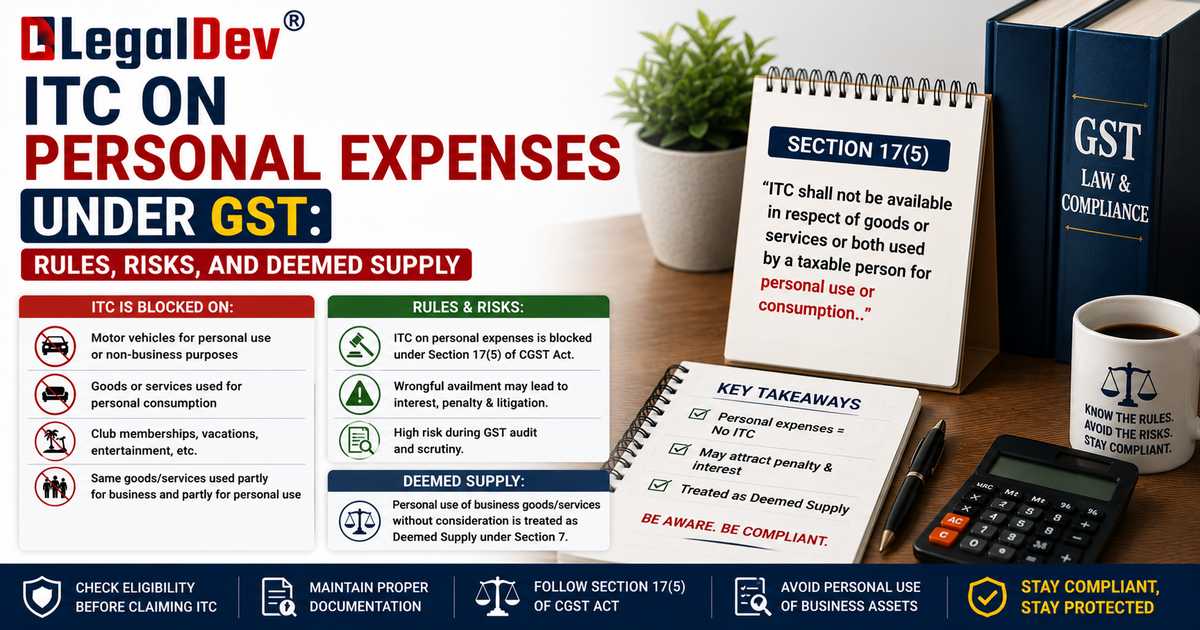
ITC on personal expenses under GST
Personal expenses sit at the centre of a rule that looks simple on paper but creates two separate risks in practice: ITC denied at the point of purchase, and a fresh GST liability created later if a business asset that already carried ITC is diverted to personal use. This page looks specifically at how personal consumption is treated under GST, how mixed business-and-personal expenses are handled, and the deemed supply consequence that catches many businesses off guard.
For the broader list of blocked ITC categories, see Blocked Input Tax Credit Under GST. For how shared inputs between taxable and exempt supplies are apportioned, see Input Tax Credit Calculation.
The basic rule: no ITC on personal consumption
Section 17(5)(g) blocks ITC on goods or services used for personal consumption. This sits alongside the broader requirement under Section 16 that a purchase must be used in the course or furtherance of business for ITC to be claimed at all. In effect, the personal-consumption block is doing very little extra work of its own. If an expense is genuinely personal, it was never going to clear the basic business-use test in the first place.
Where this rule actually matters is in the grey area: expenses that carry a business justification on the surface but are, in substance, benefiting an individual rather than the business itself.
Identifying personal versus business expenses
A few recurring patterns tend to blur this line in practice.
A sole proprietor or partner buying goods through the business GSTIN for use in their own home, such as furniture, appliances, or electronics, is personal consumption even though the invoice carries the business's registration.
A director or senior employee using a company asset, such as a vehicle or a laptop, exclusively for personal purposes rather than business work falls under the same treatment, regardless of how the asset was originally classified in the books.
Reimbursed personal expenses, where an employee pays for something personal and the business reimburses the amount, do not become eligible for ITC simply because the payment passes through business accounts. The nature of the underlying expense, not who ultimately pays for it, determines ITC eligibility.
Genuinely mixed-use expenses, where the same purchase serves both business and personal purposes, such as a mobile phone connection used for both client calls and personal use, are treated differently again and are addressed separately below.
Mixed-use assets and expenses
Where an asset or input service is used partly for business and partly for personal purposes, only the business-use portion is eligible for ITC. Common examples include a work-from-home internet connection, a personal vehicle occasionally used for client visits, or a mobile plan used for both business and personal calls.
For inputs and input services used partly for business and partly for non-business purposes on an ongoing basis, GST law provides a formula-based apportionment mechanism rather than leaving the split to a rough estimate. This is the same common-credit apportionment approach used when a business has both taxable and exempt supplies, covered in detail on the ITC calculation page. The practical takeaway for personal-versus-business mixed use is that claiming the full ITC on an expense with a genuine personal component, rather than the apportioned business share, is a common source of later reversal and interest.
Deemed supply: when personal use creates a fresh GST liability
This is the part of the personal-expenses rule that catches businesses out, because it works in the opposite direction from ITC denial. If a business has already claimed ITC on an asset and that asset is later put to personal use, or permanently transferred out of the business without consideration, GST law can treat this as a deemed supply, creating an output tax liability on the business rather than simply disallowing a credit.
Two provisions cause this. Under Schedule II, where goods forming part of business assets are put to private use, or made available to any person for a purpose other than the business, this is treated as a supply of services, even without any payment changing hands. Separately, under Schedule I, the permanent transfer or disposal of a business asset on which ITC was availed is treated as a supply of goods, again without needing any consideration to be paid.
The distinction between this and the basic Section 17(5)(g) block matters. Section 17(5)(g) stops ITC from being claimed in the first place on something bought for personal use. Schedule I and Schedule II operate afterward, on assets where ITC was legitimately claimed at the time of purchase because the asset was genuinely for business use, but the asset's status later changes.
Worked example: deemed supply on asset diversion
A hotel business buys an air conditioning unit for one of its guest rooms and claims ITC on the purchase, since it is genuinely used for the business at the time. Two years later, the business permanently transfers this unit to a director's personal residence without charging anything for it. Because ITC was claimed on the unit, this transfer is treated as a deemed supply, and the business becomes liable to pay an amount linked to the ITC originally claimed on that asset, adjusted for the period it was used in the business, under the capital goods disposal rules.
Worked example: no deemed supply where ITC was never claimed
A furniture retailer's owner takes a set of furniture from business stock for personal use at home, but the business never claimed ITC on this particular stock. Since no ITC was availed on the furniture, this transfer does not qualify as a deemed supply, because the deeming provision under Schedule I specifically requires that ITC was claimed on the asset being transferred.
Employee gifts: a narrow exception
Gifts from an employer to an employee are treated as a supply requiring GST only where their value exceeds ₹50,000 in a financial year. Gifts below this threshold are not treated as a taxable supply, and correspondingly do not trigger the deemed-supply consequences described above for that specific transaction. This threshold is cumulative across the financial year per employee, not per individual gift.
Practical documentation to manage this risk
Because the difference between a business expense and a personal one is often a matter of use rather than appearance on an invoice, several practices reduce dispute risk:
Maintaining a fixed-asset register that tracks not just cost and depreciation but also intended and actual use, so a shift from business to personal use is flagged rather than discovered later during an audit.
Routing genuinely personal purchases by owners, partners, or directors through personal accounts rather than the business GSTIN, even when it would be administratively convenient to combine them.
Documenting the business rationale for expenses that could be questioned, such as a vehicle used for both client visits and personal errands, including a reasonable basis for the business-use proportion claimed.
Reviewing asset disposals and inter-office transfers before they happen, rather than after, since the deemed supply liability under Schedule I is triggered at the point of transfer, not at the point it is later discovered in a review.
Frequently asked questions
Can a business claim ITC on goods bought for an employee's or director's personal use?
No. Goods or services used for personal consumption are blocked under Section 17(5)(g), regardless of whose GSTIN the invoice is raised on.
What happens if a business asset that already had ITC claimed on it is later used personally?
This can trigger a deemed supply under Schedule I or Schedule II of the CGST Act, creating a fresh GST output liability on the business, separate from the original ITC claim.
Does reimbursing an employee for a personal expense make it eligible for ITC?
No. Reimbursement through business accounts does not change the underlying nature of the expense. If it was personal at the point of purchase, it remains ineligible for ITC.
Is there any GST-free threshold for gifts to employees?
Yes. Gifts up to ₹50,000 per employee in a financial year are not treated as a taxable supply. Gifts exceeding this cumulative threshold are.
How is ITC handled for an expense used partly for business and partly personally?
Only the business-use portion is eligible, generally determined through the same formula-based apportionment mechanism used for common credit between taxable and exempt supplies.