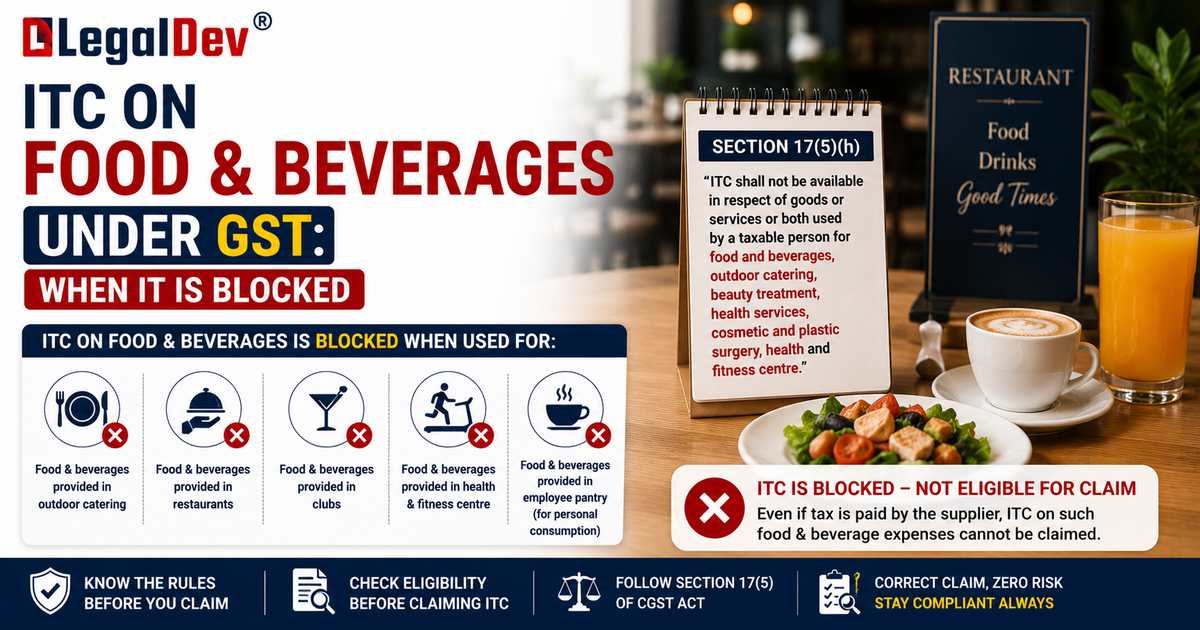
ITC on food and beverages under GST
Food and beverage expenses come up in almost every business, from client lunches to staff canteens, which makes this one of the most commonly misapplied blocked-credit rules. Section 17(5)(b) denies ITC on these expenses by default, with two narrow exceptions that depend on what the business actually does, not on how routine or necessary the expense feels.
For the complete list of blocked ITC categories, see Blocked Input Tax Credit Under GST.
What is covered under this block
ITC is blocked on food and beverages, outdoor catering, beauty treatment, health services, and cosmetic and plastic surgery. These are grouped together because they share a common feature in the eyes of the law: even when incurred by a business, they carry a strong element of personal benefit to the individual consuming them, whether that is an employee, a client, or the business owner.
This covers a wide range of everyday scenarios: client entertainment lunches, food ordered for office meetings, catering for a company event, and canteen meals provided to staff.
Exceptions to the Blocked ITC Rule
Same-line-of-business exception
Where the business itself supplies these services as an outward taxable supply, ITC on the corresponding inward purchase is allowed. The reasoning is that the credit is feeding directly into a further taxable supply of the same category, rather than being consumed internally. A restaurant claiming ITC on the raw ingredients it buys to prepare meals for paying customers falls squarely under this exception. A catering company claiming ITC on the food it purchases to fulfil a catering contract is in the same position.
This exception is about matching the nature of the inward purchase to the nature of the outward supply. A software company that also runs an in-house cafeteria purely for staff, without charging for meals or supplying catering as a business line, does not qualify under this exception just because food changes hands within the business.
Legal obligation exception
Where a law currently in force requires an employer to provide a particular service to employees, ITC on that mandatory provision is allowed. The commonly cited example is a factory legally required under the Factories Act to run a canteen once its workforce crosses a prescribed threshold. Because the canteen is not a discretionary benefit but a statutory compliance requirement, the credit on related food and catering costs becomes available.
This exception is narrower than it might appear. A company that voluntarily runs a subsidised canteen as a staff welfare measure, without being under a specific legal obligation to do so, does not qualify. The obligation has to come from a law currently in force, not from company policy or industry practice.
Expenses Where ITC Is Still Blocked
Several common scenarios fall outside both exceptions and remain blocked:
Client entertainment meals, however clearly tied to business development, are blocked because entertainment is inherently for the personal benefit of the person dining, not an outward supply of catering.
Food ordered for internal office meetings or events is blocked for the same reason, since it is consumed internally rather than supplied onward.
A voluntary staff canteen, run as a benefit rather than a statutory requirement, is blocked because it does not meet the legal-obligation exception.
Health checkups, gym memberships tied to wellness programmes, and cosmetic procedures offered as an employee benefit are blocked under the same clause, since they are grouped with food and beverages in this restriction.
Worked examples
A restaurant chain buys vegetables, meat, and packaging worth ₹8,00,000 plus GST in a month to prepare meals sold to customers. Since the restaurant's outward supply is food service itself, ITC on these purchases is available under the same-line-of-business exception.
A garment manufacturer runs a subsidised canteen for its 400 factory workers because the Factories Act requires a canteen at that headcount. ITC on the food and catering costs for this canteen is available under the legal-obligation exception.
A marketing agency takes a prospective client to dinner to discuss a proposal. ITC on this meal is blocked, since client entertainment does not fall under either exception, regardless of its business purpose.
A logistics company voluntarily provides free lunch to its office staff as a retention benefit, with no legal requirement to do so. ITC on this catering arrangement is blocked, because the obligation is a company policy choice rather than a statutory requirement.
Frequently asked questions
Can a business claim ITC on client entertainment meals?
No. Client entertainment is not covered by either exception under Section 17(5)(b), so ITC remains blocked regardless of the business reason for the expense.
Is ITC available on a staff canteen?
Only if the business is legally required to run the canteen under a law currently in force, such as the Factories Act at a prescribed worker threshold. A voluntary canteen provided as a staff benefit does not qualify.
Can a restaurant claim ITC on the ingredients it buys?
Yes. Since the restaurant's own outward supply is food and beverage service, ITC on ingredients used to prepare that service is allowed under the same-line-of-business exception.
Is ITC blocked on health checkups provided to employees?
Health services are grouped in the same restriction as food and beverages, so ITC is blocked unless a legal obligation or a matching outward supply exception applies.
Does the exception apply if the business only occasionally caters events for clients?
The exception applies where catering or food service is genuinely part of the business's own taxable outward supplies, not where food is incidentally arranged as part of an unrelated service.