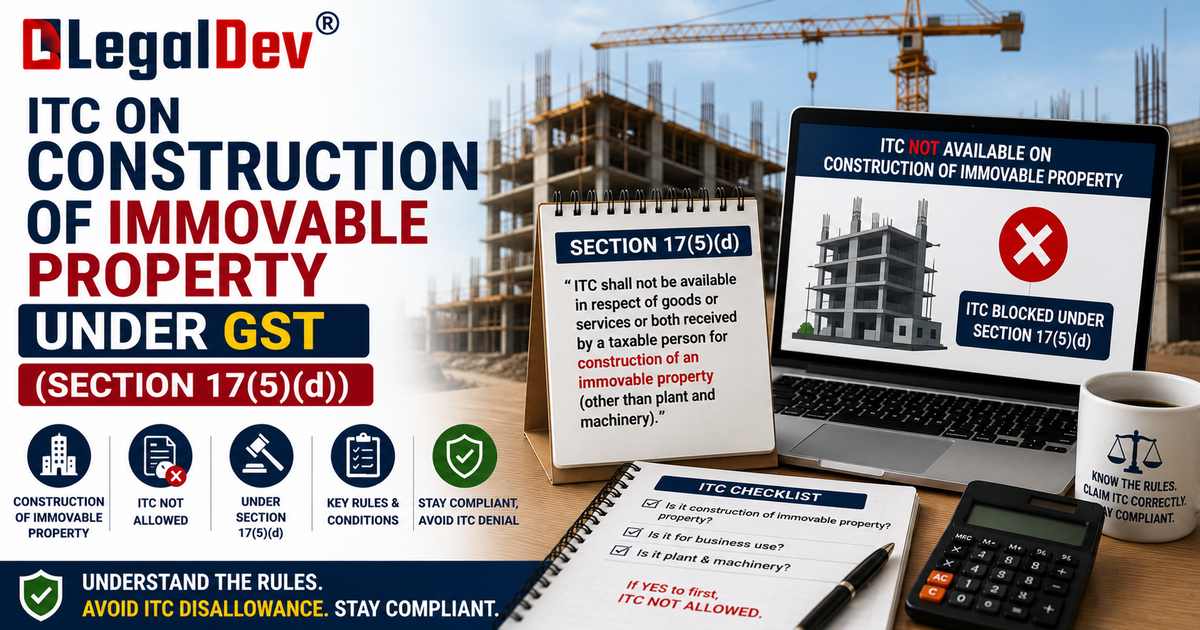
ITC on construction of immovable property under GST
Section 17(5)(d) blocks Input Tax Credit on goods or services a business procures on its own account to construct immovable property, whether that property is a factory, an office building, or a commercial complex meant for leasing. This rule has been at the centre of one of the most closely watched GST disputes of the last few years, which makes it worth understanding both the statutory text and how that text has actually been applied.
This page covers own-account construction specifically. Where a business hires a contractor and the arrangement qualifies as a works contract, see ITC on Works Contract Services. For the complete list of blocked ITC categories, see Blocked Input Tax Credit Under GST.
The basic rule
ITC is blocked on goods or services received by a business for constructing an immovable property on its own account, to the extent the cost is capitalised in its books of accounts. "Construction" here is defined broadly to include reconstruction, renovation, additions, or alterations, not just a new building from the ground up.
The capitalisation test is what actually decides whether a given cost is blocked. If an expense is added to the value of the building as a capital asset, ITC is denied. If the same type of cost, such as routine repairs and maintenance, is instead booked as a revenue expense in the profit and loss account rather than capitalised, ITC is allowed. Two businesses incurring what looks like a similar renovation cost can land on opposite sides of this rule purely based on how the expense is treated in their books.
The plant and machinery exception
The one standing carve-out in this clause is plant and machinery, which is excluded from the definition of immovable property for this specific purpose. ITC on goods or services used to construct plant and machinery remains available even though the same restriction blocks credit on constructing a building or civil structure. This exception is what turned into the centre of a major legal dispute over how broadly "plant" could be interpreted.
The Safari Retreats dispute
A company constructing a shopping mall intended for renting out commercial space to tenants sought ITC of roughly ₹34 crore on the construction costs, arguing that since the mall's rental income was itself subject to GST, denying credit on its construction broke the basic chain of GST neutrality.
In October 2024, the Supreme Court ruled that a building could, in specific circumstances, qualify as "plant" under the exception, if it is constructed to serve the business's own special technical requirements. The Court set out what has since been referred to as a functionality test, meaning the question is not simply whether something is a building, but whether it functions as a plant for the specific business supplying taxable services from it. On this reasoning, a mall built and configured specifically for the business of leasing commercial space could, on the right facts, fall within the plant exception rather than being blocked as ordinary immovable property.
The retrospective amendment that followed
The government responded to this ruling through the Finance Act 2025, amending Section 17(5)(d) with retrospective effect from 1 July 2017, replacing the phrase "plant or machinery" with "plant and machinery." This is a narrower composite term, and it is explicitly defined elsewhere in Section 17 in a way that excludes buildings and other civil structures from qualifying as "plant" on their own. In effect, the amendment removed the interpretive room that had allowed a building to be treated independently as a plant based on its function, which was the exact reasoning the Supreme Court had relied on.
The government's own review petition seeking reconsideration of the original judgment was later dismissed by the Supreme Court in May 2025, with the Court finding no error in its earlier ruling. That dismissal did not revive the original interpretation for future claims, however, because the retrospective amendment had already changed the statutory text the exception is judged against. The practical result is that, under the current wording of the law, ITC on constructing a building or civil structure meant for renting or leasing remains blocked, even where the property is used to provide a taxable leasing service, unless the structure genuinely qualifies as plant and machinery in the narrower, defined sense rather than through a functional argument about the building as a whole.
Because this amendment operates retrospectively and its constitutional validity has been discussed by commentators, businesses that claimed ITC on real estate construction relying on the original Supreme Court reasoning should treat that position as currently unsettled and confirm the applicable position before relying on it further.
Worked examples
A logistics company constructs a warehouse for its own storage operations and capitalises the full construction cost as a fixed asset. ITC on the goods and services used in this construction is blocked under the general rule, since a warehouse is a civil structure and does not qualify as plant and machinery.
A pharmaceutical manufacturer installs specialised cold-storage refrigeration units and the structural framework built specifically to house and operate that equipment. If this framework qualifies as plant and machinery in the narrower defined sense, rather than as a general building, ITC on its construction can remain available.
A company repairs a leaking roof on its existing office building and records the cost as repairs and maintenance in its profit and loss account, without capitalising it. Since the cost is not capitalised, ITC on this repair is allowed, even though the same type of work would be blocked if it had been capitalised as a building improvement instead.
Frequently asked questions
Is ITC always blocked on constructing a building for business use?
Where the construction cost is capitalised in the books, ITC is generally blocked, unless the structure qualifies as plant and machinery in the narrower sense defined under the current law.
What is the plant and machinery exception under Section 17(5)(d)?
It is a carve-out allowing ITC on constructing plant and machinery, as distinct from general immovable property such as buildings and civil structures, which remain excluded from this exception.
What did the Supreme Court rule in the Safari Retreats case?
In October 2024, the Court held that a building could qualify as plant under a functionality test if constructed for a business's own special technical requirements, allowing ITC in that specific case on a mall built for leasing.
Did the retrospective 2025 amendment undo the Safari Retreats ruling?
Effectively, yes, for the current position going forward. The amendment narrowed the exception to "plant and machinery," a defined term that excludes buildings and civil structures, removing the interpretive basis the Court had relied on.
Does capitalising a renovation cost always block ITC?
Yes, where the renovation cost is capitalised as an addition to the property's value. If the same cost is instead treated as revenue expenditure, such as ordinary repairs, ITC is not blocked under this clause.