ITC on motor vehicles under GST
Motor vehicles are one of the most common expenses businesses try to claim ITC on, and one of the most frequently denied. Section 17(5)(a) of the CGST Act blocks credit on vehicles used to transport people, with a narrow set of exceptions built around the vehicle's actual business role rather than who happens to be using it.
This page looks specifically at how the vehicle-related block works in practice. For the full list of blocked ITC categories, see Blocked Input Tax Credit Under GST.
When ITC on Motor Vehicles Is Blocked
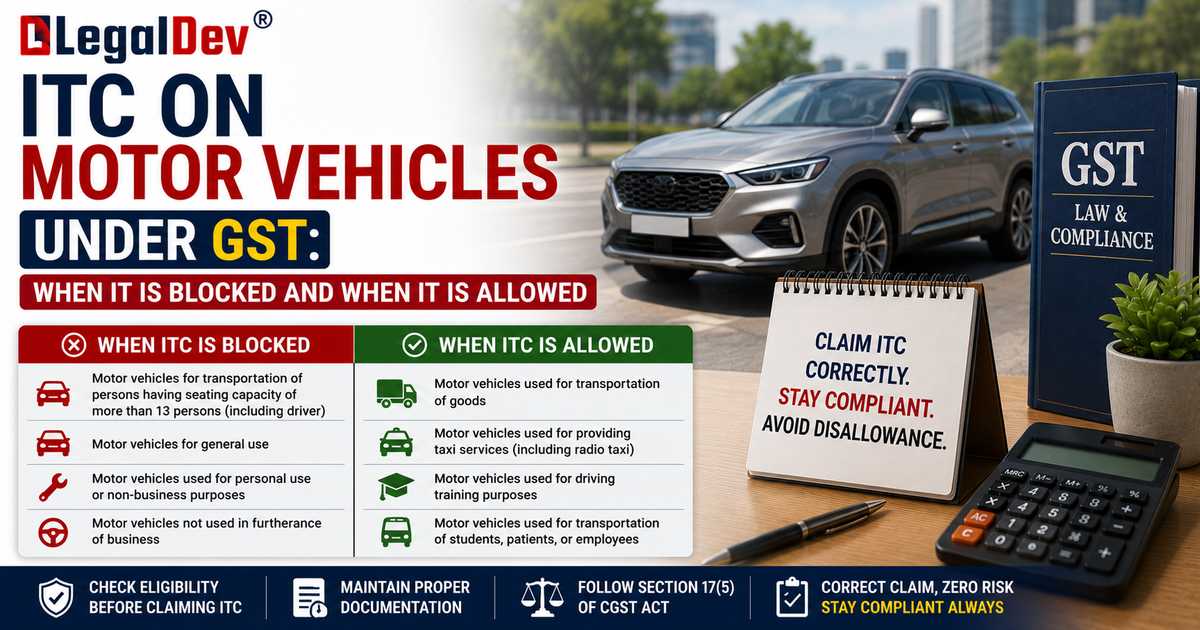
ITC is blocked on motor vehicles used for transporting persons, where the approved seating capacity is up to thirteen persons, including the driver. This covers the ordinary company car bought for a director, a sales team, or general staff use. It does not matter whether the vehicle is used occasionally for business errands. If its primary function is passenger transport and it falls within this seating threshold, the credit is denied by default.
The block extends beyond the vehicle purchase itself. General insurance, servicing, and repair and maintenance costs on a blocked vehicle are also ineligible for ITC, since these are treated as directly connected services under the same restriction.
Vehicles above the seating threshold
A vehicle with an approved seating capacity of more than thirteen persons, including the driver, falls outside this specific block. Employee buses and larger passenger vehicles used for staff transport can therefore carry ITC, subject to the general conditions under Section 16 still being met.
The three exceptions
ITC on a passenger vehicle becomes available where the vehicle is used for one of three specific purposes.
Further supply of such vehicles. A car dealership holding vehicles as stock-in-trade is not consuming the vehicle for its own transport needs. It is selling the vehicle onward, so ITC on the purchase is allowed.
Transportation of passengers. A business that supplies passenger transport as a taxable service, such as a cab operator or a tour and travel company, can claim ITC on the vehicles used to provide that service, because the vehicle is the direct input into a taxable outward supply.
Imparting driving training. A driving school using vehicles specifically to train learners can claim ITC on those vehicles, since training is the core service being supplied.
Outside these three situations, ownership structure does not change the outcome. Leasing a vehicle instead of buying it, or routing the purchase through a company rather than an individual, does not open up ITC if the vehicle's actual use remains passenger transport for the business's own convenience.
Vessels and aircraft follow the same logic
The same rule, with the same three exceptions, applies to vessels and aircraft. A business that owns an aircraft solely for the convenience of its senior management cannot claim ITC on it. An airline operating passenger flights, or a business using its aircraft to transport goods, falls under the relevant exception.
Commercial and goods-transport vehicles
Vehicles used for transporting goods rather than persons, such as trucks and delivery vans, are not covered by this particular block at all. ITC on goods-carrying commercial vehicles, and on their insurance and maintenance, is generally available where the vehicle is used in the course of business, since the restriction under Section 17(5)(a) is specifically about passenger vehicles.
Worked examples
A logistics company buys three delivery trucks for transporting goods to customers. ITC on the trucks, their insurance, and their servicing is available, since goods transport is outside the passenger-vehicle block entirely.
A manufacturing company buys a sedan for its finance director's use, including office commutes and client visits. ITC on the purchase, insurance, and servicing of this car is blocked, because the vehicle's function is passenger transport for company personnel and none of the three exceptions apply.
A car dealership buys ten hatchbacks to display and sell in its showroom. ITC on these vehicles is available, since they are held as stock for further supply rather than for the dealership's own transport use.
A tour operator buys a fifteen-seater van to run sightseeing packages for tourists. Since the seating capacity exceeds thirteen, this vehicle falls outside the specific block regardless of the exceptions, and ITC is available subject to the standard conditions.
Frequently asked questions
Can a business claim ITC on a car bought for an employee?
Only if the vehicle is used for further supply of vehicles, providing passenger transport as a taxable service, or driving training. A car bought for general staff or executive use does not qualify for ITC.
Is ITC available on a vehicle's insurance if the vehicle itself is blocked?
No. Insurance, servicing, and repair costs on a blocked vehicle are ineligible for ITC in the same way as the vehicle itself.
Does leasing a vehicle instead of buying it change the ITC position?
No. The exceptions depend on how the vehicle is actually used in the business, not on whether it is owned outright or leased.
Is ITC blocked on trucks and delivery vehicles?
No. The block under Section 17(5)(a) applies specifically to vehicles used for transporting persons. Goods-carrying commercial vehicles fall outside this restriction.
What seating capacity triggers the block?
Vehicles with an approved seating capacity of up to thirteen persons, including the driver, fall under the block. Vehicles designed for more than thirteen persons are outside it.