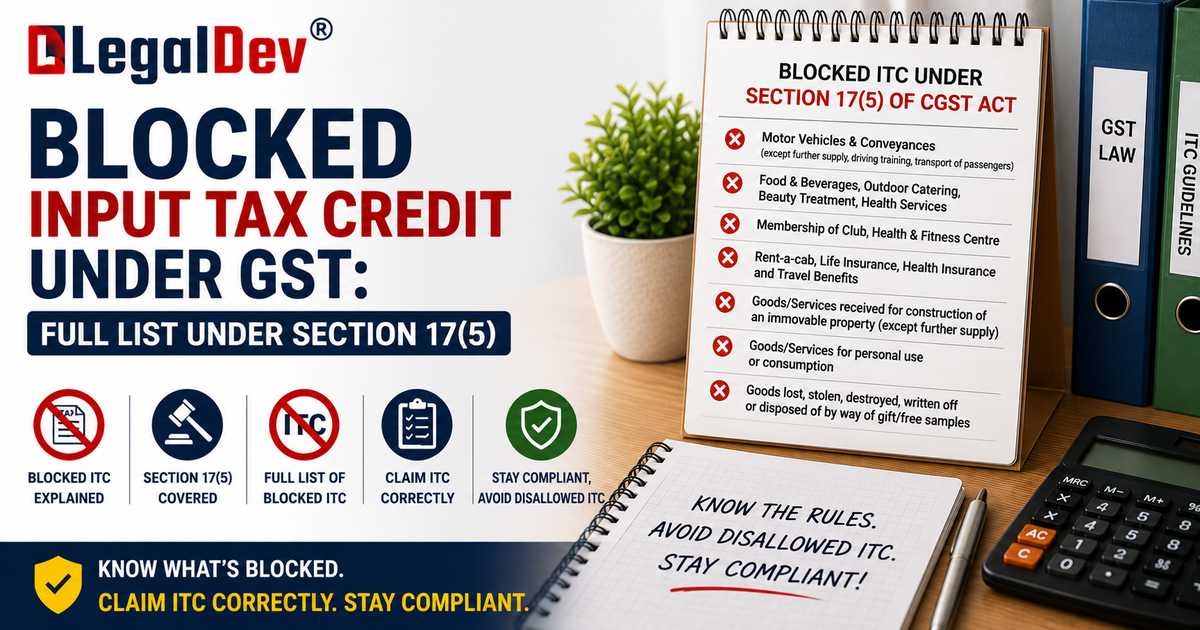
Blocked Input Tax Credit Under GST
Section 17(5) of the CGST Act sets out a specific negative list of goods and services on which a registered business cannot claim Input Tax Credit, even when the purchase is genuinely for business use and every other condition under Section 16 is met. This is what businesses usually mean when they talk about blocked ITC or ineligible ITC. This page works through that list clause by clause, the exceptions attached to each entry, and what happens when blocked credit is claimed by mistake.
For the broader eligibility conditions a purchase has to satisfy before ITC can be claimed at all, see Conditions for Claiming Input Tax Credit. For how blocked ITC fits into the wider concept, see the Input Tax Credit page.
What blocked ITC actually means
A purchase can pass every condition under Section 16, carry a valid invoice, be paid in full, and still be denied credit if it falls under one of the categories listed in Section 17(5). This is by design. The provision exists to prevent GST credit from flowing through expenses that carry a strong personal-consumption element, or that the government has decided should not reduce a business's output tax liability regardless of how the purchase is booked.
Blocked credit is not the same as ineligible ITC caused by a filing gap, such as an invoice missing from GSTR-2B. A missing invoice can still become eligible once the supplier corrects their filing. Blocked credit under Section 17(5) cannot become eligible under any circumstances, because the law denies it outright rather than making it conditional on documentation.
The categories of blocked ITC under Section 17(5)
Motor vehicles for passenger transport
ITC on motor vehicles used to transport persons, with a seating capacity of up to thirteen (including the driver), is blocked. This covers company cars bought for directors, executives, or general staff use.
The block does not apply where the vehicle is used for further supply of such vehicles, for transportation of passengers as a taxable service, or for imparting driving training. A car dealership claiming ITC on vehicles held as stock, or a cab aggregator claiming ITC on vehicles used to provide rides, falls under these exceptions and can claim the credit.
Vessels and aircraft
The same restriction applies to vessels and aircraft, with the same set of exceptions: further supply, passenger transport as a taxable service, or transportation of goods. A business that owns an aircraft purely for the convenience of its executives cannot claim ITC on it; an airline operating passenger flights can.
General insurance, servicing, repair, and maintenance of blocked vehicles
Once a motor vehicle, vessel, or aircraft falls under the block above, ITC is also denied on services connected to it, including general insurance, servicing, and repair and maintenance costs. If the underlying vehicle qualifies for an exception, these related services qualify too.
Food, beverages, outdoor catering, and related personal-consumption services
ITC is blocked on food and beverages, outdoor catering, beauty treatment, health services, and cosmetic and plastic surgery. Two situations lift this block. First, a business that itself supplies these services as an outward taxable supply can claim ITC on the corresponding inward purchase, since the credit is used to make a further taxable supply of the same category rather than for consumption. A restaurant claiming ITC on its own ingredients is a straightforward example. Second, where a law currently in force obliges an employer to provide a particular service to its employees, such as a factory legally required to run a canteen above a prescribed worker threshold, ITC on that mandatory provision is allowed.
Membership of clubs, health, and fitness centres
Fees paid for club, health, and fitness centre membership are blocked outright, with no comparable exception for employers who provide these as a benefit. This applies even where the membership is offered as part of an employee welfare policy.
Rent-a-cab, life insurance, and health insurance
ITC on rent-a-cab services, and on life and health insurance, is blocked by default. The exception mirrors the food and beverage rule: it becomes available where the government notifies the service as obligatory for an employer to provide to its employees under any law currently in force, or where the business itself is in the business of supplying that same category of service.
Travel benefits for employees, including leave or home travel concession
ITC on travel benefits extended to employees on vacation, such as leave travel concession or home travel allowance, is blocked. This applies regardless of how routinely the benefit is offered as part of an employment package.
Works contract services for immovable property
ITC on works contract services is blocked when the resulting supply is for the construction of an immovable property. The specific exception is where the works contract service is itself an input for a further works contract service, such as a main contractor claiming ITC on services procured from a sub-contractor for the same project.
Goods or services received for construction of immovable property on own account
Where a business procures goods or services on its own account, rather than through a works contract, for constructing an immovable property, ITC is blocked in the same way. "Construction" here includes reconstruction, renovation, additions, or alterations, to the extent the cost is capitalised in the books of account. This capitalisation test matters in practice. If a renovation cost is treated as a capital addition to the building's value, ITC is blocked. If the same cost is booked as revenue expenditure, such as routine repairs and maintenance, ITC is allowed. The one standing exception across this entire category is plant and machinery, which remains eligible for ITC even when installed as part of constructing a structure, since plant and machinery is treated as a distinct asset class rather than as immovable property for this purpose.
Tax paid under the composition scheme
A business cannot claim ITC on tax that has been paid by a supplier under the composition scheme, since composition suppliers do not pass on credit in the way regular taxpayers do.
Goods or services used for personal consumption
Any goods or services used for personal consumption, rather than business use, are blocked, independent of whether the same category of expense might otherwise be eligible in a business context.
Goods lost, stolen, destroyed, written off, or disposed of as gifts or free samples
ITC is blocked on goods that are lost, stolen, destroyed, or written off, and on goods disposed of by way of gift or free sample. The reasoning is straightforward: if the goods never reached a taxable supply, the credit chain has nowhere to complete.
Tax paid due to fraud, suppression, or confiscation-related demands
ITC is also blocked on tax paid through demand orders raised under fraud or wilful misstatement provisions, and in certain detention and confiscation situations. This category has been narrowed by recent amendments, which restrict the fraud-related block to demands relating up to a specified financial year and propose removing the detention and confiscation references altogether, so the exact scope here should be checked against the current notified position at the time of filing.
Corporate social responsibility expenditure
A separate clause blocks ITC on goods or services used for CSR activities that a company is required to undertake under the Companies Act. This closed a long-running dispute where businesses argued that CSR spending, being a legal obligation, should qualify as being in the course of business. The law now settles the point the other way. GST paid on goods or services procured specifically for a mandated CSR activity cannot be claimed as credit, even though the underlying expenditure is legally compulsory.
Quick reference table
|
Category
|
ITC status
|
Key exception
|
|
Motor vehicles up to 13-seater
|
Blocked
|
Further supply, passenger transport service, driving training
|
|
Vessels and aircraft
|
Blocked
|
Same as above, plus transportation of goods
|
|
Insurance, servicing, repair of the above
|
Blocked
|
Available when the vehicle itself qualifies for an exception
|
|
Food, beverages, outdoor catering
|
Blocked
|
Own outward supply of the same service, or legal obligation to employees
|
|
Club, health, and fitness membership
|
Blocked
|
No exception
|
|
Rent-a-cab, life and health insurance
|
Blocked
|
Legal obligation to employees, or own outward supply of the same service
|
|
Employee travel benefits (leave/home travel)
|
Blocked
|
No exception
|
|
Works contract for immovable property
|
Blocked
|
Input for a further works contract service
|
|
Own-account construction of immovable property
|
Blocked
|
Plant and machinery
|
|
Composition scheme tax
|
Blocked
|
No exception
|
|
Personal consumption
|
Blocked
|
No exception
|
|
Lost, stolen, destroyed, written-off, or gifted goods
|
Blocked
|
No exception
|
|
CSR expenditure
|
Blocked
|
No exception
|
What happens if blocked ITC is claimed by mistake
Claiming ITC on any of the categories above and using it to reduce output tax liability is treated as wrongly availed and utilised credit. Under Section 50(3) of the CGST Act, this attracts interest at 24 percent per year, calculated from the date the credit was utilised until the date it is reversed, which is a materially higher rate than the interest charged on ordinary delayed tax payments. A department audit that uncovers such a claim months or years after it was made can therefore result in an interest bill that is a significant fraction of the original credit amount.
Businesses generally reduce this risk by maintaining a dedicated blocked-credit register alongside their normal purchase records, tagging expenses in categories like employee insurance, vehicle servicing, and CSR spend at the point of booking rather than relying on a year-end review to catch them.
How blocked ITC is reported
Blocked or ineligible ITC identified during a period is reported in Table 4(D)(2) of GSTR-3B, separately from the eligible credit reported in Table 4(A). This keeps the blocked amount visible in the return rather than simply excluded, which supports a cleaner audit trail if the classification is ever questioned.
Frequently asked questions
What is blocked ITC under GST?
Blocked ITC refers to Input Tax Credit that cannot be claimed under Section 17(5) of the CGST Act, regardless of whether the underlying purchase was genuinely for business use.
Can ITC be claimed on a company car bought for an employee's use?
No, unless the business is in the trade of selling vehicles, providing passenger transport as a taxable service, or running a driving school, in which case the specific exception applies.
Is ITC available on health insurance provided to employees?
Only if a law currently in force makes it obligatory for the employer to provide that insurance, or if the business itself supplies health insurance as an outward taxable service.
Is ITC blocked on all construction-related expenses?
ITC is blocked on construction of immovable property, including renovation costs that are capitalised in the books, with plant and machinery remaining the one standing exception to this rule.
Can ITC be claimed on CSR spending?
No. A specific clause blocks ITC on goods or services procured for CSR activities mandated under the Companies Act, even though the spending itself is a legal requirement.
What is the penalty for wrongly claiming blocked ITC?
Interest is charged at 24 percent per year under Section 50(3), calculated from the date the wrongly claimed credit was used to pay output tax until the date it is reversed.