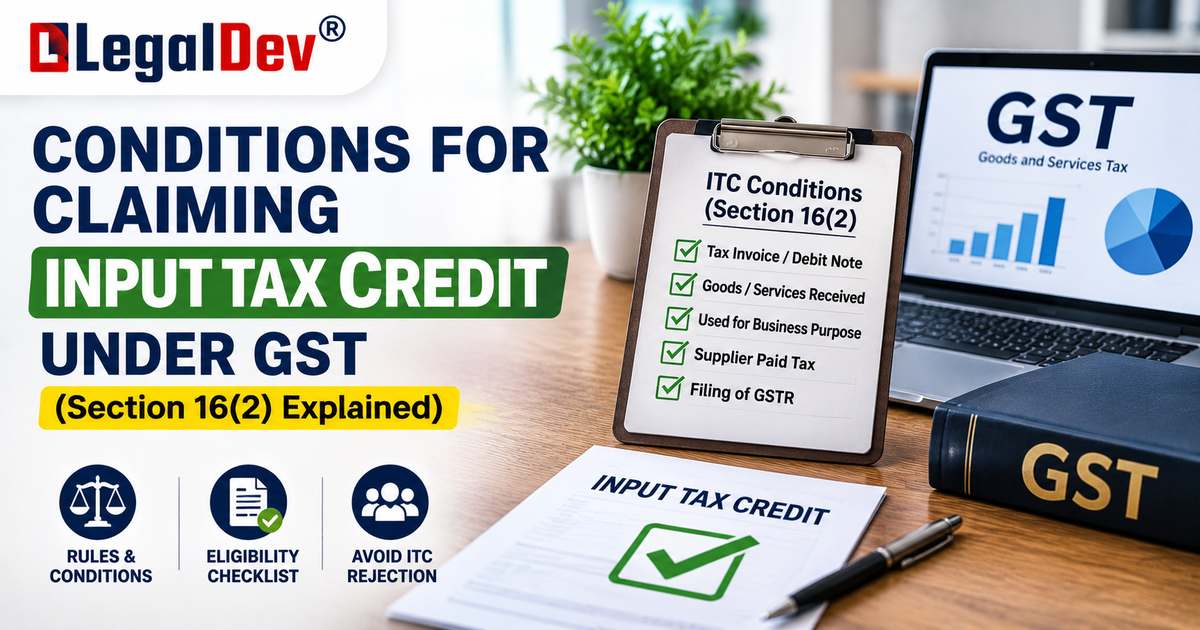
Conditions for Claiming Input Tax Credit Under GST
Section 16(1) of the CGST Act gives a registered person the right to claim Input Tax Credit. Section 16(2), however, is what actually controls whether that right can be exercised. It opens with a "notwithstanding" clause, which in plain terms means it overrides everything else in Section 16 — no ITC can be taken unless every condition listed here is met at the same time.
This page walks through those specific statutory conditions clause by clause, including the provisos attached to them and what happens when a condition is broken. For a broader question of who is allowed to claim ITC in the first place, see Input Tax Credit Eligibility Under GST. For the full concept and how ITC fits into GST overall, see the Input Tax Credit.
Why Section 16(2) Matters More Than Section 16(1)
Section 16(1) sounds generous — any GST paid on business purchases can be claimed as credit. Section 16(2) narrows that promise sharply. It lists four conditions that must all be satisfied together, and if even one fails, the credit is blocked for that particular invoice, regardless of how genuine the underlying purchase was. Courts have described ITC less as an automatic entitlement and more as a conditional benefit — available only once the statutory checklist is cleared.
The Four Conditions Under Section 16(2)
Condition 1: Possession of a Prescribed Tax Document
The recipient must be in possession of a tax invoice, debit note, or another document specifically prescribed for this purpose — such as a bill of entry for imported goods or an invoice issued by an Input Service Distributor. A purchase order, proforma invoice, or verbal agreement does not satisfy this condition, no matter how clearly the transaction is documented elsewhere.
Condition 2: Receipt of Goods or Services
The recipient must have actually received the goods or services. Two specific situations are addressed within this condition itself:
-
Where goods are delivered to a third party on the recipient's instruction (a "bill-to-ship-to" arrangement), receipt is deemed to occur when the goods reach that third party.
-
Where goods are supplied in lots or instalments against a single invoice, credit becomes available only on receipt of the last lot — not in proportion to each partial delivery.
Condition 3: Tax Actually Paid by the Supplier
The tax charged on the invoice must have actually been paid to the government by the supplier, either in cash or through the supplier's own credit. This is the condition that has drawn the most litigation, because it makes a buyer's ITC dependent on a compliance step performed entirely by someone else — the supplier. If the supplier collects GST from the buyer but never deposits it, the buyer's credit can be denied even though the buyer paid in good faith. This provision has been challenged in various High Courts on constitutional grounds, and rulings on it have continued to evolve.
Condition 4: Filing of the Return Under Section 39
The recipient must have furnished their own return (GSTR-3B) for the relevant tax period. ITC cannot be claimed outside the return-filing mechanism — there is no separate application or standalone claim process.
The 180-Day Payment Condition (Second Proviso to Section 16(2))
Attached to Section 16(2) is a further condition that operates after ITC has already been claimed: if the recipient does not pay the supplier — the value of the supply along with the tax — within 180 days from the date of the invoice, the ITC already availed must be reversed, along with interest.
A few specifics of this rule:
-
The 180-day period runs from the invoice date, not the date the goods or services were received.
-
This condition does not apply to supplies taxable under reverse charge, since there the recipient itself pays the tax directly to the government.
-
The law does not prescribe a specific mode of payment. In practice, settlement through a financial or commercial credit note, or through book adjustment, has been treated as valid payment for this purpose in several interpretations.
-
Once payment is actually made to the supplier, the reversed ITC can be reclaimed in a later return.
-
Under Rule 37 of the CGST Rules, where payment is made only partially, the ITC reversal is proportionate to the unpaid amount.
Example: A company receives a service invoice dated 5 April for ₹2,00,000 plus ₹36,000 GST and claims the ₹36,000 as ITC in the same month. If payment to the supplier is still pending after 180 days — around early October — the company must add back ₹36,000 to its output tax liability along with interest, in the return for the period in which the 180 days lapse. If the company eventually pays the supplier in December, it can reclaim the ₹36,000 in that period's return.
What Happens When a Condition Is Not Met
Failure to satisfy any of the Section 16(2) conditions has different practical consequences depending on which one is broken:
|
Condition Not Met
|
Practical Consequence
|
|
No valid tax invoice or document
|
ITC cannot be claimed at all for that transaction
|
|
Goods/services not yet received
|
ITC has to wait until actual (or deemed) receipt
|
|
Supplier has not paid tax / invoice missing from GSTR-2B
|
Credit does not appear in GSTR-2B and stays blocked until corrected
|
|
Recipient has not filed GSTR-3B
|
ITC cannot be claimed until the return is filed
|
|
Payment to supplier not made within 180 days
|
Previously claimed ITC must be reversed with interest, reclaimable later
|
In all of these situations, the underlying purchase can be entirely genuine — Section 16(2) does not ask whether the transaction happened, only whether the compliance checklist has been completed.
How These Conditions Differ From General Eligibility
It helps to keep two ideas separate:
-
Eligibility answers the question "is this person and this type of purchase allowed to carry ITC at all" — for example, whether the claimant is GST-registered, or whether the purchase falls under a blocked category.
-
Conditions under Section 16(2) answer a narrower question — "even for an eligible person and an eligible purchase, has every compliance step been completed correctly."
A purchase can be fully eligible in principle and still fail to yield ITC in a given period simply because one of these four conditions, or the 180-day rule, has not yet been satisfied.
Practical Checklist Before Claiming ITC
Before claiming ITC on any invoice, it is worth confirming:
-
The invoice or debit note is in hand and contains the correct GSTIN, invoice number, and tax amount
-
The goods or services have actually been received (fully, in the case of instalment deliveries)
-
The credit appears in the current period's GSTR-2B
-
GSTR-3B for the period is being filed on time
-
Payment to the supplier, including the tax component, is tracked against the 180-day limit
Frequently Asked Questions
What are the four conditions for claiming ITC under Section 16(2)?
Possession of a valid tax invoice or prescribed document, receipt of the goods or services, actual payment of tax by the supplier to the government, and filing of the recipient's own GST return.
Do all four conditions need to be satisfied together?
Yes. Section 16(2) begins with a non-obstante clause, meaning all four conditions must be met simultaneously. Failing even one blocks the ITC for that invoice.
What is the 180-day rule for ITC?
If the recipient does not pay the supplier the value of the supply along with GST within 180 days of the invoice date, previously claimed ITC has to be reversed along with interest, and can be reclaimed once payment is made.
Does the 180-day rule apply to reverse charge supplies?
No. Since the recipient itself pays the tax directly to the government under reverse charge, this condition does not apply to such supplies.
Can ITC be denied if the supplier does not pay tax, even if the buyer paid in good faith?
Under Section 16(2)(c), yes — ITC is linked to the supplier actually depositing the tax. This provision has been the subject of ongoing litigation in various High Courts.
Is ITC available if goods are received in instalments?
Only after the last instalment or lot against that invoice is received, not proportionately with each partial delivery.