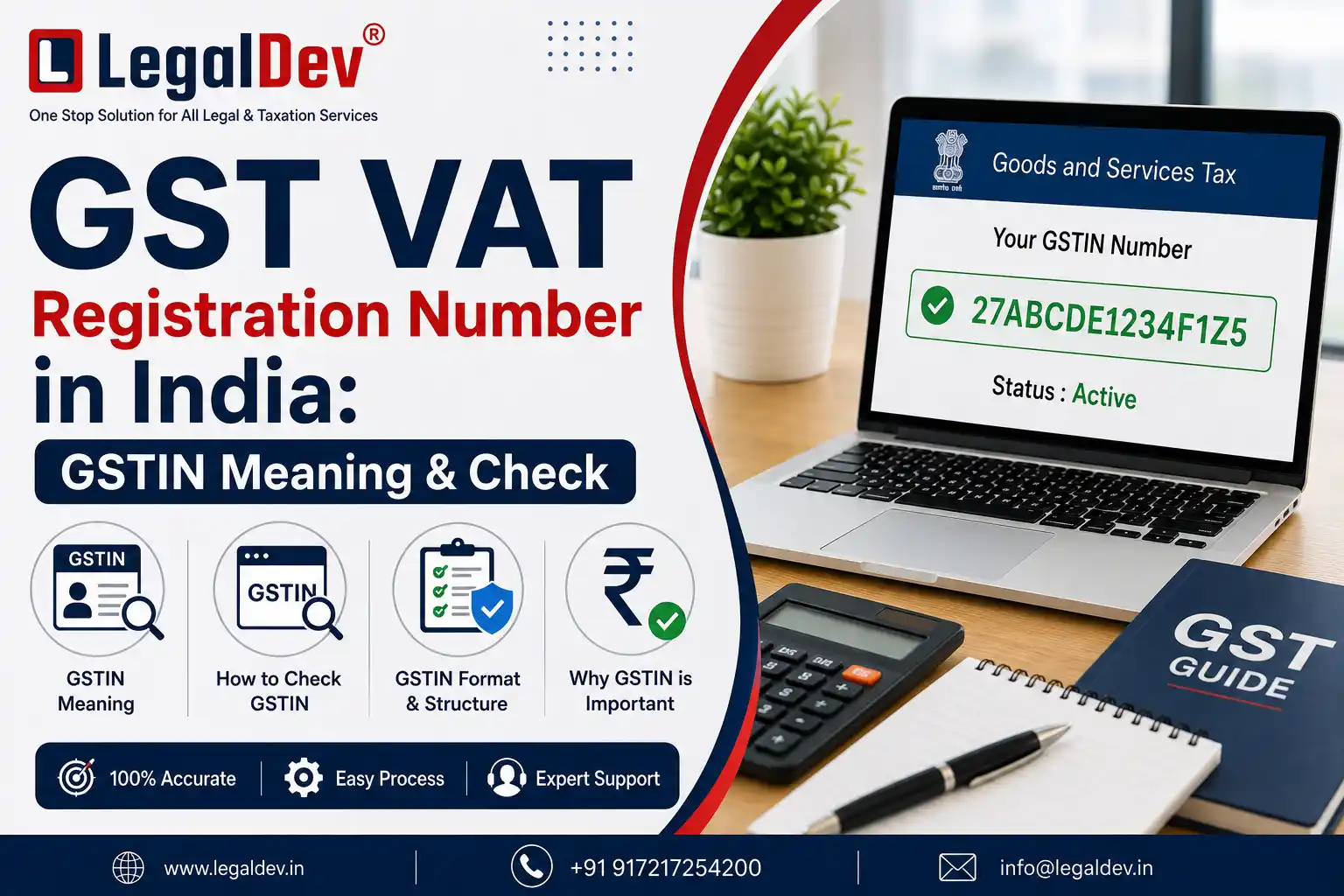
GST/VAT Registration Number in India: This article is written and reviewed against the Central Goods and Services Tax Act, 2017, current GST Council notifications, and the live GST portal (gst.gov.in) rather than paraphrased from other blogs. Every number, threshold, and rule below is dated so you can confirm it hasn't changed since publication. GST rules move, and a compliance article without a "last updated" date is one you shouldn't rely on.
Quick answer
A GST registration number, formally called a GSTIN (Goods and Services Tax Identification Number), is the unique 15-digit alphanumeric code the government assigns to every business registered under GST in India. "VAT registration number" is a separate, older term. Value Added Tax still exists in India today, but only for a narrow set of goods (petrol, diesel, aviation turbine fuel, and alcohol for human consumption) that were never brought under GST, so a VAT registration number and a GSTIN are not the same thing and are not interchangeable.
Key takeaways
|
Question |
Short answer |
|
What is GSTIN? |
A 15-digit, PAN-based tax ID issued to every GST-registered business in India |
|
Is VAT still used in India? |
Yes, but only for petrol, diesel, aviation turbine fuel, crude oil, and alcohol for human consumption |
|
Who needs a GST number? |
Goods businesses above ₹40 lakh turnover, service businesses above ₹20 lakh (lower in special category states) |
|
Does GST registration cost money? |
No, it's free on the official portal. Fees only apply if you hire a CA or consultant |
|
How do I check if a GST number is real? |
Search it free on gst.gov.in under Search Taxpayer → Search by GSTIN/UIN |
|
How long does registration take? |
Typically 2–7 working days with Aadhaar authentication; longer without it |
What is a GST registration number (GSTIN)?
A GSTIN is a unique 15-digit alphanumeric identifier issued to every taxpayer who successfully registers under India's Goods and Services Tax system. Under Section 25 of the Central Goods and Services Tax Act, 2017, every person who registers for GST is assigned this number, and it becomes the business's official tax identity for filing returns, claiming input tax credit, and issuing tax invoices.
You'll often see it called by several names interchangeably: GST number, GST registration number, or GSTIN. They all refer to the same 15-digit code. GSTN (Goods and Services Tax Network), by contrast, is a different thing entirely: it's the organisation that manages the IT backbone of the GST portal, not a number you're assigned.
A related but separate ID is the UIN (Unique Identification Number), issued to specific entities such as foreign diplomatic missions and UN bodies for claiming tax refunds. It follows the same 15-digit structure but exists for a narrower purpose.
GST vs VAT in India: are they the same thing?
They are not, and this is where most "GST VAT registration number" searches actually go wrong. Before July 1, 2017, Indian businesses registered for VAT with their state tax department and received a state-issued Taxpayer Identification Number (TIN). When GST launched, it absorbed VAT, service tax, central excise duty, and a string of other indirect taxes into one nationwide system, and TIN was replaced by GSTIN.
VAT didn't disappear completely, though. A small, fixed set of goods were kept outside GST for constitutional and revenue reasons and are still taxed under state VAT law today:
-
Petrol and diesel
-
Aviation turbine fuel (ATF)
-
Crude oil
-
Natural gas (partially brought under GST from September 2025 for some uses, with VAT still applying elsewhere)
-
Alcohol for human consumption
Alcohol is excluded for a different legal reason than the petroleum products. The Constitution defines GST's scope to exclude alcohol for human consumption outright, so bringing liquor under GST would require a constitutional amendment. Petroleum products, on the other hand, are not constitutionally excluded. The GST law already covers them, but the GST Council hasn't yet notified a date for GST to actually apply, so they remain under VAT and central excise duty until that happens. In December 2025, the Ministry of Finance confirmed in a written reply to the Lok Sabha that there is presently no proposal to bring petroleum products or alcoholic beverages under GST unless the GST Council recommends it.
What this means practically: if your business only deals in goods and services covered by GST (the overwhelming majority of businesses), you only need a GSTIN, not a separate VAT number. A VAT registration number in India today is relevant only to businesses that specifically deal in fuel, crude oil, or alcohol for human consumption, and those registrations are handled by each state's excise or VAT department, separately from the GST portal.
GST number format: how to read a 15-digit GSTIN
Every GSTIN follows the same fixed structure, built around the business's PAN. Take this example: 27ABCDE1234F1Z5
|
Position |
Digits |
What it represents |
|
1–2 |
27 |
State code (here, Maharashtra) |
|
3–12 |
ABCDE1234F |
The business's 10-character PAN |
|
13 |
1 |
Entity number: which registration this is for this PAN within this state |
|
14 |
Z |
A fixed default character, reserved for future use |
|
15 |
5 |
Check digit, calculated from the preceding 14 characters for error detection |
A few details worth knowing beyond the basic breakdown:
State code (digits 1–2): Based on the 2011 Census state numbering, later extended for new codes. A business operating in more than one state needs a separate GSTIN for each state, and every one of those GSTINs will share the same PAN but carry a different state code.
PAN (digits 3–12): Because GSTIN is PAN-based, the person or entity applying must already hold a valid PAN. This is why PAN is the first document requested at GST registration.
Entity code (digit 13): If a business registers more than once within the same state under the same PAN (common for large entities with multiple verticals), this digit increments: 1 for the first registration, 2 for the second, and so on.
Check digit (digit 15): This is calculated using a checksum formula over the first 14 characters. It's why a single mistyped character anywhere in a GSTIN will fail portal validation, since the check digit exists specifically to catch that.
GST state code reference
|
Code |
State/UT |
Code |
State/UT |
|
01 |
Jammu & Kashmir |
20 |
Jharkhand |
|
02 |
Himachal Pradesh |
21 |
Odisha |
|
03 |
Punjab |
22 |
Chhattisgarh |
|
04 |
Chandigarh |
23 |
Madhya Pradesh |
|
05 |
Uttarakhand |
24 |
Gujarat |
|
06 |
Haryana |
26 |
Dadra & Nagar Haveli and Daman & Diu |
|
07 |
Delhi |
27 |
Maharashtra |
|
08 |
Rajasthan |
29 |
Karnataka |
|
09 |
Uttar Pradesh |
30 |
Goa |
|
10 |
Bihar |
31 |
Lakshadweep |
|
11 |
Sikkim |
32 |
Kerala |
|
12 |
Arunachal Pradesh |
33 |
Tamil Nadu |
|
13 |
Nagaland |
34 |
Puducherry |
|
14 |
Manipur |
35 |
Andaman & Nicobar Islands |
|
15 |
Mizoram |
36 |
Telangana |
|
16 |
Tripura |
37 |
Andhra Pradesh |
|
17 |
Meghalaya |
38 |
Ladakh |
|
18 |
Assam |
|
|
|
19 |
West Bengal |
|
|
Check Now: GST registration process
Who actually needs a GST registration number?
GST registration becomes mandatory once your aggregate turnover crosses the applicable threshold, which is calculated across your entire PAN nationwide, not per state, and includes taxable, exempt, and export supplies.
|
Category |
Normal category states |
Special category states |
|
Goods suppliers |
₹40 lakh |
₹20 lakh |
|
Service providers (and mixed suppliers) |
₹20 lakh |
₹10 lakh |
Special category states with the lower threshold include Arunachal Pradesh, Assam, Jammu & Kashmir, Manipur, Meghalaya, Mizoram, Nagaland, Sikkim, Tripura, Himachal Pradesh, and Uttarakhand. The specific threshold that applies can vary by whether the business supplies goods, services, or both, so check your state's current classification before assuming.
Certain categories must register regardless of turnover, including:
Casual taxable persons and non-resident taxable persons
Businesses making inter-state taxable supplies
E-commerce operators and most sellers supplying through e-commerce platforms
Agents supplying goods or services on behalf of another taxable person
Online service providers supplying from outside India to unregistered persons in India
Registration is also available voluntarily, below the threshold, if a business wants to claim input tax credit, deal with larger registered clients, or simply appear more credible to B2B customers who prefer GST-compliant vendors.
How to apply for a GST registration number
Go to the official GST portal at gst.gov.in and select New Registration under the Services tab.
Complete Part A: enter PAN, mobile number, and email; you'll receive OTPs on both, and once verified, a Temporary Reference Number (TRN) is generated.
Complete Part B using the TRN: business details, principal place of business, bank account details, and the authorised signatory's information.
Upload documents: PAN card, Aadhaar of the proprietor/partners/directors, business constitution proof (partnership deed, certificate of incorporation, etc.), and address proof for the place of business (electricity bill, rent agreement, or an NOC from the property owner).
Complete Aadhaar authentication. As per a GSTN advisory dated February 12, 2025, Aadhaar and biometric authentication are part of the standard verification flow, and completing this step promptly is what keeps processing time on the shorter end.
Submit using DSC or e-Signature. Companies and LLPs need a Digital Signature Certificate; other entity types can typically use Aadhaar-based e-Sign.
Receive your Application Reference Number (ARN), then track status until your GSTIN is issued.
Processing time: with Aadhaar authentication completed, registration is commonly granted within roughly 3–7 working days; without it, the process can extend closer to 21 working days because of additional physical verification of the place of business.
Cost: GST registration on the official portal carries no government fee. Any amount you pay is a professional fee to a CA, consultant, or filing platform for their assistance, not a government charge.
If you already have a GSTIN and just need to confirm the business details behind it:
Go to gst.gov.in.
Under Search Taxpayer, choose Search by GSTIN/UIN (there is also a Search by PAN option).
Enter the 15-digit number and submit.
The portal returns the legal business name, registration date, taxpayer type, and current status: Active, Cancelled, or Suspended.
Verifying before you transact with a new vendor matters for a practical reason: only a genuine, active GSTIN correctly reported on an invoice supports smooth input tax credit flow for your business. A cancelled or suspended GSTIN on a supplier's invoice can create ITC problems on your side even if you did nothing wrong.
A note on "search by business name": some third-party tools advertise this feature, but whether the official portal currently exposes a reliable name-based search varies with portal updates, so treat GSTIN-based or PAN-based search as the dependable method and verify name-search availability directly on the portal before relying on it.
Common mistakes to avoid
Assuming "VAT number" and "GST number" are interchangeable for a general business. Unless you specifically deal in fuel or alcohol, you only need a GSTIN.
Registering under the wrong state code because the principal place of business address wasn't finalised before applying. This creates jurisdiction and invoicing headaches later.
Delaying Aadhaar authentication, which materially extends how long the ARN takes to convert into an active GSTIN.
Not tracking turnover in real time. Liability to register arises the moment turnover crosses the threshold during the year, not at year-end. Filing more than 30 days after crossing the threshold can create a gap period where the business was liable but unregistered.
Trusting a GSTIN without checking its status. A syntactically correct 15-digit number can still belong to a cancelled registration.
Pros and limitations of the GST system compared to the old VAT regime
|
|
GST (current) |
VAT (pre-2017, still active only for fuel/alcohol) |
|
Scope |
Nationwide, goods and services |
State-specific, goods only |
|
Input tax credit |
Available across the full supply chain, inter-state included |
Limited by state; no credit on inter-state purchases |
|
Registration |
One PAN-based GSTIN per state |
State-issued TIN, rules varied by state |
|
Compliance |
Single unified return framework |
Different rules, rates, and forms per state |
|
Where it still applies |
Almost everything |
Only petrol, diesel, ATF, crude oil, alcohol for human consumption |
Frequently asked questions
What is a GST registration number?
It's the 15-digit GSTIN issued by the government to every business or individual registered under GST in India, used for filing returns, paying tax, and claiming input tax credit.
What is the full form of GSTIN?
Goods and Services Tax Identification Number.
Is VAT and GST the same in India?
No. GST replaced VAT for almost all goods and services in July 2017. VAT still exists, but only for petrol, diesel, aviation turbine fuel, crude oil, and alcohol for human consumption.
What is a VAT registration number in India today?
A registration issued by a state's VAT or excise department, relevant only to businesses dealing in the fuel and alcohol categories still taxed under VAT rather than GST.
Is VAT still applicable in India?
Yes, on a narrow list of goods (petrol, diesel, ATF, crude oil, and alcohol for human consumption) that were kept outside GST for constitutional and state-revenue reasons.
How many digits are in a GST number?
15 alphanumeric characters.
What does each digit of the GST number mean?
The first two digits are the state code, the next ten are the business's PAN, the 13th is an entity code, the 14th is a fixed "Z," and the 15th is a check digit for validation.
How do I find my own GST registration number?
It's issued to you after successful registration on gst.gov.in and appears on your GST registration certificate; you can also retrieve it by logging into the portal with your credentials.
How do I check a GST number by name?
Use the GST portal's Search Taxpayer tool. GSTIN-based and PAN-based search are the most consistently available methods; check the portal directly to confirm whether name-based search is currently offered.
How do I verify a GST number online?
On gst.gov.in, go to Search Taxpayer → Search by GSTIN/UIN, enter the 15-digit number, and the portal displays the registered business name, type, and current status.
What is the state code in a GST number?
The first two digits, indicating which state or union territory the business is registered in, based on Census-derived numbering.
Is GSTIN different from GSTN?
Yes. GSTIN is your individual 15-digit registration number. GSTN (Goods and Services Tax Network) is the organisation that runs the GST portal's IT infrastructure, and it's not a number assigned to taxpayers.
Can one PAN have multiple GSTINs?
Yes. A business operating in more than one state needs a separate GSTIN per state, all linked to the same PAN, differentiated by state code and entity number.
What is the 14th digit "Z" in a GSTIN?
A fixed default character used by the system; it doesn't vary between businesses and is reserved for potential future use.
What is the check digit in a GST number for?
The 15th character validates the preceding 14 characters using a checksum formula, so the portal can catch a mistyped GSTIN before it's processed.
Is GST registration mandatory for small businesses?
Only once turnover crosses the applicable threshold (₹40 lakh for goods, ₹20 lakh in special category states; or ₹20 lakh for services, ₹10 lakh in special category states), or if the business falls into a mandatory-registration category regardless of turnover, such as inter-state supply or e-commerce selling.
What is the GST registration turnover limit in 2026?
₹40 lakh for goods suppliers and ₹20 lakh for service providers in normal category states, with lower thresholds in specified special category states.
How do I apply for a GST number online?
Through gst.gov.in: complete Part A for OTP verification and a TRN, then Part B with business, bank, and document details, followed by Aadhaar authentication and DSC/e-Sign submission.
What documents are required for GST registration?
PAN card, Aadhaar of the proprietor/partners/directors, business constitution proof (incorporation certificate, partnership deed, etc.), and address proof for the principal place of business.
How long does it take to get a GST number?
Typically about 3–7 working days with completed Aadhaar authentication; without it, processing can take up to roughly 21 working days due to additional verification.
Is there a fee for GST registration?
No government fee applies on the official portal. Any cost you incur is a professional fee if you use a CA, consultant, or third-party filing service.
What happens if I don't register for GST despite crossing the threshold?
The business remains liable to pay GST from the date the threshold was crossed, and can face penalties and interest for operating unregistered beyond the required filing window.
Can a GSTIN be cancelled or suspended?
Yes. GSTIN status on the portal shows as Active, Cancelled, or Suspended. Always verify status before relying on a vendor's GSTIN, since a suspended registration can affect input tax credit on your side.
What products still attract VAT instead of GST in India?
Petrol, diesel, aviation turbine fuel, crude oil, and alcohol for human consumption: the fixed list of items never brought under the GST framework.
Conclusion
A GST registration number and a VAT registration number are not the same thing in India today, and knowing the difference matters more than it sounds: almost every business only ever needs a GSTIN, while VAT registration is now a narrow, state-level requirement that applies to a short, fixed list of fuel and alcohol categories. Once you understand the 15-digit GSTIN structure (state code, PAN, entity number, the fixed "Z," and the check digit), reading, applying for, or verifying any GST number becomes straightforward. If you're registering for the first time, confirm which threshold applies to your business type and state before you begin, and if you're checking someone else's GSTIN, always verify current status on the official portal rather than assuming a well-formatted number is an active one.
About the Author
ppsingh Content contributor, LegalDev LegalDev provides GST registration, GST verification, and GST search services for Indian businesses. https://legaldev.in/