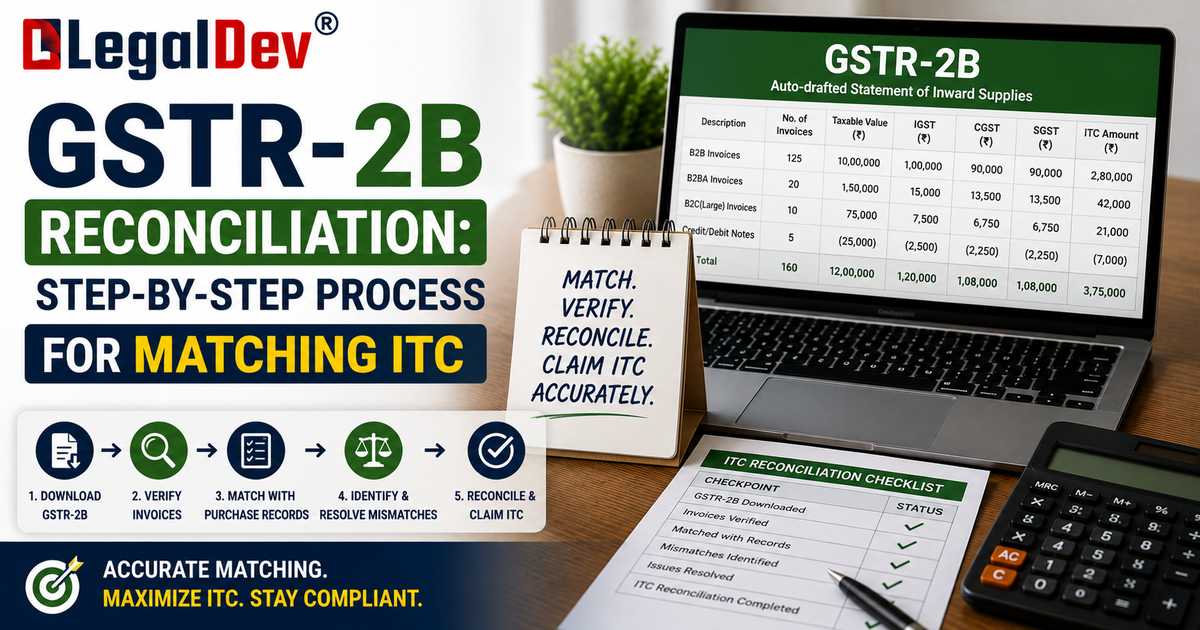
GSTR-2B Reconciliation
Matching GSTR-2B against a business's own purchase records is not a single lookup — it is a structured monthly exercise that sorts every invoice into a small number of categories and decides what to do with each one before GSTR-3B is filed. This page sets out that process in detail, including how to build a reconciliation statement and the categories every mismatch eventually falls into.
This page assumes familiarity with what GSTR-2B is and how it is structured — see GSTR-2B and Input Tax Credit for that background. If reconciliation turns up ITC that appears to be genuinely missing, see Missing ITC in GSTR-2B for what to do next.
Why Reconciliation Is a Distinct Exercise
GSTR-2B tells a business what the system says is available. The purchase register tells a business what it believes it actually bought. Reconciliation is the process of bringing these two records into agreement before relying on either one to file a return — because filing directly from either source in isolation is what causes both under-claims and over-claims.
Setting Up a Reconciliation Statement
A basic GSTR-2B reconciliation statement lines up each invoice against four reference points:
|
Field
|
Purpose
|
|
Supplier GSTIN and name
|
Identify the vendor for follow-up
|
|
Invoice number and date
|
Match the exact document, not just the vendor
|
|
Value and tax amount per books
|
What the business recorded
|
|
Value and tax amount per GSTR-2B
|
What the system shows as available
|
Every invoice is then tagged into one of a small number of match categories, described below.
The Core Reconciliation Categories
Category 1: Matched — Claim as Normal
Invoice value and tax amount agree in both the books and GSTR-2B. This is the majority of transactions in a well-run business and requires no further action beyond claiming the credit.
Category 2: In Books, Not in GSTR-2B
The purchase is recorded, but the corresponding credit does not appear in GSTR-2B for the period. This is usually a timing or filing issue on the supplier's side. Do not claim this ITC yet — it needs to be tracked separately and picked up once it appears in a later period's GSTR-2B.
Category 3: In GSTR-2B, Not in Books
The system shows credit that the business has not recorded as a purchase. Before rejecting it outright in IMS, check whether it is simply an unbooked transaction (a genuine purchase not yet entered in the accounting system) rather than an error. If it turns out to be a duplicate, an invoice meant for a different GSTIN, or unrelated to the business, it should be rejected.
Category 4: Value Mismatch
The invoice exists on both sides but the amount differs — commonly due to a rounding difference, a supplier's clerical error, or a credit note that has not been accounted for correctly on one side. These need individual verification rather than blanket acceptance or rejection.
Category 5: Marked "ITC Not Available"
GSTR-2B itself flags some invoices as ineligible, with a stated reason (blocked credit, supplier under composition scheme, place-of-supply mismatch, or time-barred credit). These should be reviewed against the reason given rather than assumed to be an error requiring correction.
Step-by-Step Reconciliation Process
Step 1 — Export both data sets. Download GSTR-2B (Excel or JSON) and export the purchase register for the same period from the accounting system, in a comparable format.
Step 2 — Run an automated match first. For businesses with meaningful invoice volume, a rule-based or software-assisted match on GSTIN, invoice number, and value catches the bulk of Category 1 matches quickly, leaving only genuine exceptions for manual review.
Step 3 — Classify every exception into Categories 2 to 5 above, rather than treating "unmatched" as a single undifferentiated pile.
Step 4 — Assign an owner and action to each exception. A missing invoice (Category 2) needs supplier follow-up; a value mismatch (Category 4) needs verification against the original document; an unexpected GSTR-2B entry (Category 3) needs an IMS decision.
Step 5 — Finalise the ITC figure for the period based only on what has been confirmed as matched or resolved, and carry forward unresolved items to the next period's reconciliation rather than dropping them.
Step 6 — Retain the reconciliation statement as supporting documentation. A dated, categorised reconciliation working is useful evidence if a claim is later questioned, showing that ITC was claimed on a considered basis rather than blindly copied from the purchase register.
Handling Recurring Timing Differences
Not every mismatch reflects an error. Two situations create predictable, recurring gaps that a reconciliation process should account for rather than treat as new problems each month:
-
Quarterly (QRMP) suppliers — if a supplier files quarterly, invoices from the first two months of a quarter will not appear in GSTR-2B until the quarter's GSTR-1 is filed, typically in the third month. This is a timing difference, not a defect.
-
Credit notes filed against the wrong period or invoice — a supplier's credit note reduces the buyer's available ITC. If it is filed in the wrong month or linked to the wrong original invoice, it can distort the reconciliation until traced back to the correct transaction.
Reconciliation Frequency and Discipline
Reconciliation works best as a monthly discipline tied to the GSTR-2B generation date rather than an occasional catch-up exercise:
-
Reconcile promptly after the 14th, once the draft GSTR-2B is available
-
Take IMS actions based on the reconciliation findings before the return is filed
-
Recompute GSTR-2B if any action was taken after the initial draft
-
Revisit unresolved Category 2 items each subsequent month until they clear or age out
Businesses that reconcile only once a quarter, or only when preparing the annual return, typically find a larger backlog of unresolved mismatches — some of which may already be close to the time limit for claiming ITC.
Frequently Asked Questions
What is GSTR-2B reconciliation?
It is the process of matching invoice-level data in GSTR-2B against a business's own purchase register, categorising any mismatches, and resolving them before ITC is claimed in GSTR-3B.
How often should GSTR-2B reconciliation be done?
Ideally every month, shortly after GSTR-2B is generated on the 14th, rather than in a periodic catch-up exercise.
What should be done with an invoice that is in the purchase register but not in GSTR-2B?
It should not be claimed yet. It should be tracked separately, followed up with the supplier, and picked up once it appears in a later GSTR-2B.
Why does an invoice sometimes appear in GSTR-2B with a different value than the books?
Common reasons include rounding differences, a supplier's data entry error, or a credit note that has not been correctly recorded on one side of the reconciliation.
Is a reconciliation statement useful during a GST audit or notice?
Yes. A dated, categorised reconciliation working shows that ITC was claimed after a considered review, which is useful supporting evidence if a claim is questioned later.