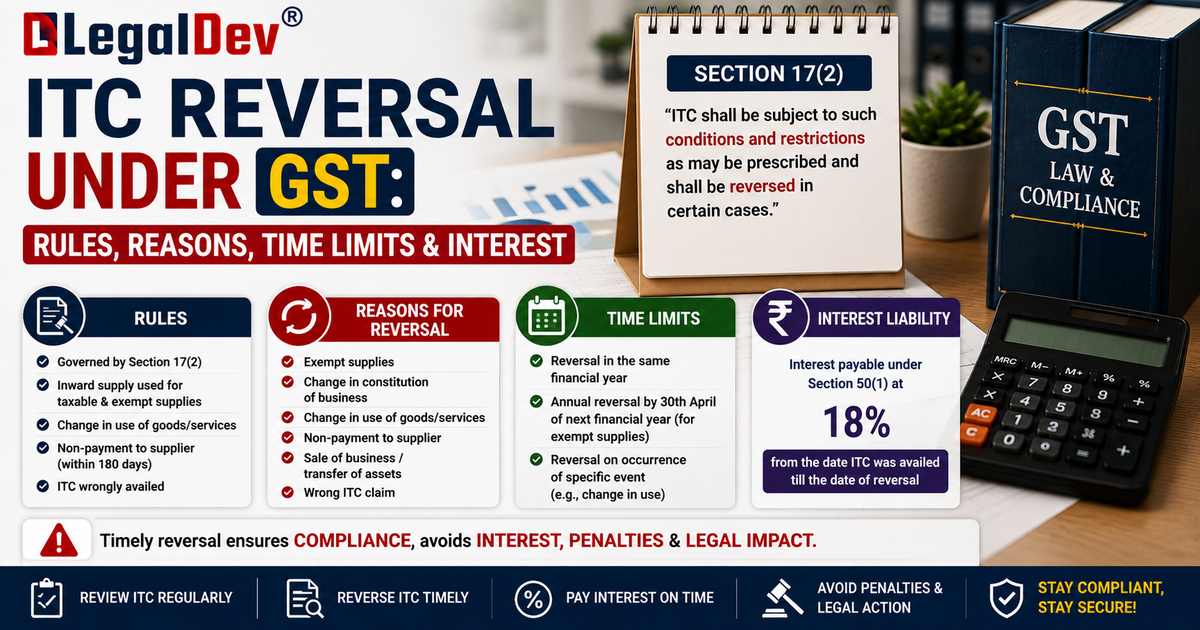
ITC Reversal Under GST
Reversal is what happens when Input Tax Credit that was correctly claimed at the time no longer qualifies to be retained, and has to be added back to output tax liability along with interest. This is a different situation from blocked ITC, where credit was never eligible in the first place. Reversal deals with credit that was valid when claimed but has since been affected by a later event, whether that is non-payment to a supplier, a shift in how an asset is used, or a portion of turnover being exempt from GST.
This page gives an overview of every reversal trigger under GST. Each one is covered in full detail on its own page, linked below.
Reversal versus blocked credit
It helps to separate two ideas that often get mixed up. Blocked ITC under Section 17(5) is credit that was never available to begin with, regardless of documentation or conditions being met, because the expense falls into a category the law specifically excludes. Reversal applies to credit that was genuinely eligible and correctly claimed, but a subsequent event requires part or all of it to be given back. The two can look similar in a GSTR-3B filing, since both reduce net ITC, but they are governed by different provisions and, in several cases, different interest rates.
The main triggers for ITC reversal
Non-payment to the supplier within 180 days
Where a buyer claims ITC on an invoice but does not pay the supplier, including the tax component, within 180 days of the invoice date, the credit has to be reversed. This is one of the most common reversal situations businesses encounter, since it depends entirely on the buyer's own payment cycle rather than any external event.
Full mechanics and worked interest calculations: ITC Reversal Under Rule 37 Practical guidance on managing supplier payments and disputed invoices: ITC Reversal for Non-Payment to Supplier
Use of common inputs for exempt supplies
Where a business uses the same inputs and input services for both taxable and exempt supplies, the portion of ITC attributable to exempt supplies has to be reversed. This is calculated using a prescribed formula and reconciled annually against actual figures for the financial year.
Full formula, exempt supply definitions, and annual true-up process: ITC Reversal for Exempt Supplies
Capital goods used for both taxable and exempt supplies
Capital goods present a separate reversal calculation from ordinary inputs, because their credit is tracked over a deemed useful life of sixty months rather than reversed all at once.
Full formula and worked example: ITC Reversal on Capital Goods
Supplier reports the invoice but does not pay tax
Under Rule 37A, if a supplier's invoice appears in the buyer's GSTR-2B because the supplier reported it in GSTR-1, but the supplier then fails to actually pay that tax in their own GSTR-3B by the prescribed date, the buyer has to reverse the corresponding ITC. This is distinct from the 180-day rule, since it depends on the supplier's compliance rather than the buyer's payment. It is covered in detail on GSTR-2B and Input Tax Credit.
Switching to the composition scheme or cancellation of registration
A regular taxpayer who switches to the composition scheme, or whose registration is cancelled, has to reverse ITC held on inputs in stock, inputs contained in semi-finished or finished goods, and capital goods, computed as on the day before the switch or cancellation takes effect. This is reported through Form ITC-03 rather than through the regular GSTR-3B reversal tables.
Goods written off, lost, or disposed of as gifts
Where goods on which ITC was claimed are subsequently lost, stolen, destroyed, written off, or given away as a gift or free sample, the credit has to be reversed. This overlaps conceptually with the blocked-credit rule for the same categories, since the outcome is the same regardless of whether the credit is denied upfront or reversed after the fact.
Interest on ITC reversal
The interest rate applicable to a reversal depends on which provision triggers it, and this distinction matters because the difference is substantial.
|
Situation
|
Interest provision
|
Rate
|
|
Non-payment to supplier within 180 days (Rule 37)
|
Section 50(1), via Rule 88B
|
18% per year
|
|
ITC wrongly availed and utilised (including blocked credit claimed by mistake)
|
Section 50(3), via Rule 88B
|
24% per year
|
|
Common credit reversal for exempt supplies (Rule 42)
|
Section 50(1) principles applied through Rule 88B
|
18% per year on any shortfall identified at annual true-up
|
Under Rule 88B, if a taxpayer has a sufficient ITC balance sitting in the electronic credit ledger at the time reversal becomes due, no interest is charged on that reversal, since nothing was actually paid out using the wrongly retained credit. This nuance is often missed and can meaningfully reduce the interest exposure on a reversal that is caught and corrected promptly.
How reversal is reported
Reversal amounts are reported in Table 4(B) of GSTR-3B, split between permanent reversals (blocked credit that should not have been claimed) and temporary reversals of the kind covered on this page, which can generally be reclaimed once the underlying condition is resolved, such as payment being made to the supplier. The full breakdown of GSTR-3B's ITC table is covered in How to Claim Input Tax Credit.
Can reversed ITC be reclaimed?
Most reversals covered on this page are temporary rather than permanent. Once the triggering event is resolved, such as the supplier finally being paid, or exempt-supply proportions being finalised at year-end with a favourable adjustment, the previously reversed credit can generally be reclaimed in a later period's GSTR-3B, without being subject to the usual time limit for claiming fresh ITC.
Frequently asked questions
What is the difference between blocked ITC and reversed ITC?
Blocked ITC was never eligible to be claimed at all under Section 17(5). Reversed ITC was correctly claimed at the time but has to be given back because of a later event, such as non-payment to the supplier or a shift in how an asset is used.
What interest rate applies to ITC reversal?
It depends on the trigger. Non-payment to a supplier within 180 days attracts 18% interest under Section 50(1). ITC that was wrongly availed and utilised, such as blocked credit claimed by mistake, attracts a higher 24% rate under Section 50(3).
Can reversed ITC be claimed again later?
In most cases, yes. Once the condition causing the reversal is resolved, such as the supplier being paid, the credit can be reclaimed in a subsequent GSTR-3B, generally without being subject to the standard time limit for claiming ITC.
Where is ITC reversal reported in the GST return?
In Table 4(B) of GSTR-3B, which separates permanent reversals of ineligible credit from temporary reversals that can later be reclaimed.
Is interest always charged when ITC is reversed?
Not always. Where a sufficient ITC balance was available in the electronic credit ledger throughout the period in question, Rule 88B provides that no interest is charged on that reversal.