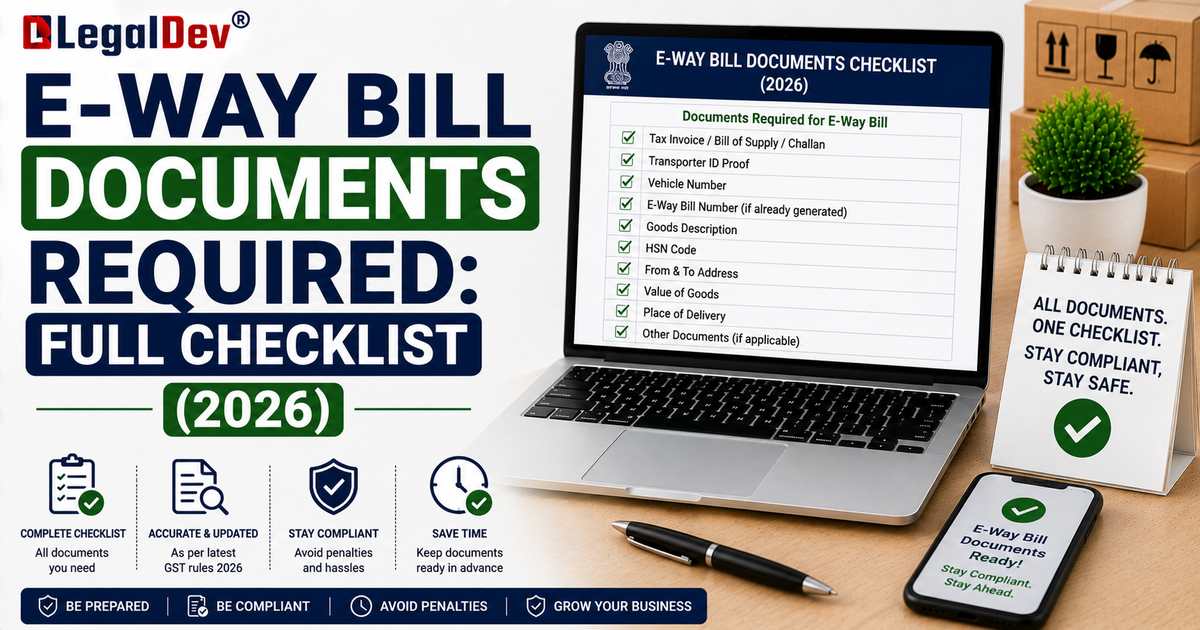
E-Way Bill Documents Required: Complete Document Checklist
Half the time an e-way bill entry goes wrong, it's not because someone didn't know the rules. It's because they were hunting for a document mid-entry that they should have had open before they even logged in. Here's everything you need, split into what you need to generate the bill and what needs to physically travel with the shipment.
What You Need Before You Sit Down to Generate It
Start with the invoice, bill of supply, or delivery challan for whatever's being moved; this is the document every other field on the e-way bill gets pulled from. Alongside it, you'll need the GSTIN of both supplier and recipient, or "URP" wherever one side isn't GST-registered.
The HSN code matters too, since it decides the tax rate and how the item gets classified. If a third-party transporter is handling the move and the vehicle isn't confirmed yet, have their transporter ID ready. If you already know which vehicle it's going on, you'll need the registration number in the standard format instead.
Finally, depending on how the goods are travelling, you may need a transport document reference: a goods receipt number for road, a railway receipt number for rail, an airway bill number for air, or a bill of lading number if it's going by ship.
What Should Physically Travel With the Goods
Once the e-way bill exists, a few things should stay with the shipment, or at least be pulled up on a phone the moment an officer asks. The e-way bill itself, printed or digital, with its EBN and QR code visible. The invoice, bill of supply, or delivery challan it's built on. And the vehicle's own registration paperwork, in case anything needs cross-checking on the spot.
Driver's licence and the other standard transport documents required under the Motor Vehicles Act still apply too, separately from anything GST asks for.
Bill-to-Ship-to Shipments Need One More Thing
If the billing party and the delivery address are different businesses, you'll also need the Ship-To GSTIN, which has been mandatory to declare on its own since August 2026. Skip it, and the e-way bill won't actually reflect where the goods are going, which is exactly the kind of mismatch that draws attention if the shipment gets checked mid-route.
Documents for the Less Routine Movements
Job work shipments run on a delivery challan showing the value of what's being sent, since there's no invoice for a movement that isn't a sale. Sales returns need the original invoice reference alongside a delivery challan or credit note documenting what's coming back. Goods heading to an exhibition, or moving on a sale-on-approval basis, travel on a delivery challan too, since ownership hasn't changed hands yet. And imports use the Bill of Entry in place of a standard invoice, for the leg of the journey from the port or ICD to the importer's own warehouse.
What Happens When the Paperwork Doesn't Match
A mismatch between what's on the e-way bill and what's actually in the vehicle, whether it's the invoice value, the wrong vehicle number, or a document that's simply missing, gets treated as non-compliance under Section 129 of the CGST Act. That means detention, and a penalty that can run well past what the paperwork gap alone would have cost you to fix in advance. Our E-Way Bill Penalty page breaks down the exact numbers.
A Five-Point Check Before You Hit Generate
Before you start filling in the portal, confirm you're holding: the correct invoice or delivery challan, the recipient's GSTIN or their "URP" status, the right HSN code, either the vehicle number or the transporter's ID, and the correct destination PIN code, since that last one quietly decides your distance calculation and validity period too.
Frequently Asked Questions
Does the e-way bill need a physical printout, or is digital enough?
A digital copy on a phone, along with the QR code, is generally accepted. A lot of people still print one anyway, mostly because mobile connectivity isn't always reliable on the road.
What replaces the invoice for a stock transfer between branches?
A delivery challan. There's no sale happening, so there's no tax invoice to reference.
Can a purchase order stand in for an invoice?
No. The portal wants a document that actually reflects the movement, a tax invoice, bill of supply, or delivery challan, not a purchase order.
What should the transporter carry beyond the e-way bill itself?
The usual vehicle paperwork required under the Motor Vehicles Act: driver's licence, registration certificate, insurance. None of that is GST-specific, but officers can ask for it just the same.
Read Next
Once your documents are ready, move on to How to Generate an E-Way Bill for the full step-by-step process. Or, if you want the exact field-level detail these documents feed into, check E-Way Bill Part A and E-Way Bill Part B.