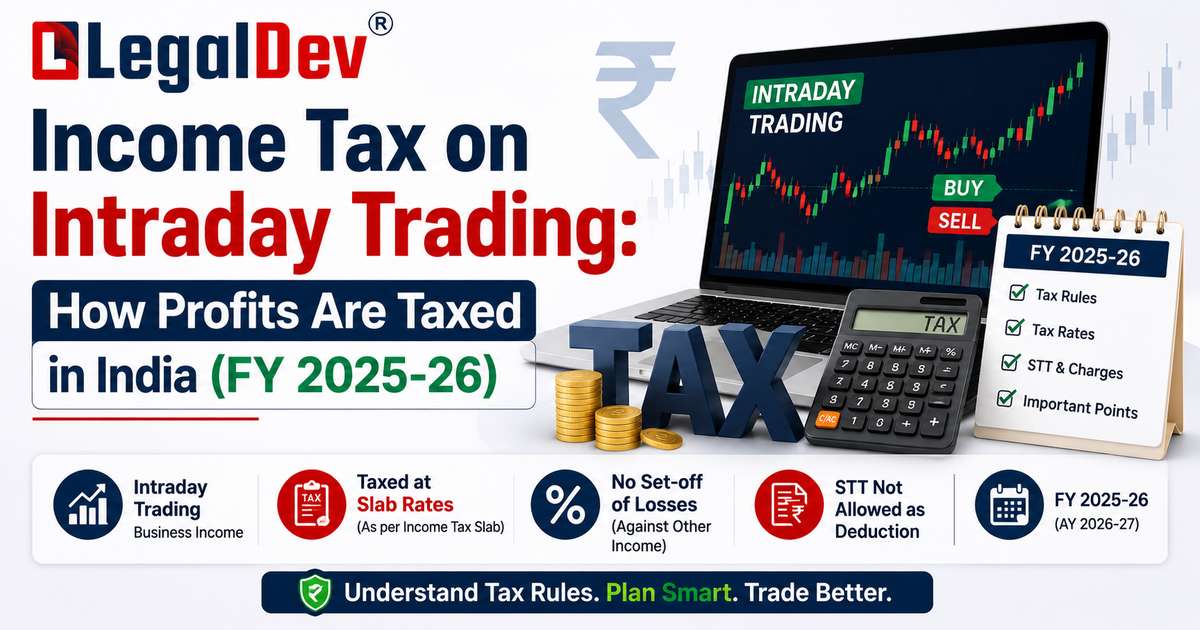
Income Tax on Intraday Trading
Intraday trading has grown massively popular in India. Over 11 crore active traders are registered on NSE as of 2025. But while most traders focus on charts and strategies, taxes often come as a surprise.
The big confusion? Many traders assume intraday profits are taxed like capital gains. They are not. Getting this wrong leads to incorrect ITR filing and, worse, income tax notices.
This guide breaks down everything you need to know about income tax on intraday trading for FY 2025-26.
What Is Intraday Trading?
Intraday trading means buying and selling shares on the same day. You do not take delivery of the shares. Positions are squared off before the market closes.
The goal is simple: profit from short-term price movements within a single trading session.
Since no actual ownership of shares changes hands, income tax law treats this differently from regular investing.
How Is Intraday Trading Income Classified Under Tax Law?
Under Section 43(5) of the Income Tax Act, 1961, intraday trading is classified as speculative business income.
Why speculative? Because you are not investing in shares. You are speculating on price movements without any intention to hold the asset overnight.
This means your intraday profits are taxed under the head "Profits and Gains from Business or Profession" (PGBP) — not under capital gains.
This is an important distinction. Capital gains come with special rates and exemptions. Intraday income gets none of that. It is added to your total annual income and taxed at your applicable slab rate, just like business earnings.
Note on the Income Tax Act 2025: The new Income Tax Act came into force on April 1, 2026. The speculative business treatment for intraday trading continues under Section 66 of the new Act (previously Section 43(5) of the 1961 Act). For FY 2025-26 returns, the rules discussed in this guide apply. Consult a CA for filings under the new Act from FY 2026-27 onwards.
Capital Assets vs Trading Assets: Understanding the Difference
A share can be either a capital asset or a trading asset depending on your role — investor or trader.
Investors hold stocks for the long term. Their aim is capital appreciation and dividend income. Profits from selling these shares are taxed as capital gains (LTCG or STCG).
Traders buy and sell frequently to profit from short-term price changes. Their income falls under business income and is taxed at slab rates, up to 30%.
Based on this, trading income splits into two types:
Speculative Business Income — Intraday equity transactions. No delivery takes place. Taxed under PGBP.
Non-Speculative Business Income — Delivery-based trades, equity F&O, commodity and currency futures and options. These are not speculative in nature.
Tax Rates on Intraday Trading Income (FY 2025-26)
Intraday trading income is not taxed at a flat rate. It is added to your total income and taxed at your applicable slab.
New Tax Regime (Default from FY 2025-26)
|
Total Income
|
Tax Rate
|
|
Up to Rs. 4 lakhs
|
Nil
|
|
Rs. 4 lakhs to Rs. 8 lakhs
|
5%
|
|
Rs. 8 lakhs to Rs. 12 lakhs
|
10%
|
|
Rs. 12 lakhs to Rs. 16 lakhs
|
15%
|
|
Rs. 16 lakhs to Rs. 20 lakhs
|
20%
|
|
Rs. 20 lakhs to Rs. 24 lakhs
|
25%
|
|
Above Rs. 24 lakhs
|
30%
|
Old Tax Regime
|
Total Income
|
Tax Rate
|
|
Up to Rs. 2.5 lakhs
|
Nil
|
|
Rs. 2.5 lakhs to Rs. 5 lakhs
|
5%
|
|
Rs. 5 lakhs to Rs. 10 lakhs
|
20%
|
|
Above Rs. 10 lakhs
|
30%
|
Surcharge applies on higher incomes. A 4% Health and Education Cess is added on top of the tax amount in both regimes.
Practical Tax Calculation Example
Here are the income details of a 30-year-old trader for FY 2025-26:
-
Annual Salary: Rs. 10 lakhs
-
Intraday equity trading income (speculative): Rs. 2 lakhs
-
F&O trading income (non-speculative): Rs. 2 lakhs
-
Short-term capital gains on listed shares: Rs. 1 lakh
-
Interest from bank deposits: Rs. 1 lakh
Step 1 — Capital Gains Tax: Short-term capital gains on listed equity (where STT is paid) are taxed at 20% under Section 111A. Tax on STCG = 20% of Rs. 1 lakh = Rs. 20,000 + 4% cess.
Step 2 — Total Income (excluding STCG): Rs. 10 lakhs (salary) + Rs. 2 lakhs (intraday) + Rs. 2 lakhs (F&O) + Rs. 1 lakh (interest) = Rs. 15 lakhs
Step 3 — Slab Tax (Old Regime):
|
Slab
|
Tax
|
|
0 to Rs. 2.5 lakhs
|
Nil
|
|
Rs. 2.5 lakhs to Rs. 5 lakhs
|
Rs. 12,500
|
|
Rs. 5 lakhs to Rs. 10 lakhs
|
Rs. 1,00,000
|
|
Rs. 10 lakhs and above
|
Rs. 1,50,000
|
|
Total
|
Rs. 2,62,500
|
Total Tax Liability = Rs. 2,62,500 + Rs. 20,000 = Rs. 2,82,500 (+ cess)
Which ITR Form Do Intraday Traders File?
Since intraday trading is treated as business income, you must file ITR-3.
You also need to prepare financial statements — a profit and loss account and balance sheet.
ITR Filing Due Dates for FY 2024-25:
-
September 15, 2025 — if tax audit is not applicable
-
October 31, 2025 — if tax audit is applicable
Tax Audit Rules for Intraday Traders
Whether a tax audit applies depends on your turnover and declared profits.
If you opt for Presumptive Taxation under Section 44AD:
-
No tax audit required if turnover is up to Rs. 3 crore AND profits are at least 6% of turnover.
-
Tax audit required if you have a loss or profits below 6% of turnover AND your total income exceeds the basic exemption limit.
If you do not opt for Presumptive Taxation:
-
Presumptive taxation cannot be used if turnover exceeds Rs. 3 crore.
-
If turnover is below Rs. 1 crore, tax audit is not required even without presumptive taxation.
If your turnover exceeds Rs. 10 crore: A tax audit is mandatory regardless of profit or loss. This applies when more than 95% of transactions are digital — which covers all intraday trading.
How to Calculate Intraday Trading Turnover
For intraday trading, turnover is calculated as the absolute value of all profits and losses — not the total value of trades executed.
Formula: Turnover = Sum of all profits (positive) + Sum of all losses (treated as positive)
Example: Ektha buys 100 shares of ITC at Rs. 75 and sells them the same day at Rs. 80. Profit from Trade 1 = (80 - 75) x 100 = Rs. 500
The next day, she buys 200 shares of a company at Rs. 500 and sells them at Rs. 460. Loss from Trade 2 = (500 - 460) x 200 = Rs. 8,000
Absolute Turnover = Rs. 500 + Rs. 8,000 = Rs. 8,500
The loss is not deducted. Both figures are added together.
Deductible Expenses for Intraday Traders
Since intraday trading is treated as a business, you can claim certain expenses to reduce your taxable profit:
-
Brokerage charges
-
Securities Transaction Tax (STT)
-
GST on brokerage
-
Exchange transaction charges
-
Internet and phone bills used for trading
-
Depreciation on computer or laptop used for trading
-
Research and trading software subscriptions
-
SEBI turnover fees
Keep proper records and invoices. These directly lower your net taxable income.
How Intraday Trading Losses Are Treated
Losses from intraday trading are called speculative business losses.
Key rules:
-
They can only be set off against speculative business income (other intraday profits).
-
They cannot be adjusted against salary, rental income, capital gains, or F&O income.
-
Unused losses can be carried forward for up to 4 assessment years.
-
Carry forward is only allowed if you file your ITR on time — September 15 or October 31, as applicable.
Advance Tax for Intraday Traders
If your estimated total tax liability for the year exceeds Rs. 10,000, you must pay advance tax.
For traders not opting for Presumptive Taxation:
|
Instalment
|
Due Date
|
|
15% of total tax
|
By June 15
|
|
45% of total tax
|
By September 15
|
|
75% of total tax
|
By December 15
|
|
100% of total tax
|
By March 15
|
For traders opting for Presumptive Taxation: Pay 100% of the advance tax in one instalment by March 15.
Missing advance tax deadlines results in interest under Sections 234B and 234C.
Do You Need to Maintain Books of Accounts?
Yes, in many cases.
Books of accounts are required under Section 44AA if your intraday trading income exceeds Rs. 2.5 lakhs or your turnover exceeds Rs. 25 lakhs — unless you have opted for presumptive taxation.
Maintain a cash book, ledger, and trade vouchers at minimum. Your broker's annual tax P&L statement is a good starting point.
Common Mistakes Intraday Traders Make in Taxes
1. Treating intraday income as capital gains. This is the most common error. Intraday income is business income. Filing it under capital gains leads to notices.
2. Not filing ITR-3. If you have intraday income, ITR-1 or ITR-2 are not the right forms.
3. Missing the ITR filing deadline. If you miss the due date, you lose the right to carry forward intraday losses to future years.
4. Ignoring advance tax. Many traders wait until March. Quarterly advance tax payments are required if your liability crosses Rs. 10,000.
5. Not claiming deductible expenses. Brokerage, STT, internet bills — these reduce taxable income. Many traders skip this entirely.
Frequently Asked Questions
Is it compulsory to file ITR for intraday trading? Y
es, if your total income including intraday profits exceeds the basic exemption limit, ITR filing is mandatory.
How do I report intraday profit in my ITR?
Report it under the PGBP head as speculative business income in ITR-3.
What tax rate applies to intraday trading profits?
There is no flat rate. Intraday income is added to your total income and taxed at your applicable slab rate — ranging from 5% to 30% depending on your total earnings.
Can intraday losses be set off against F&O profits?
No. Intraday (speculative) losses can only be set off against other speculative income. F&O income is non-speculative. These two cannot be mixed.
What if I selected the wrong assessment year while paying tax?
You can update challan details and file the return. Respond to any notice from the Assessing Officer explaining the error. A rectification request under Section 154 can also be filed.
Final Word
Intraday trading income is taxed as speculative business income under Indian tax law. There is no flat rate, no capital gains treatment, and no shortcut to avoid reporting it.
File ITR-3, maintain proper trade records, pay advance tax on time, and claim every legitimate business expense. If your trading turnover is significant or your situation is complex, getting a CA to review your return before filing is worth it.
The rules are clear. The compliance is manageable. What gets traders into trouble is ignoring it until the notice arrives.