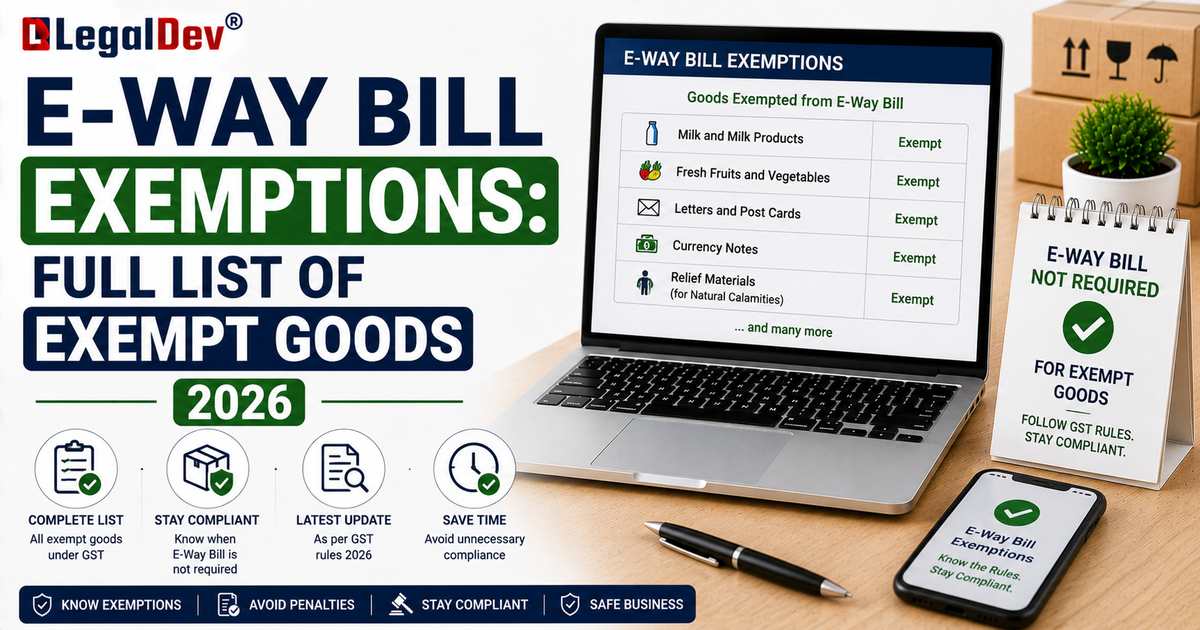
E-Way Bill Exemptions: When Is an E-Way Bill Not Required?
Not everything that moves needs paperwork. Rule 138(14) of the CGST Rules carves out a specific list of goods and situations where an e-way bill simply isn't required, no matter how large the shipment. Here's the full list, laid out so you can check your own case quickly.
Goods That Don't Need an E-Way Bill
Fresh produce is the biggest category: fruits, vegetables, meat, fish, and eggs in their unprocessed or fresh state, along with fresh milk, curd, lassi, and buttermilk. Bread, in all its forms, is also exempt.
Newspapers and printed periodicals don't need one either. Nor does currency, whether coins or notes, or postal baggage moving through the Department of Posts. Human blood and blood products are exempt, and so are used personal and household effects, the kind of thing that comes up when someone relocates.
LPG supplied to households and non-domestic exempted category customers is exempt, as is kerosene sold under the Public Distribution System. Jewellery and articles made by goldsmiths and silversmiths, covered under Chapter 71, are generally exempt too, though some states apply their own rules here instead of a blanket exemption. Kerala, for instance, requires an e-way bill for gold movements above a separate, much higher threshold, rather than exempting it outright.
Alcoholic liquor for human consumption is exempt because it falls outside GST entirely, along with petrol, diesel, natural gas, and aviation turbine fuel, which remain outside the GST regime for now.
When the Exemption Comes From How Goods Move, Not What They Are
A few exemptions have nothing to do with the goods themselves and everything to do with the mode of transport or the specific movement involved.
Non-motorised conveyance, think handcarts, is exempt regardless of what's being carried. So is a short trip to a weighbridge and back, as long as it's within 20 km and a delivery challan accompanies the goods. Anything moving under direct customs supervision, from a customs port, airport, air cargo complex, or land customs station to an Inland Container Depot or Container Freight Station for clearance, is also exempt. Goods transiting through India to somewhere else, under customs bond, fall into this same bucket. Empty cargo containers being moved don't need an e-way bill either, and neither does a straightforward weighment trip where no supply is actually happening.
Exemptions Baked Into GST Law Itself
Some transactions never attract GST in the first place, which means the e-way bill question doesn't even arise. Schedule III of the CGST Act lists activities that aren't treated as a supply of goods or services at all, certain employee-related transactions being a common example.
Exports get partial relief here too, but only once the goods are fully under customs supervision. The leg from the exporter's own premises to the port typically still needs a domestic e-way bill.
States Can Add to This, Within Limits
Beyond the central Rule 138(14) list, a handful of states have notified their own local relaxations, mostly around higher intra-state thresholds or exemptions relevant to their local economy. Jammu & Kashmir has gone furthest, exempting intra-state movement from the e-way bill requirement entirely, whatever the value. For the fuller picture of how state thresholds affect whether you need one at all, see our E-Way Bill Limit page.
Things People Often Get Wrong
A lower intra-state threshold in your origin state doesn't help you once the shipment crosses a state line; the standard ₹50,000 inter-state figure kicks in regardless. Job work movements aren't automatically exempt either, even though no sale is involved, an e-way bill is still needed if the value crosses the threshold. And splitting one large consignment into several smaller invoices to dodge the threshold doesn't create a real exemption. Tax officers can, and do, club these back together during scrutiny.
A Quick Way to Check Your Shipment
Start with the goods themselves: do they appear on the Rule 138(14) list above? If not, check the transport side, non-motorised transport and customs-supervised movement are exempt regardless of what's being carried. Neither applies? Then you're back to the standard rules on threshold and applicability.
Frequently Asked Questions
Is gold jewellery always exempt?
Mostly, but not everywhere. Jewellery under Chapter 71 is generally exempt from the standard requirement, but some states run their own version of this rule. Kerala, for example, still asks for an e-way bill on gold moved between branches above ₹10 lakh.
What about goods sent out for repair?
If it's moving on a delivery challan rather than as a sale, it's still not automatically exempt. An e-way bill is needed if the value crosses the threshold, since repair movement isn't one of the listed exemptions.
Are exports fully off the hook?
Only for the portion of the journey happening under customs supervision. The domestic leg, from the exporter's warehouse to the port or airport, generally still needs a standard e-way bill.
Can I generate one voluntarily even if my goods are exempt?
Yes, and businesses often do this anyway, just for their own transport records, even though nothing in the law requires it.