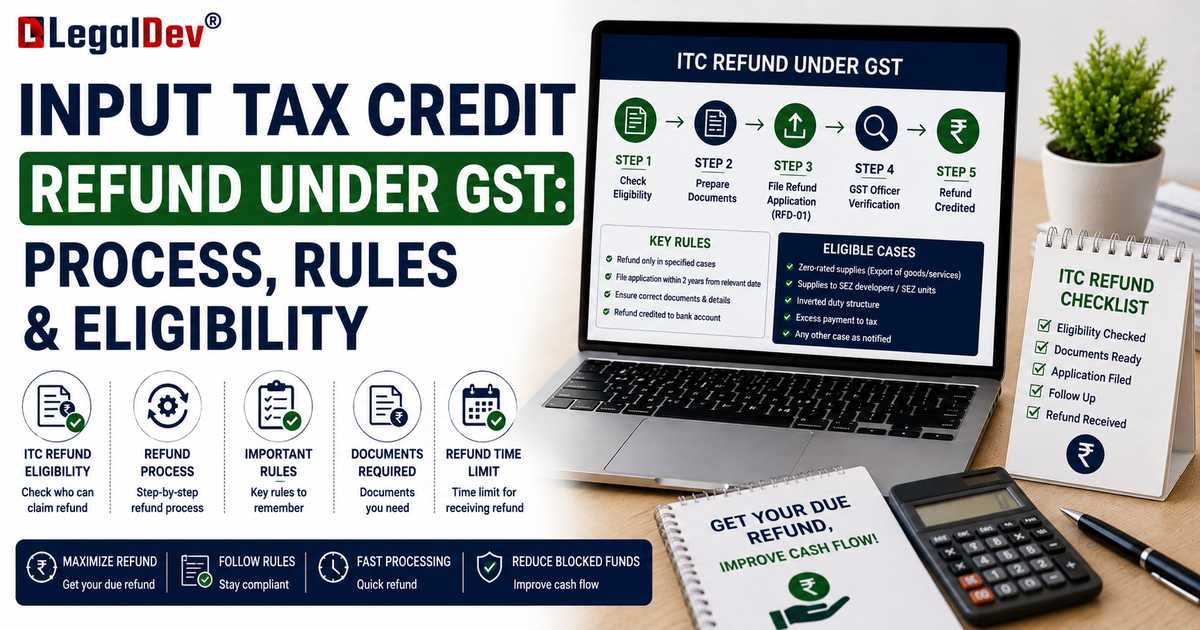
Input Tax Credit Refund Under GST
ITC is normally meant to be used, not refunded — you claim it, then set it off against output GST. But GST law recognises that in certain situations, credit piles up faster than you can use it, and locking that money in the electronic credit ledger indefinitely isn't fair. Section 54(3) of the CGST Act allows a refund of this unutilised, accumulated ITC in exactly two situations.
When can accumulated ITC be refunded
Zero-rated supplies (exports and SEZ supplies). If you export goods or services, or supply to an SEZ unit, the transaction is zero-rated. You can either pay IGST on the supply and claim it back, or supply under a Letter of Undertaking without paying tax and claim a refund of the ITC that built up instead. Both routes lead to a refund, just through different documentation.
Inverted duty structure. This happens when the GST rate on your inputs is higher than the rate on your output — common in sectors like textiles, footwear, and fertilisers where raw material attracts more tax than the finished product. The excess credit that accumulates because of this rate mismatch is refundable, subject to a specific formula.
Outside these two categories, refund is also available for excess balance in the electronic cash ledger, tax paid on a supply later found to be non-taxable, or finalisation of provisional assessment — but these aren't really "ITC refunds" in the way exporters and inverted-rate manufacturers use the term, and they don't involve accumulated credit at all.
Where refund is not available
A refund under Section 54(3) is specifically blocked in a few situations:
-
Where the output supply is nil-rated or fully exempt (except in specific notified cases)
-
Where the government has notified that goods/services are not eligible for this refund
-
Where the exporter has already claimed duty drawback on the same tax component
-
Where an inverted duty situation exists only because of a straight rate cut on the same product, not a genuine input-output rate mismatch (per CBIC Circular No. 135/05/2020)
How the process broadly works
-
Reconcile eligible ITC and confirm the category your claim falls under
-
File Form RFD-01 on the GST portal for the relevant tax period, along with Statement 1/1A and supporting documents
-
A deficiency memo (RFD-03) may be issued if documents are incomplete — this restarts your filing window, so respond quickly
-
For low-risk categories, a 90% provisional refund can be sanctioned within 7 days pending full verification, with the balance settled after scrutiny
-
The proper officer issues a sanction order (RFD-06) or a rejection with reasons
The two-year clock
Every refund application must be filed within two years from the relevant date — for exports, this is generally the date of the shipping bill or the date of receipt of payment for services; for inverted duty refunds, it's linked to the due date of the return for the period the claim relates to. Miss this window and the claim can't be filed at all, regardless of merit.
Which category applies to you
FAQs
Is GST refund the same as an income tax refund?
No. This is specifically about unutilised ITC sitting in your electronic credit ledger — it has nothing to do with income tax.
Can a trader (non-manufacturer, non-exporter) claim an ITC refund?
Generally no, unless the trader is exporting goods or is otherwise covered under a notified refund category. Domestic traders with normal-rated purchases and sales don't accumulate refundable ITC in the ordinary course.
How long does a refund actually take to reach my bank account?
The law requires the 90% provisional amount within 7 days for eligible categories and final sanction within 60 days of a complete application, though real-world timelines vary with document quality and departmental workload.
Can I claim both export refund and inverted duty refund in the same period?
Yes, if your business genuinely has both — an exporter with an inverted-rate domestic segment can file separate claims for each category.