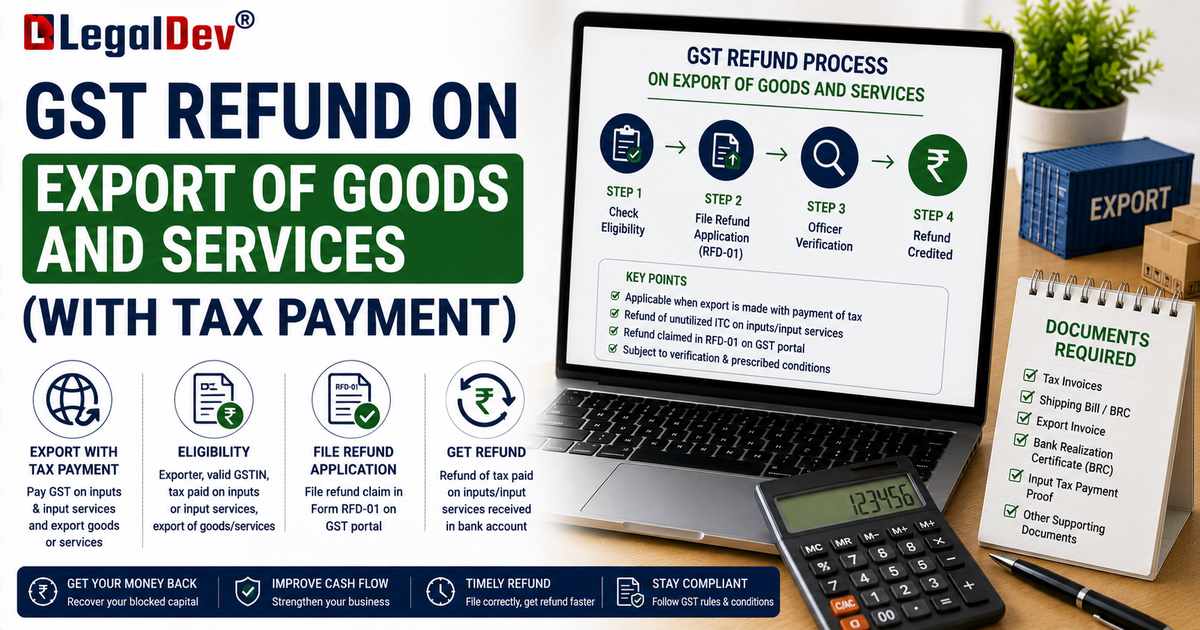
Refund on Export of Goods and Services Under GST
Exports are zero-rated under GST, meaning the government doesn't want tax embedded in the price of what you're sending out of the country. There are two ways to get there: pay IGST on the export and claim it back afterward, or export without paying tax at all under a Letter of Undertaking. This page is about the first route — the one where you pay first, then get refunded.
How the with-tax route works for goods
If you export goods on payment of IGST, you don't file a separate refund application in most cases. The shipping bill itself is treated as the refund application, once you've filed your export general manifest and the relevant GSTR-3B for that period. ICEGATE and the GST portal exchange data automatically, and the refund is processed largely on autopilot — which is the main reason many exporters prefer this route over LUT despite the upfront cash outflow.
For this auto-route to work, three things need to line up:
-
The GSTR-3B for the period must be filed with the correct export details
-
The shipping bill number and IGST amount must match what's declared in your returns
-
There should be no risk flags — mismatches or discrepancies pull the case out of automatic processing and into manual scrutiny
How the with-tax route works for services
Export of services doesn't have a shipping bill equivalent, so it follows the standard RFD-01 application process instead — you file it for the relevant period, attach the Statement 3 details (invoice-wise export of services along with FIRC/BRC as proof of receipt in foreign exchange), and the officer processes it manually rather than through the automated goods route.
Conditions to qualify as an export for this refund
-
The recipient is located outside India (for services) or the goods physically leave India (for goods)
-
Payment is received in convertible foreign exchange, or in INR where the RBI permits it
-
Supplier and recipient are not merely establishments of the same legal person (this rules out certain related-party structures from being treated as exports)
Cash flow trade-off versus LUT
Paying IGST upfront and waiting for a refund ties up working capital, sometimes for weeks even with the auto-processing route. Businesses with tight margins or frequent, high-volume exports often prefer the LUT route instead, precisely to avoid that cash lock-up. The right choice usually comes down to how reliably fast your refunds have historically processed and how much capital you can afford to park in transit.
Common reasons refunds get stuck
-
Shipping bill data not matching GSTR-1/GSTR-3B figures exactly
-
Bank account not validated or not linked correctly on the GST portal
-
Export invoice value mismatched against the shipping bill value
-
GSTR-3B for the relevant period filed late, which delays the automatic trigger
FAQs
Do I need to file RFD-01 separately if I've paid IGST on goods exports?
No, not usually — the shipping bill functions as the refund claim once your returns are filed correctly. RFD-01 is used for services exports and for cases pulled into manual processing.
Is this route faster than exporting under LUT?
Not necessarily. It removes the LUT paperwork, but you still wait for the refund to be processed, and you've paid the tax upfront in the meantime. Many exporters find LUT more capital-efficient even though it needs its own documentation.
What if my shipping bill data doesn't match my GST returns?
The refund gets held up until the mismatch is corrected. This is the single most common reason automatic export refunds stall.
Can partial shipments or part-payments affect the refund?
Yes — refund is generally tied to the value actually realised, so partial or delayed payment receipt can affect timing and, in some cases, the eligible amount.