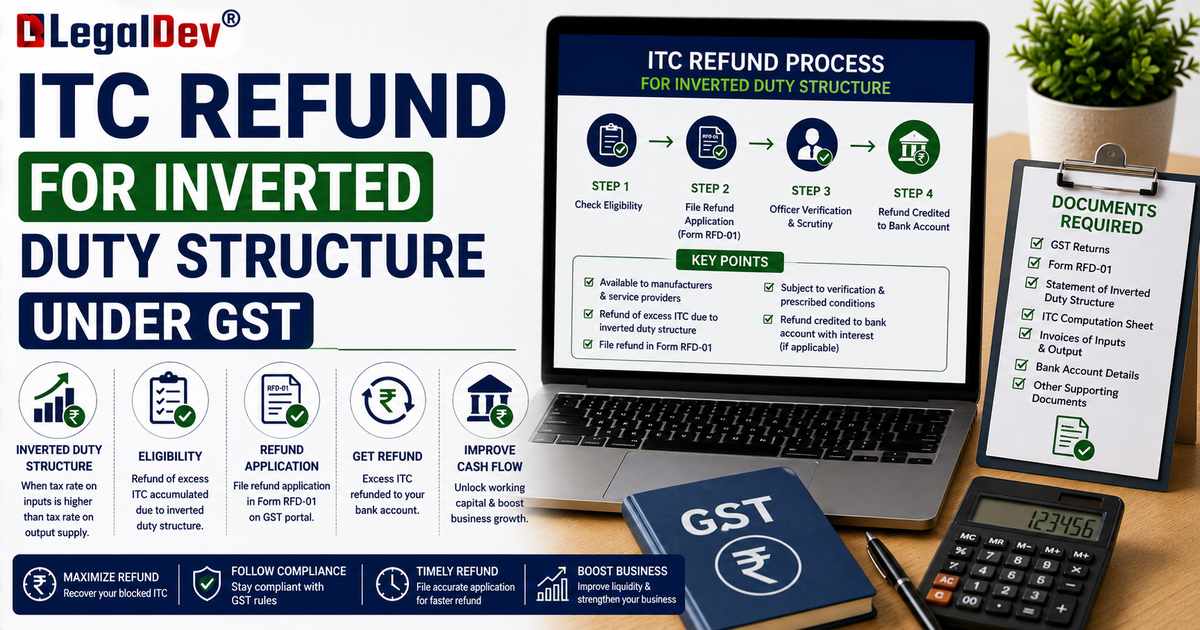
ITC Refund for Inverted Duty Structure Under GST
An inverted duty structure sounds technical, but the situation is simple: you're paying more GST on what you buy than you charge on what you sell. Under GST 2.0's rationalised slabs, this shows up most often where raw material sits at 18% and the finished product lands at 5% — textiles, footwear components, and certain fertiliser inputs are classic examples. The credit that piles up because of this mismatch qualifies for a refund under Section 54(3) read with Rule 89(5).
The Rule 89(5) formula
The refund amount is calculated as:
Maximum Refund Amount = (Turnover of inverted-rated supply of goods × Net ITC ÷ Adjusted Total Turnover) − Tax payable on such inverted-rated supply
Where:
-
Net ITC is the ITC availed on inputs during the period — this excludes ITC on capital goods, and it also excludes input services following the 2022 amendment, which reworked the formula to proportionately factor in input-service credit without directly refunding it
-
Turnover of inverted-rated supply is the value of outward supplies where the input rate exceeds the output rate
-
Adjusted Total Turnover is broadly your total turnover in the state, excluding certain exempt or non-relevant supplies as defined in Rule 89(4)
Worked example
A manufacturer buys raw material worth ₹10,00,000 taxed at 18% (₹1,80,000 GST) and sells the finished goods worth ₹12,00,000 taxed at 5% (₹60,000 GST) in the same period, with no other purchases or sales.
-
Net ITC (on inputs) = ₹1,80,000
-
Turnover of inverted-rated supply = ₹12,00,000
-
Adjusted Total Turnover = ₹12,00,000 (assuming this is the only turnover)
-
Tax payable on inverted-rated supply = ₹60,000
Maximum Refund = (₹12,00,000 × ₹1,80,000 ÷ ₹12,00,000) − ₹60,000 = ₹1,80,000 − ₹60,000 = ₹1,20,000
The actual refund sanctioned can't exceed the ITC genuinely available and reconciled in the electronic credit ledger for the period, even if the formula produces a higher figure.
Where this refund is blocked
-
Where the inverted rate exists purely because of a rate notification reducing tax on the same output product, without any structural difference between input and output classification (per CBIC Circular No. 135/05/2020)
-
Where the output supply is nil-rated or fully exempt
-
Where the goods or services are specifically notified by the government as ineligible for this refund category
-
ITC on capital goods is never part of this refund calculation, only inputs (goods) qualify, and input services are factored in only indirectly through the formula, not refunded directly
Why courts have kept revisiting this formula
The original 2017 version of Rule 89(5) excluded input services from "Net ITC" entirely, which the Supreme Court upheld as constitutionally valid in Union of India v. VKC Footsteps India (2022), even while acknowledging it produced an anomaly for businesses with high input-service costs. The GST Council responded with a July 2022 amendment (Notification No. 14/2022-CT) that proportionately built input-service credit into the formula without directly refunding it. Multiple High Courts since then have held this amendment to be curative and clarificatory, meaning it applies retrospectively to pending claims from earlier periods — so if you have an old rejected or pending claim from before 2022, it may be worth revisiting under the current formula.
Filing checklist
-
Confirm your inverted-rate turnover and Net ITC figures reconcile with GSTR-1, GSTR-3B, and GSTR-2B for the claim period
-
File Form RFD-01 within two years from the due date of the return for the relevant period
-
Attach Statement 1 with the computation, along with supporting purchase and sales invoices
-
A 90% provisional refund can be sanctioned for eligible categories within 7 days, with the balance settled after verification
FAQs
Can a service provider claim an inverted duty refund?
Generally no — this refund is specifically for goods where input GST exceeds output GST. A handful of court rulings have allowed narrow exceptions for services, but it isn't the default position.
Is ITC on capital goods included in the refund calculation?
No. Net ITC under Rule 89(5) covers inputs (goods) only, capital goods are excluded entirely.
What if my input and output rates are the same, but I still have excess credit?
That's not an inverted duty structure, and this refund route doesn't apply — the credit accumulation would need to fall under a different category, such as exports, to be refundable.
Can I claim this refund every month?
Yes, if the inverted-rate situation persists, you can file period-wise, subject to the two-year time limit for each period's claim.