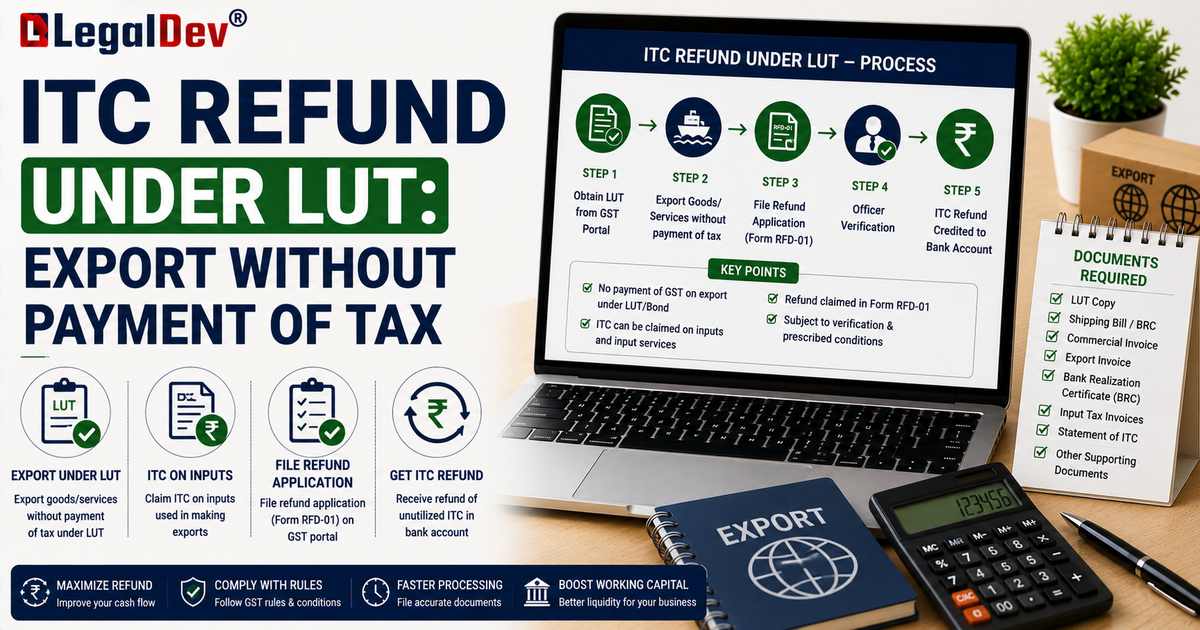
ITC Refund Under LUT (Export Without Payment of Tax)
A Letter of Undertaking lets an exporter ship goods or supply services abroad without paying IGST at all, on the promise that the export will actually happen as declared. Instead of a tax-and-refund cycle, you skip the tax entirely — and then claim back the ITC that piled up on your inputs, since you had no output IGST to set it against.
Who can use LUT
Most regular exporters qualify by default. You're excluded only if you've been prosecuted for tax evasion involving an amount above ₹2.5 crore under GST or an earlier indirect tax law. There's no minimum turnover requirement to be eligible — even a first-time exporter can file one.
If you don't qualify for LUT, the fallback is a bond with bank guarantee, which is rarer in practice now that LUT eligibility covers the vast majority of exporters.
Filing and validity
-
LUT is filed online in Form RFD-11 on the GST portal, for each financial year
-
It's furnished on your own letterhead, self-certified — no CA certification or department approval visit is typically needed
-
Once filed, it's valid for the entire financial year in which it's furnished; a fresh LUT is required at the start of the next year
-
If the conditions of the LUT are breached (export doesn't materialise as declared, for instance), the exporter may have to pay tax with interest, or fall back to a bond
How the refund itself works
Since no IGST is paid, there's nothing for customs to auto-process the way it does for shipping-bill-based refunds. Instead, you file Form RFD-01 for the relevant period, along with:
-
Statement 3 (for services) or Statement 3A (for goods), listing invoice-wise export details
-
Copies of shipping bills or bills of export, and FIRC/BRC for services confirming receipt of payment in foreign exchange
-
A declaration that the ITC claimed hasn't already been refunded through another route
The refundable amount is computed using the standard formula for zero-rated supply refunds — broadly, ITC availed during the period, apportioned by the ratio of zero-rated turnover to total turnover, capped at the actual eligible credit for that period.
Why exporters often prefer this over paying IGST
The math is simple: no upfront tax payment means no working capital tied up while waiting for a refund cycle. For businesses with tight margins, thin cash buffers, or very frequent shipments, that difference compounds fast. The trade-off is a slightly more manual refund process on the ITC side, since it doesn't move through the same automated shipping-bill trigger as the with-tax route.
Common mistakes that delay LUT refunds
-
Filing the refund claim before the LUT for that financial year is actually in place
-
Mismatch between invoice value declared in GSTR-1 and the shipping bill or FIRC
-
Claiming refund for ITC that includes blocked or ineligible credit — this gets flagged during scrutiny and slows the whole claim
-
Not maintaining a clean one-to-one mapping between export invoices and the foreign exchange realised against them
FAQs
Do I need a bank guarantee to use LUT?
No, LUT itself doesn't require one — a bank guarantee is only relevant if you fall back to the bond route because you're not LUT-eligible.
How often do I need to renew LUT?
Once every financial year. It doesn't carry forward automatically to the next year.
What if my export doesn't go through after filing LUT?
You may be required to pay the applicable IGST with interest on that specific transaction, since the export condition attached to the LUT wasn't met.
Can a service exporter use LUT the same way as a goods exporter?
Yes, LUT applies equally to export of services, provided the transaction meets the conditions for a zero-rated supply — payment in convertible foreign exchange being the key one.