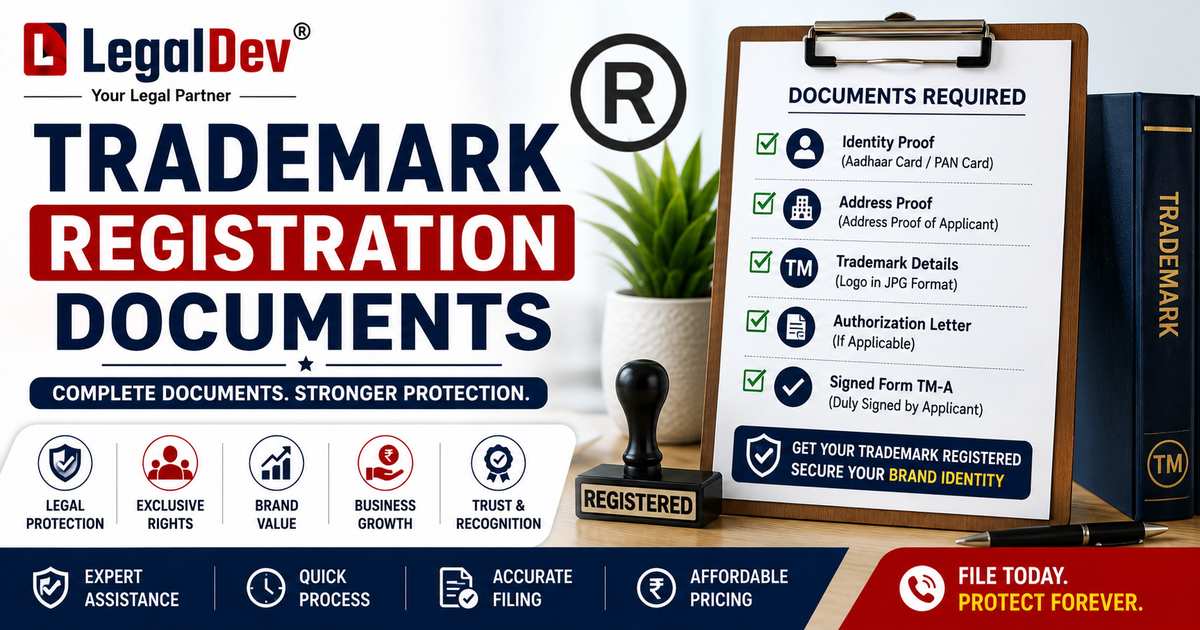
Trademark Registration Documents Required
Every trademark application needs three things at minimum: Form TM-A itself, a clear graphical representation of the mark, and identity proof of the applicant. Beyond that, the exact document list depends entirely on who's applying, an individual, a proprietorship, a partnership or LLP, a private limited company, or a trust, and whether the mark has already been in use before the application date. Missing even one applicant-specific document is one of the most common, entirely avoidable reasons trademark examination gets delayed.
This page is part of the same cluster as our Trademark Registration guide, which covers the full registration process end to end. This page exists purely for the documents: what's genuinely required, what's required only for certain applicant types, and a correction worth knowing before you file, since the power of attorney form most guides still name is technically outdated.
Quick Answer: What Every Applicant Needs
-
Form TM-A, the trademark application form itself, filed online through the IP India e-filing portal.
-
A graphical representation of the mark, a JPEG or PNG image, roughly 8x8 cm, in colour or black and white.
-
Identity and address proof of the applicant, PAN and Aadhaar for individuals, or entity-specific proof for companies, LLPs, and partnerships.
-
Power of Attorney, in Form TM-M, not the older Form TM-48 still cited across a lot of published content, if a trademark agent or attorney is filing on your behalf.
-
A User Affidavit, only if you're claiming the mark has already been in use before the filing date, supported by invoices, packaging, or advertising evidence.
-
A Udyam or DPIIT certificate, if you want to claim the concessional filing fee available to small enterprises and recognised startups.
Documents Required From Every Applicant, Regardless of Type
Three elements form the base of any trademark application, no matter who's filing:
-
Form TM-A, containing the applicant's legal name and entity details, the mark itself (wordmark, logo, or other type), the class or classes of goods and services under the Nice Classification, and a declaration of use, either "proposed to be used" or a specific date of prior use.
-
Graphical representation of the mark. For a wordmark, the text itself suffices. For a logo or device mark, a clear digital image, typically JPEG or PNG, around 8x8 cm, is required.
-
A goods and services description, specific enough to genuinely cover your business activity without being so broad that it invites objections during examination.
The Power of Attorney: Form TM-M, Not Form TM-48
This is worth getting right, since it's one of the more persistently repeated inaccuracies in published trademark guidance. Under the Trade Marks Rules, 2002, authorising an agent to file and act on your behalf used Form TM-48. The Trade Marks Rules, 2017 replaced that entirely, and under Rule 19(1), the correct current form is Form TM-M, one of just eight consolidated forms that replaced 74 separate forms under the older rules. Form TM-48 has been retired for years now, though references to it persist widely, including in some older editions of the Trade Marks Manual itself, which is likely why the outdated name keeps circulating.
A few practical rules that apply to this authorisation regardless of what it's called:
-
It must be executed in favour of a named individual, a registered trade marks agent, a practising advocate, or a person in the applicant's sole and regular employment (a constituted attorney). Section 145 of the Trade Marks Act, 1999 doesn't permit authorising a firm generically, without naming the specific individual who will sign and appear.
-
It must be duly stamped under the Indian Stamp Act, 1899.
-
It's required whenever anyone other than the applicant themselves signs or files the application. An applicant filing entirely on their own behalf, without an agent or attorney, doesn't need this document at all.
An authorisation that names only a firm, without a specific individual, triggers a procedural objection during examination, costing a correction filing and several weeks of delay.
Documents by Applicant Type
Individual or sole proprietor
-
PAN card
-
Aadhaar card, or another government-issued identity proof
-
Recent passport-size photograph
Partnership firm
-
Partnership deed
-
PAN card of the firm
-
Identity and address proof of at least one authorised partner signing the application
LLP
-
LLP incorporation certificate
-
LLP agreement
-
Identity proof of the designated partner signing on the LLP's behalf
Private limited or public limited company
-
Certificate of Incorporation
-
PAN card of the company
-
Identity proof of the authorised signatory (typically a director) filing on the company's behalf
Trust, society, or NGO
-
Trust deed, or the society's/NGO's registration certificate, as proof the organisation legally exists
-
Identity and address proof of the authorised signatory
Foreign individual or entity
-
A valid passport as the primary identity document for individuals
-
Certificate of incorporation from the home jurisdiction for companies, translated into English if issued in another language
-
A board resolution authorising the filing, for foreign companies
-
An address for service in India, typically the Indian trademark agent's address
-
The Power of Attorney (Form TM-M) notarised, and in some cases apostilled or legalised, per the applicant's home country's requirements, a materially heavier documentation step than what Indian applicants go through for the same form
The User Affidavit: When "Already in Use" Needs Proof
Every application declares either "proposed to be used" or a specific prior-use date. Claiming prior use strengthens an application, since it can establish seniority over a mark filed later but registered first, but the claim isn't taken at face value. A User Affidavit, notarised, and accompanied by supporting evidence, is required to back it up:
-
Sales invoices bearing the mark, dated before the claimed use date
-
Product packaging or labels displaying the mark
-
Advertising material, print or digital
-
Photographs of signage, events, or promotional activity
-
Screenshots or extracts from e-commerce listings where the goods have been sold under the mark
Filing "proposed to be used" instead, when the mark genuinely hasn't launched yet, is entirely valid and avoids the affidavit requirement altogether. The mistake worth avoiding is claiming an early use date without evidence that can actually support it if the claim is challenged later, whether by an examiner or by a third party during opposition.
Claiming the MSME or Startup Fee Discount
Government filing fees for trademark applications drop by 50% for eligible applicants, roughly Rs. 4,500 instead of Rs. 9,000 per class, on producing the right proof:
-
Udyam Registration Certificate, in the applicant's own name, valid as of the filing date, for small enterprises.
-
DPIIT Startup Recognition Certificate, in the applicant's own name, valid as of the filing date, for recognised startups.
-
Individual applicants and sole proprietorships also qualify for the reduced fee automatically, without needing either certificate, since the concession applies to natural persons filing as individuals by default.
The certificate has to be current and correctly named to the applicant; a Udyam certificate registered under a different legal name than the trademark applicant won't be accepted to support the discount.
Documents You Don't Actually Need at Filing
A fair number of published checklists list documents the Trade Marks Registry doesn't actually call for at the filing stage, which can lead applicants to over-prepare or, worse, delay filing while chasing paperwork that was never required:
-
GST registration certificate isn't a standalone requirement. It only becomes relevant if GST invoices are submitted as supporting exhibits within a User Affidavit for a prior-use claim.
-
Board resolution isn't something the Trade Marks Registry itself requires or requests for a company applicant, even though it's commonly good internal governance practice to have one.
-
Rent agreement or address proof for the principal place of business isn't a prescribed filing attachment. The address for service in India is simply declared on Form TM-A under Rule 17 and accepted as declared, not independently verified with separate proof at filing.
-
A trademark search report isn't mandatory to file an application, though running one before filing, through a tool like our free Trademark Search, is a strongly recommended practical step to avoid filing a mark that's likely to face an objection or opposition from an existing registration.
Additional Documents for Special Mark Types
-
Sound marks need a 30-second audio recording in MP3 format, along with a graphical (notation-based) representation of the sound.
-
Device marks and logos need the graphical representation described earlier; a wordmark application doesn't need this at all, since the mark is text-only.
-
Collective and certification marks require the governing regulations for use of the mark, in addition to the standard application documents.
Document Format Requirements Worth Confirming Before You File
-
Logo files are generally expected in JPEG or PNG format, sized around 8x8 cm.
-
Filing online requires either standard portal login credentials or, for certain filing categories and professional filers, a Class 3 Digital Signature Certificate.
-
A notarised affidavit needs to be genuinely notarised, a signed but unnotarised statement doesn't satisfy the User Affidavit requirement.
Common Mistakes With Trademark Registration Documents
-
Citing or preparing "Form TM-48" instead of the current Form TM-M, based on outdated guidance still circulating widely.
-
Authorising a firm generically in the Power of Attorney instead of naming a specific individual agent or advocate, triggering a procedural objection.
-
Claiming a prior-use date without evidence that can actually support it if the claim is later questioned.
-
Submitting a Udyam or DPIIT certificate under a different legal name than the trademark applicant, which invalidates the fee discount claim.
-
Gathering documents that aren't actually required at filing, such as a rent agreement or GST certificate, while missing genuinely required ones, such as the correctly executed Power of Attorney.
Frequently Asked Questions
Is Form TM-48 still used for trademark power of attorney in India?
No. Form TM-48 was retired when the Trade Marks Rules, 2017 came into force. The current form is Form TM-M, under Rule 19(1). References to TM-48 in circulation today reflect outdated, pre-2017 guidance.
Do I need a User Affidavit if my trademark hasn't launched yet?
No. If you're filing on a "proposed to be used" basis, no prior-use claim is being made, so no affidavit is required. The affidavit only applies when you're claiming the mark was already in use before the application date.
What documents does a private limited company need for trademark registration?
The company's Certificate of Incorporation, its PAN card, and identity proof of the authorised signatory (typically a director) filing the application, along with the standard Form TM-A and graphical representation of the mark that every applicant needs.
Can an individual get a discount on the government trademark filing fee?
Yes. Individual applicants and sole proprietorships qualify for the reduced fee automatically, without needing a Udyam or DPIIT certificate, since the concession applies to natural persons by default.
Do foreign applicants need extra documents compared to Indian applicants?
Yes, meaningfully more. Foreign individuals need a passport as identity proof; foreign companies need a translated certificate of incorporation and a board resolution. The Power of Attorney also needs notarisation, and in some cases apostille or legalisation, per the applicant's home country's requirements, a step Indian applicants generally don't need for the same form.
Is a GST certificate required to register a trademark?
No, not as a standalone document. It's only relevant if GST invoices are being submitted as supporting evidence within a User Affidavit for a prior-use claim, in which case it functions as an exhibit, not an independently required attachment.
Get Your Documents Right the First Time
An incorrectly executed Power of Attorney or a missing applicant-type document is exactly the kind of gap that adds months to examination, not days. LegalDev prepares and verifies the full document set for individuals, MSMEs, startups, companies, and foreign applicants before filing. See our Trademark Registration for MSMEs or Trademark Registration for Private Limited Companies service pages, or check your mark's availability first with our free Trademark Search tool.