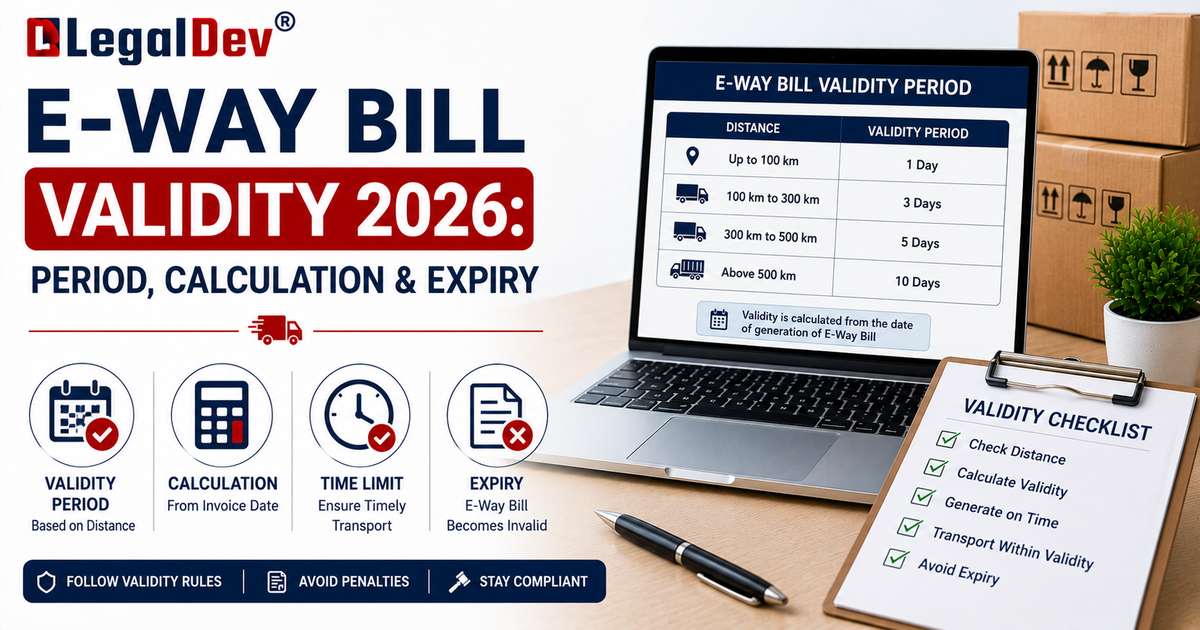
E-Way Bill Validity: Period, Calculation and Expiry Rules
An e-way bill isn't valid forever. It expires based on how far your goods need to travel, and missing that window can mean detention at a checkpoint, even if every other detail on the bill is correct. This page explains exactly how validity is calculated, how to extend it, and what happens if it runs out mid-journey.
The Basic Validity Rule
E-way bill validity is based on distance, not on the type of goods or their value:
-
Regular cargo: 1 day for every 200 km, or part thereof.
-
Over-Dimensional Cargo (ODC): 1 day for every 20 km, or part thereof.
"Or part thereof" matters a lot here. Any distance beyond a full 200 km slab, even by 1 km, rounds up to a full extra day.
How the 10% Distance Buffer Works
The portal auto-calculates the distance between the source and destination PIN codes, and it allows you to enter up to 10% more than that calculated distance. So if the system calculates 600 km between two points, you can enter up to 660 km. This buffer accounts for the fact that real routes are rarely a perfectly straight line.
Validity Examples
|
Distance
|
Validity (Regular Cargo)
|
|
Up to 200 km
|
1 day
|
|
201 km to 400 km
|
2 days
|
|
401 km to 600 km
|
3 days
|
|
600 km (exact example)
|
3 days (600 ÷ 200 = 3)
|
For Over-Dimensional Cargo, the same logic applies but in 20 km slabs, so a 45 km ODC shipment gets 3 days of validity (up to 20 km = day 1, 21-40 km = day 2, 41-60 km = day 3).
When Does the Validity Clock Start?
Validity is calculated from the moment the e-way bill is generated, not from when the vehicle actually starts moving, and not from when Part B is filled in for a delayed shipment. If you generate an e-way bill at 10 AM on Monday for a 1-day validity period, it expires at 11:59 PM on Tuesday, since a "day" here runs from midnight to midnight, not in 24-hour blocks from the generation time.
For example, generating an e-way bill at 11:20 PM still counts that partial day as day one; the bill then expires at midnight at the end of the next full validity day.
How to Extend E-Way Bill Validity
If a shipment is delayed, whether due to a breakdown, traffic, or any other genuine reason, you can extend the validity before it expires:
-
Log in to the e-way bill portal.
-
Go to "Extend Validity" from the dashboard.
-
Enter the e-way bill number and provide the reason for the delay (breakdown, natural calamity, law and order situation, or other).
-
Update the current location of the goods and the remaining distance to be covered.
-
Submit to generate the extension.
Extension window: You can extend the validity only within 8 hours before or 8 hours after the original expiry time, not at any random point earlier in the journey.
Extension cap: Total validity, including all extensions, cannot exceed 360 days from the date the e-way bill was originally generated. Beyond that point, a fresh e-way bill is required rather than a further extension.
What Happens If the E-Way Bill Expires
An expired e-way bill means the goods are technically moving without valid documentation. If a GST officer checks the shipment after expiry, the goods and vehicle can be detained under Section 129 of the CGST Act, and the business may face a penalty. This holds even if the delay was entirely outside the transporter's control, which is exactly why the extension window exists, and why using it promptly matters.
If a delay is expected, extend the validity before expiry rather than after, since the portal generally won't let you extend once too much time has passed beyond the 8-hour post-expiry window.
Checking an E-Way Bill's Current Validity Status
You can check the live status of any e-way bill by logging into the portal and using the "Search" option, entering the e-way bill number. This shows the current validity, whether it's still active, and how much time remains.
Frequently Asked Questions
Does validity depend on the value of the goods?
No. Validity is based purely on distance, regardless of consignment value or goods type (apart from the separate ODC vs regular cargo distinction).
Can I extend validity multiple times?
Yes, as long as each extension happens within the 8-hour window around expiry, and the total validity doesn't exceed 360 days from the original generation date.
What if my goods reach the destination before the validity expires?
Nothing further is required for validity purposes, though you can now use the voluntary closure facility to mark the e-way bill as delivered once the goods arrive.
Is the validity period the same for rail, air, and ship transport?
The distance-based calculation applies the same way across transport modes, though practical transit times vary, so plan generation timing accordingly for longer rail or sea journeys.
What's the difference in validity for transportation "other than ODC" versus regular cargo?
"Regular cargo" and "transportation other than ODC" refer to the same category under the rules; both get 1 day per 200 km. Only Over-Dimensional Cargo gets the stricter 1 day per 20 km rule.
Read Next
If you're about to generate a new e-way bill, see our How to Generate an E-Way Bill guide to get the distance and validity right from the start. For the underlying legal framework, check E-Way Bill Rules.