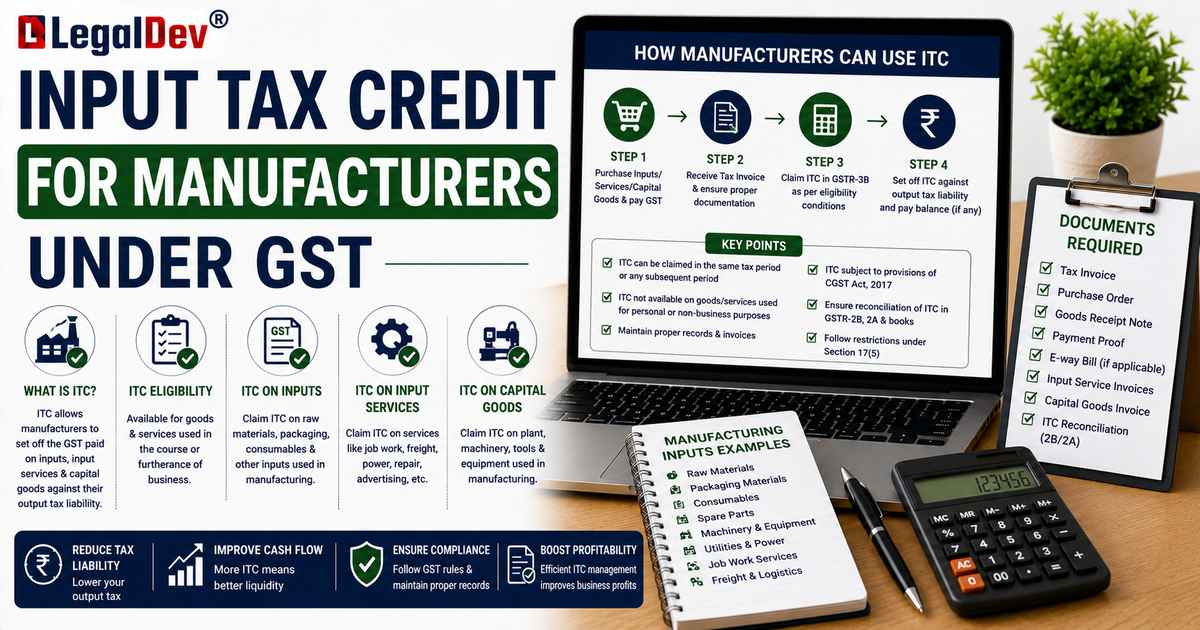
Input Tax Credit for Manufacturers Under GST
A manufacturer's ITC position looks different from most other businesses in one specific way: the credit chain runs through several stages — raw material, work-in-progress, machinery, and often job work — before a single rupee of output tax is charged. That length is exactly where most manufacturing-specific ITC issues show up.
Raw material and consumables
ITC on raw material is claimed as it's purchased, not when it's consumed in production — GST doesn't track cost-of-goods-sold the way accounting does. This means a manufacturer's ITC and output tax liability rarely move in lockstep month to month; a heavy procurement month can show large unutilised credit even before any of that stock is turned into finished goods.
Consumables used in the manufacturing process — lubricants, cleaning agents, packing material — are eligible the same way raw material is, as long as they're used in the course of business and not diverted for personal use.
Machinery and plant is usually the largest single claim
Because capital goods ITC is available in full in the period of purchase (see our capital goods guide), a manufacturer investing in new production lines sees a large one-time credit hit the electronic credit ledger. This is worth planning around — a big machinery purchase can temporarily push a manufacturer into an ITC-heavy position even with normal sales volumes.
The distinction between eligible "plant and machinery" and blocked "immovable property" (covered in detail on our ITC on machinery page) matters more for manufacturers than almost any other business type, since factory construction and machinery installation often happen in the same capital project.
Job work is a manufacturing-specific wrinkle
Sending raw material or semi-finished goods to a job worker doesn't trigger a reversal of ITC already claimed, as long as the goods return within the prescribed period (generally one year for inputs, three years for capital goods) or are supplied directly from the job worker's premises with proper documentation. Manufacturers who outsource significant parts of production need to track this timeline carefully — goods not returned or supplied onward within the window are deemed a supply, with tax and interest implications.
Inverted duty structure hits manufacturers hardest
Of all business types, manufacturers are the ones most likely to run into an inverted duty situation — buying inputs at a higher GST rate than the rate charged on the finished product. Textile, footwear, and fertiliser manufacturing are the sectors that see this most often under the current GST 2.0 rate structure. Where this applies, the excess accumulated ITC is refundable under Rule 89(5) — see our inverted duty refund guide for the formula and worked example.
Common reconciliation issues specific to manufacturing
-
Multiple vendors for the same raw material, each with different GSTR-1 filing discipline, making GSTR-2B reconciliation heavier than for a business with fewer, larger suppliers
-
Debit and credit notes for quality rejections and returns, which need to be tracked separately from the main purchase register
-
Freight and transportation ITC on inbound raw material versus outbound finished goods, which sometimes gets mixed up in the books
FAQs
Does ITC accumulate faster for manufacturers than for traders?
Often yes, mainly because of large one-time machinery purchases and, in some sectors, structurally higher input tax rates than output rates.
Is there a separate ITC scheme for small manufacturers?
No separate ITC scheme exists based on business type — eligibility rules are the same regardless of turnover, though small manufacturers under the composition scheme cannot claim ITC at all, since composition dealers don't charge output GST either.
Can a manufacturer claim ITC on electricity and fuel used in production?
Electricity is outside GST altogether, so there's no ITC to claim on it. Fuel like petrol and diesel is also outside GST for most uses currently, meaning no ITC is available on those either, regardless of how directly they're used in manufacturing.
What happens to ITC on raw material that's damaged or destroyed before use?
ITC must be reversed on goods lost, destroyed, written off, or given away as free samples — this is specifically blocked under Section 17(5)(h), and it's a common gap manufacturers miss when scrapping damaged stock.