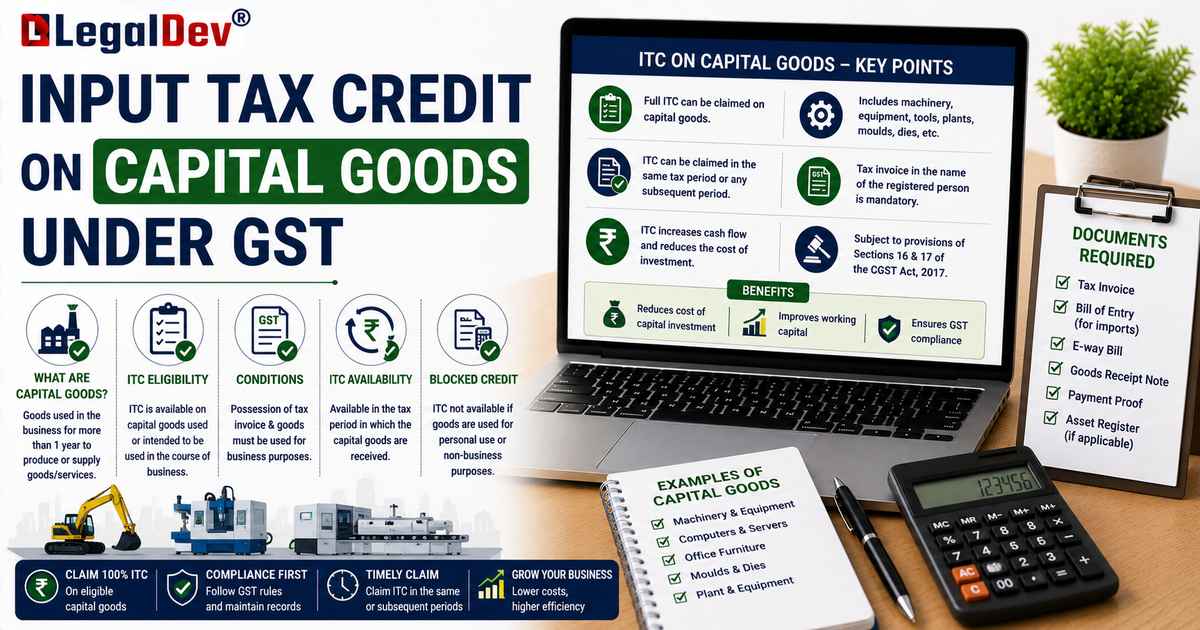
Input Tax Credit on Capital Goods Under GST
Capital goods get a genuinely simpler deal under GST than they did in the pre-GST regime, where credit on plant and machinery had to be claimed in instalments over several years. Under GST, if the asset qualifies, you can claim the entire ITC in the same period you receive it — no spreading it out. The trade-off is a set of rules that watch what happens to that asset afterward.
What counts as capital goods
Under Section 2(19) of the CGST Act, capital goods are goods whose value is capitalised in your books of account and which are used or intended to be used in the course or furtherance of business. The test isn't the nature of the item, it's how you account for it — the same machine could be a capital good for one business and a trading item (stock-in-trade) for another, depending on how it's booked.
Basic eligibility conditions
The general ITC conditions apply here too — a valid tax invoice, the goods actually received, tax actually paid by the supplier to the government, and the relevant return filed. Beyond that, two capital-goods-specific rules matter most:
No double benefit with depreciation. Under Section 16(3), if you claim depreciation under the Income Tax Act on the GST component of a capital asset's cost, you forfeit ITC on that same tax component. You have to pick one — claim ITC and depreciate only the base cost, or depreciate the full cost including GST and skip ITC. Almost every business chooses the ITC route since it's an immediate, certain benefit versus a depreciation deduction spread over years.
Blocked capital goods stay blocked. Section 17(5) restrictions apply to capital goods exactly as they do to any other purchase. Motor vehicles for passenger transport (with limited exceptions), and goods used for personal consumption, don't become eligible just because they're capitalised. See our Blocked ITC guide for the full list.
Mixed use: business and exempt supplies together
Where a capital good is used partly for taxable supplies and partly for exempt supplies or non-business purposes, you can't claim full ITC upfront and forget about it. Rule 43 requires you to track and reverse the exempt/personal-use portion over the asset's deemed useful life of 60 months (5 years) from the invoice date.
In broad terms, the mechanism works like this:
-
Full ITC is credited to the electronic credit ledger at the time of purchase
-
ITC attributable to exempt supplies and non-business use is calculated using a prescribed formula and added back to output liability, spread across the remaining useful life
-
If the asset was already partly used for non-business purposes before being brought fully into taxable use, a proportionate deduction is made from the eligible credit
This calculation gets detailed fast, and we cover the asset-specific versions of it — machinery, computers, and vehicles each have their own practical quirks — on the linked pages below.
What happens when you sell or dispose of the asset
Under Section 18(6), if you sell, transfer, or otherwise dispose of capital goods on which you claimed ITC, you have to pay an amount equal to whichever is higher of:
-
ITC originally claimed, reduced by a percentage points for every quarter (or part of a quarter) of use, calculated per prescribed rules, or
-
The tax on the transaction value of the sale
This is essentially GST's way of clawing back credit proportionate to how much "unused life" the asset had left when it left your books.
Where the specifics differ by asset type
-
Plant and machinery → ITC on Machinery — covers what counts as "plant and machinery" versus immovable property, and where foundation/civil work fits in
-
Computers and IT equipment → ITC on Computers — ownership conditions, software, and employee-use devices
-
Vehicles used as business assets → ITC on Vehicles as Capital Goods — this is different from the passenger-vehicle restriction covered under Blocked ITC; this page deals with commercial/transport vehicles capitalised as business assets
FAQs
Can I claim ITC on capital goods in instalments, like the old excise regime?
No, GST allows the full eligible ITC in the period of receipt itself, subject to the usual conditions — there's no mandatory spreading.
What if I use a capital good only for exempt supplies?
Then no ITC is available on it at all — Rule 43 reversal only applies where there's a mix of taxable and exempt/non-business use, not where the use is entirely exempt.
Does the 60-month useful life reset if I later change how the asset is used?
No, the useful life is fixed at 60 months from the date of the original invoice, regardless of subsequent changes in usage pattern.
Is ITC available on capital goods used for a business's own construction of an immovable property?
Generally no — Section 17(5)(d) blocks ITC on goods and services used for construction of immovable property on your own account, with narrow exceptions like plant and machinery that isn't treated as a building or civil structure.