IEC Verification
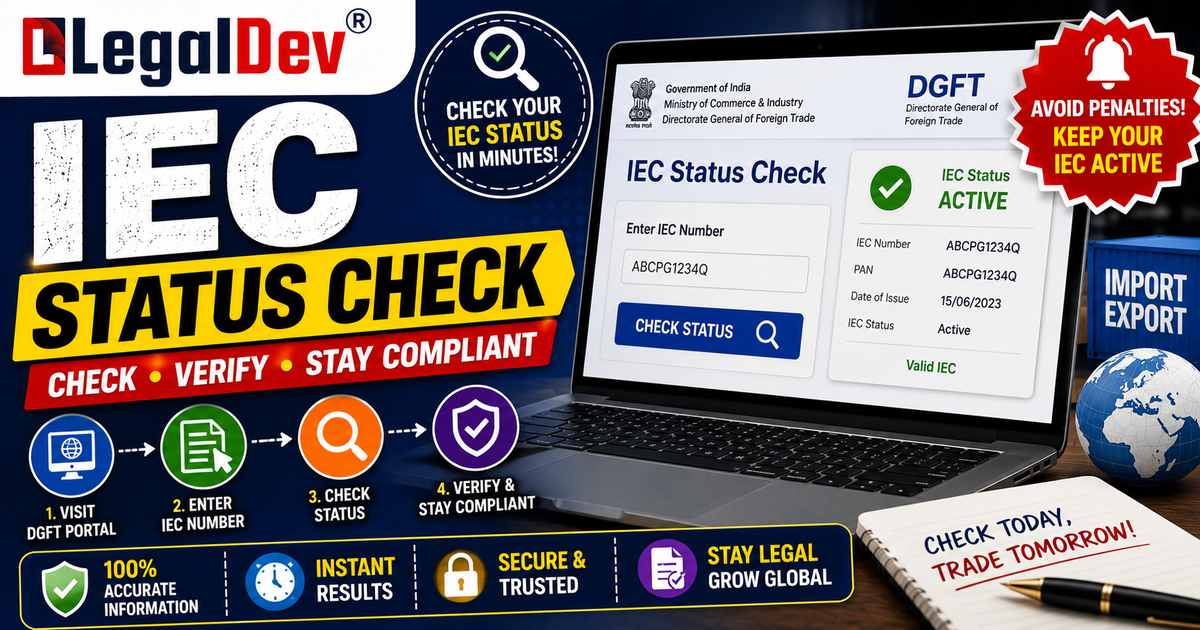
Checking whether an IEC is genuine and active takes under a minute on the DGFT portal, and you don't need to be logged in, or even be the code's owner, to do it. This matters in two very different situations: confirming your own IEC hasn't quietly lapsed, and checking whether the exporter, importer, or agent you're about to do business with actually holds a valid one. Both use the same public tool, but it's the second use case, verifying someone else's IEC before money or goods change hands, that most guides on this topic barely touch.
This page belongs to the same cluster as our Importer Exporter Code Registration guide, our How to Apply for IEC guide for getting a fresh code issued, and our IEC Modification guide for changing details on an existing one. This page covers what comes after either of those: confirming a code, yours or someone else's, is what it claims to be.
Quick Answer: How to Verify an IEC
-
Go to dgft.gov.in and open Services → View Any IEC Details. No account or login is required for this specific tool.
-
Enter the IEC number (or the applicant's PAN, since the two now share the same 10-digit format) along with the first three letters of the firm's registered name.
-
Solve the CAPTCHA and submit.
-
The result shows the current status, Active, Inactive, Suspended, Cancelled, or Under Amendment, along with the registered firm name and branch details.
-
A status other than Active is a signal to dig further, not necessarily a dealbreaker, but worth understanding before you proceed with a transaction.
Two Reasons to Verify an IEC
Most articles on this topic assume you're checking your own code. That's one legitimate reason, but not the only one, and arguably not even the more consequential one for a business regularly dealing with new trade partners.
Checking your own IEC matters because the code can go inactive without any dramatic warning sign on your end, typically because the mandatory annual confirmation between April and June was missed. You find out the hard way, usually when a shipment gets held at customs or a bank declines an international transfer, unless you'd checked beforehand.
Checking someone else's IEC matters just as much, and it's the use case a lot of businesses never think to run until something's already gone wrong. Before wiring an advance payment to a new overseas-facing supplier, before signing a distribution agreement with an unfamiliar exporter, or before extending credit terms to a new import client, pulling up their IEC status takes a minute and tells you whether the entity is actually a going concern in the eyes of DGFT, not just a name on a letterhead or a polished-looking website.
How to Verify Any IEC Without Logging In
The DGFT portal deliberately keeps this specific lookup open to the public, precisely because verification is meant to work both ways, for the code holder and for anyone about to trade with them.
-
Navigate to the DGFT portal's public services section, specifically the "View Any IEC Details" tool. This sits outside the login-gated part of the portal.
-
Enter the identifying details: the 10-digit IEC number if you have it, or the applicant's PAN, which works interchangeably since the numbers match. You'll also need to enter the first three letters of the registered firm name as an additional check.
-
Complete the CAPTCHA and submit the search.
-
Read the result carefully. Beyond the headline status, cross-check the firm name and branch address shown against what's actually on the invoice, letterhead, or agreement you're evaluating. A status of "Active" attached to a firm name that doesn't quite match what you were given is its own kind of red flag.
Making Sense of the Status Result
Each status the tool returns means something specific, and treating them all as interchangeable "problems" misses useful information:
-
Active: the IEC is valid and usable for import or export right now. This is what you want to see, whether checking your own code or a partner's.
-
Inactive: the mandatory annual confirmation wasn't completed on time. This is by far the most common non-Active status, and it's usually a compliance oversight rather than a sign of anything more serious, though it still blocks trade until fixed.
-
Suspended: something more deliberate is going on, typically a compliance issue under active review by DGFT. Worth more caution than a simple Inactive status if you're evaluating a new trade partner.
-
Cancelled: the code has been permanently withdrawn. There's no reactivation path from here; the entity would need to apply for an entirely new IEC to trade again.
-
Under Amendment: a modification request is currently pending DGFT approval. The underlying code may still be usable depending on what's being changed, but it's worth asking the counterparty directly what the amendment involves before assuming business as usual.
Why an Otherwise Legitimate Business Shows as Inactive
If you're checking your own IEC and it comes back Inactive, the most likely explanation, by a wide margin, is a missed annual confirmation. DGFT requires every IEC holder to log in and confirm their details are current once a year, between April and June, whether or not anything has actually changed. Miss that window and the code deactivates automatically from July onward. Fixing this is straightforward, our IEC Modification guide walks through updating details on an existing IEC, and the same portal path handles a lapsed annual confirmation.
If you're checking a trading partner's IEC and see Inactive, don't assume the worst either, this is genuinely common and rarely indicates fraud on its own. It's still worth asking them directly when they plan to reactivate before you commit to time-sensitive terms, since an inactive code can't clear customs or receive an international wire until it's fixed.
A Timing Quirk Worth Knowing: DGFT and ICEGATE Don't Always Sync Instantly
A freshly issued or freshly reactivated IEC can show as Active on the DGFT portal while customs systems, specifically ICEGATE, haven't picked up the update yet. This gap is usually a matter of a few days, not weeks, but it explains a specific, confusing scenario: a business insists their IEC is active, DGFT confirms it, and yet a shipment still gets flagged at the port. If you run into this, checking the date the status last changed is a useful sanity check before assuming something's genuinely wrong.
Using PAN Instead of the IEC Number
Since IEC numbers now follow the same format as PAN, you can run this same verification using just the applicant's PAN if you don't have their specific IEC number on hand, useful when you've been given a company name and PAN on an invoice but no formal IEC reference. The search behaves identically either way.
Treating IEC Verification as Part of Trade Due Diligence
For a business that regularly onboards new import or export counterparties, folding an IEC check into standard due diligence is a small, nearly free step that catches problems worth catching. A consistently Active status with a firm name and address matching what the counterparty has represented is a reasonable baseline signal. What deserves a closer look:
-
A Suspended or Cancelled status on an entity actively soliciting a deal, particularly one asking for advance payment.
-
A firm name mismatch between what the IEC records show and what's on the paperwork you've been given.
-
A very recently issued IEC attached to a counterparty claiming years of established trade history, worth a polite, direct question rather than an automatic red flag, since legitimate restructuring (a proprietorship converting to a company, for instance) does require a fresh IEC under the new entity.
None of this replaces proper commercial due diligence, but it's a genuinely useful first filter that costs nothing and takes less time than drafting the email to ask for it.
IEC Verification vs RCMC: Not the Same Check
It's worth being clear about scope here, since the two get conflated. An IEC confirms someone is legally permitted to import or export at all. A Registration-cum-Membership Certificate (RCMC), issued separately by the relevant Export Promotion Council, confirms membership status specifically tied to claiming Foreign Trade Policy benefits, duty exemptions, incentive schemes, and similar. A counterparty can hold a perfectly valid, Active IEC without ever having applied for an RCMC, and that's entirely normal unless the specific deal depends on FTP-linked benefits.
Common Mistakes When Verifying an IEC
-
Only checking the headline status and skipping the firm name and address cross-check, which is where a genuine mismatch usually shows up.
-
Assuming Inactive automatically means fraudulent or defunct, when a missed annual confirmation is by far the more common, and far less alarming, explanation.
-
Not accounting for the DGFT-to-ICEGATE sync delay and concluding a status is wrong when it's simply a few days behind.
-
Skipping verification entirely for a "familiar-looking" counterparty, when a first-time or infrequent trade relationship is exactly the situation where a one-minute check earns its keep.
Frequently Asked Questions
Do I need to log into the DGFT portal to check an IEC's status?
No. The "View Any IEC Details" tool is publicly accessible without any login, specifically so that trading partners, banks, and other third parties can verify a code independently.
Can I verify an IEC using only a company's PAN?
Yes. Since an IEC number and the holder's PAN follow the same 10-digit format, searching by PAN works exactly the same way as searching by the IEC number directly.
What does it mean if a business's IEC shows as Inactive?
Most commonly, it means the mandatory annual confirmation between April and June wasn't completed on time, which triggers automatic deactivation. It's usually a fixable compliance lapse rather than a sign the business itself is defunct, though it does mean the code can't be used for trade until it's reactivated.
Is a Suspended IEC the same as a Cancelled one?
No. Suspended generally means a compliance issue is under active review, with a path back to Active once resolved. Cancelled is permanent; there's no reactivation, and the holder would need to apply for an entirely new IEC.
Should I verify a new trading partner's IEC before doing business with them?
It's a reasonable, low-cost step, particularly before an advance payment or a first-time deal. It won't catch every risk, but confirming an Active status and a matching firm name is a useful first filter that takes under a minute.
Why would DGFT show my IEC as Active while a customs system still flags my shipment?
This usually points to a short sync delay between DGFT's own records and ICEGATE, the customs-facing system. It typically resolves within a few days; if it persists longer, it's worth raising directly with the DGFT helpdesk.
Verify With Confidence, or Fix What's Not Active
Whether you're confirming your own IEC is in good standing or checking a new trade partner before committing to a deal, a wrong assumption in either direction gets expensive fast. LegalDev helps businesses verify trade partners, fix a deactivated IEC, and keep annual compliance on track so verification never turns up a surprise. See our Importer Exporter Code Registration service to get started, or our IEC Modification guide if your own check just turned up an issue that needs fixing.