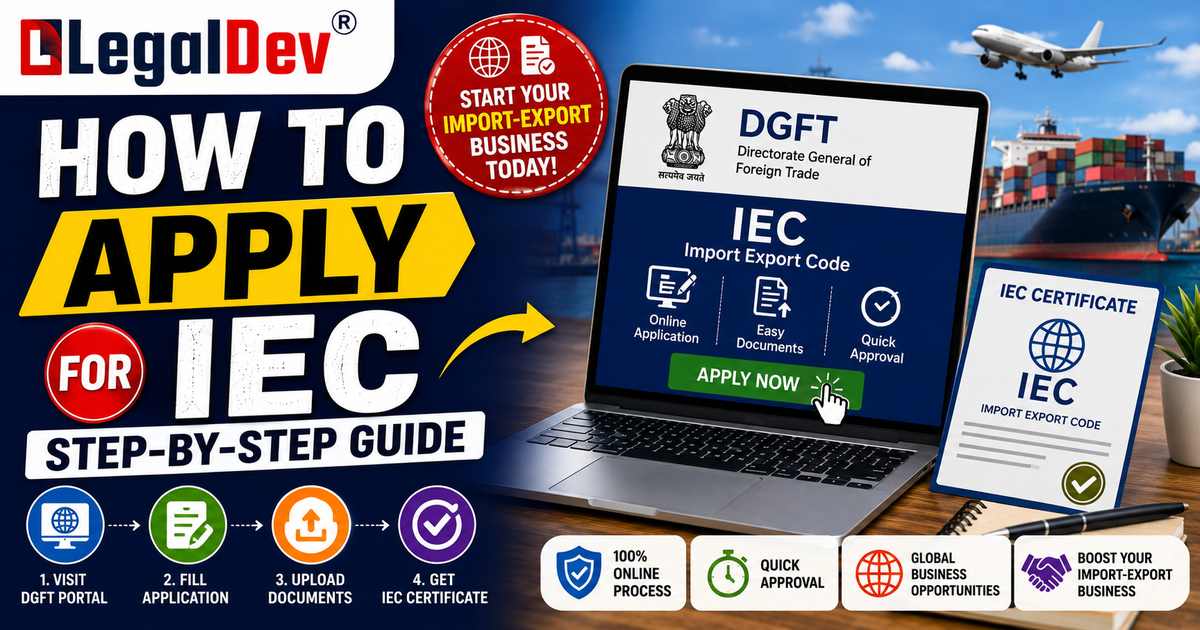
How to Apply for IEC
Applying for an Importer Exporter Code takes about 15 minutes on the DGFT portal and, with documents in order, the code itself is typically issued within 1 to 3 working days. It's entirely online, there's no physical office visit involved, and the application asks for surprisingly little: your PAN, a bank account, address proof, and a way to digitally sign the form, either a Digital Signature Certificate or Aadhaar-based e-Sign. What most application guides leave out is what happens after you get the code, since an IEC now requires an annual confirmation on the DGFT portal to stay active, a rule that didn't exist before 2021 and still catches a lot of businesses off guard.
This page is part of the same cluster as our Importer Exporter Code Registration guide, which covers IEC broadly, its purpose, eligibility, and benefits. If you're looking for why IEC matters for a global trade business specifically, our guide to why IEC is essential for global trade covers that separately. This page is entirely the practical how-to: the exact steps, documents, and fees to actually get your IEC issued, plus the compliance step that keeps it usable afterward.
Quick Answer: How to Apply for IEC
-
Visit the DGFT portal (dgft.gov.in) and register for a portal account using your PAN and mobile/email.
-
Navigate to "Apply for IEC" under Services.
-
Fill in your firm's details, name, address, bank account, and nature of business (proprietorship, partnership, LLP, company, and so on).
-
Upload the required documents: PAN, address proof, and a cancelled cheque or bank certificate.
-
Sign digitally, using a Class 3 Digital Signature Certificate, or Aadhaar-based e-Sign for eligible applicant types.
-
Pay the government fee, currently Rs. 500, online through the portal.
-
Once approved, your e-IEC certificate is generated and can be downloaded directly from the portal, typically within 1 to 3 working days.
-
Remember the annual update. Every IEC holder must log in and confirm or update their details on the DGFT portal between 1 April and 30 June every year, or the IEC gets automatically deactivated from 1 July.
Who Actually Needs to Apply
Anyone importing goods into India or exporting goods from India commercially needs an IEC before that trade can happen; customs won't clear a shipment without one attached to the transaction. This applies broadly across entity types, proprietorships, partnerships, LLPs, private and public companies, trusts, HUFs, and societies can all apply, provided the underlying entity is validly registered or constituted.
One exception worth knowing: exporters of services generally don't need an IEC, unless they're specifically availing benefits or incentives under the Foreign Trade Policy, in which case IEC becomes necessary even for a pure services business. A software consultancy invoicing only foreign clients, for instance, typically doesn't need an IEC purely to receive that income, but would need one to claim any FTP-linked export incentive tied to that revenue.
Before You Start: What You'll Need Ready
-
PAN of the applicant, individual or entity, since post-GST, the IEC number is functionally aligned with the applicant's PAN.
-
A registered bank account in the name of the business, with a cancelled cheque or a bank certificate confirming the account details.
-
Proof of business premises, a rent agreement, sale deed, or a recent utility bill, in the name of the business or a director/partner.
-
Proof of constitution, a partnership deed, incorporation certificate, or registration certificate, matching the entity type applying.
-
A way to digitally sign the application, a Class 3 DSC for the authorised signatory, or Aadhaar-based e-Sign, which is available for individual and proprietorship applicants specifically, and considerably simpler if you qualify for it.
Step-by-Step: Applying for IEC on the DGFT Portal
-
Create or log into your DGFT portal account. New users register with PAN, a mobile number, and an email address, verified through OTP.
-
Select "Apply for IEC" from the Services menu.
-
Enter your firm's profile details: legal name, PAN, nature of business, and constitution type.
-
Enter your registered office and branch details, including the state and address, which determine your jurisdictional Regional Authority for any future correspondence.
-
Enter bank account details and upload the cancelled cheque or bank certificate as proof.
-
Declare the directors, partners, or proprietor, along with their PAN and identity details.
-
Upload the supporting documents described above, address proof and constitution proof matched to your entity type.
-
Digitally sign the application using your DSC or Aadhaar e-Sign.
-
Pay the government fee (currently Rs. 500) online through the portal's integrated payment gateway.
-
Submit and track your application using the generated application reference number. Once approved, the e-IEC is available for immediate download from your DGFT portal dashboard.
Documents Required, by Entity Type
While the core document list, PAN, address proof, bank proof, stays consistent, the constitution proof changes by entity type:
-
Proprietorship: proprietor's PAN and identity proof; no separate registration document is typically needed beyond this.
-
Partnership firm: the partnership deed, along with the firm's PAN.
-
LLP or company: the Certificate of Incorporation, along with the entity's PAN.
-
Trust or society: the trust deed or society registration certificate.
Across every entity type, address proof, ideally in the business's name, or accompanied by a No Objection Certificate if it's in an individual's name, and the cancelled cheque or bank certificate remain constant requirements.
Fees and Processing Time
The government filing fee for a fresh IEC application is Rs. 500, paid online at the time of submission, with no separate fee for the certificate itself once issued. Processing is generally fast for a complete, correctly documented application, typically 1 to 3 working days, since the process is largely digital and doesn't route through a manual physical verification step for most applicants. Incomplete documentation, a mismatched bank certificate name, or an address proof that doesn't clearly establish the business's connection to the premises, are the most common reasons an otherwise routine application takes longer than expected.
The Part Most Guides Skip: The Mandatory Annual Update
This is genuinely important, and it's the reason a "how to apply" search shouldn't stop at the certificate download step. Since DGFT Notification No. 58/2015-2020, dated 12 February 2021, every IEC holder has been required to log into the DGFT portal and confirm or update their IEC details once every financial year, between 1 April and 30 June, regardless of whether anything has actually changed.
-
If nothing has changed, the confirmation itself is free.
-
If you're updating details, address, bank account, directors, a nominal government fee of Rs. 200 applies.
-
Miss the 30 June deadline, and the IEC is automatically deactivated from 1 July, with no grace period or advance warning beyond DGFT's periodic public reminders.
A deactivated IEC isn't cancelled permanently, but the practical disruption is real: customs won't clear shipments against it, banks won't process international trade payments tied to it, and any pending export incentive claims freeze until it's reactivated. Reactivation happens by simply completing the overdue update on the portal, but the "Active" status can take a few working days to propagate across connected systems like ICEGATE, during which trade activity against that code stays blocked. For a business with cargo already moving, that delay can cost far more than the update itself ever would have. Setting a recurring reminder for early April, rather than waiting until the June deadline approaches, is the simplest way to avoid this entirely.
Common Mistakes When Applying for IEC
-
Submitting a bank certificate or cancelled cheque where the account name doesn't clearly match the applying entity's registered name.
-
Uploading address proof that doesn't establish a clear connection to the business, particularly for home-based or early-stage businesses operating from a residential address without an NOC where one might be needed.
-
Assuming IEC is a one-time task with nothing further required, and missing the annual April-to-June update entirely, only discovering the deactivation when a shipment gets held at customs.
-
Applying for IEC when only exporting services, without checking first whether an FTP incentive is actually being claimed, in which case the IEC may not have been necessary at all.
-
Using an expired or improperly configured DSC at the signing step, causing the application to fail submission despite every other field being correctly filled.
Frequently Asked Questions
How long does it take to get an IEC?
Typically 1 to 3 working days for a complete, correctly documented application, since the process is fully digital with no routine physical verification step.
What is the government fee for an IEC application?
Rs. 500 for a fresh application. The annual update afterward is free if you're only confirming existing details, or Rs. 200 if you're modifying them.
Do I need a Digital Signature Certificate to apply for IEC?
A Class 3 DSC is the standard route, but Aadhaar-based e-Sign is available for individual and proprietorship applicants, which is generally simpler and avoids the separate cost and setup of obtaining a DSC.
Does every exporter need an IEC?
Exporters of goods, yes, without exception. Exporters of pure services generally don't need one, unless they're claiming benefits or incentives under the Foreign Trade Policy, in which case an IEC becomes necessary regardless of the services-only nature of the business.
What happens if I forget to update my IEC every year?
It gets automatically deactivated from 1 July if the update isn't completed by 30 June. A deactivated IEC blocks customs clearance and international trade payments until the overdue update is completed and the code is reactivated, which itself can take a few working days to fully propagate.
Can I use my IEC immediately after downloading the e-IEC certificate?
Yes. Once issued, the e-IEC is valid for use immediately, there's no separate activation step. It stays valid for the lifetime of the business, subject to completing the annual confirmation each financial year.
Get Your IEC Issued Without the Back-and-Forth
A single mismatched document, an address proof that doesn't clearly connect to the applying entity, or a bank certificate with the wrong name, is often the entire difference between a 1-day approval and a week of resubmission. LegalDev handles IEC applications end to end, and tracks the annual DGFT update deadline on your behalf so a missed confirmation never catches your business off guard. See our Importer Exporter Code Registration service to get started.