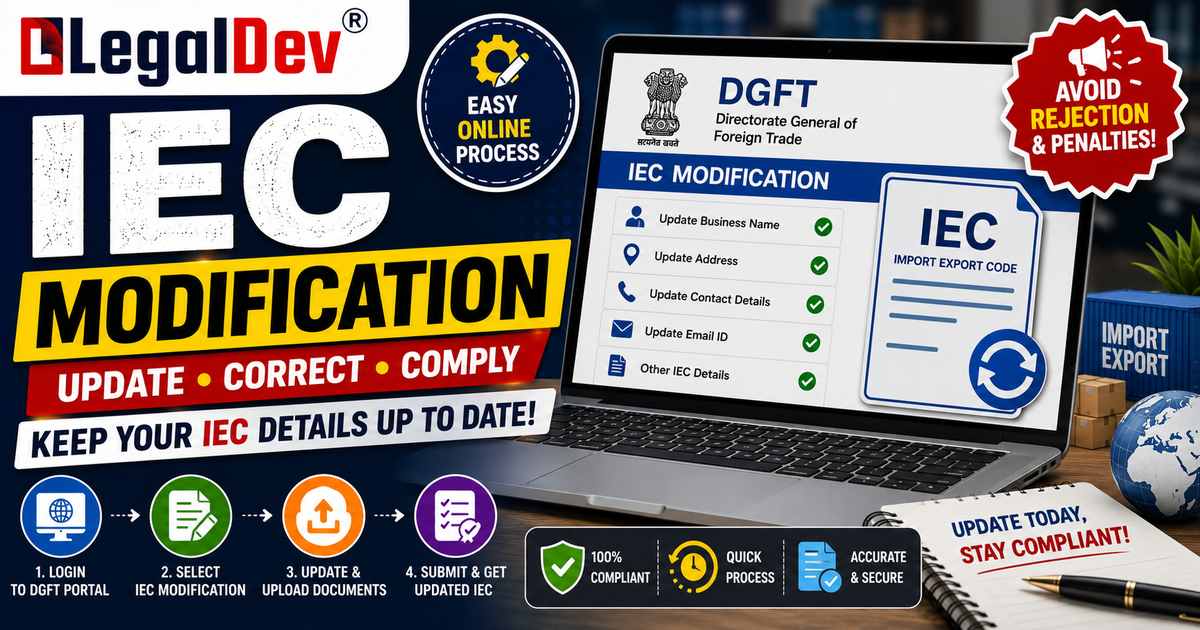
IEC Modification
IEC modification is how you update your Importer Exporter Code whenever your business details change, a new office address, a different bank account, a partner joining or leaving, at any point during the year, not on a fixed schedule. This is a distinct process from the mandatory annual update every IEC holder completes between April and June, which confirms your details are current, not necessarily changes them. Modification, by contrast, is what you use the moment something actually changes, entirely online, through the DGFT portal, with the same 10-digit code retained throughout.
This page is part of the same cluster as our Importer Exporter Code Registration guide, and our How to Apply for IEC guide, which covers getting a fresh IEC issued for the first time. This page picks up from there: what to do once your IEC exists and something about your business changes.
Quick Answer: IEC Modification
-
IEC modification updates existing details, address, bank account, directors or partners, business name, or nature of business, on your already-issued IEC.
-
It can be done anytime during the year, unlike the mandatory annual update, which is confined to the 1 April to 30 June window.
-
The government fee is Rs. 200 per modification submission.
-
Your IEC number never changes. Modification updates the details attached to it; it doesn't issue a new code.
-
PAN cannot be modified. If your business's PAN changes, converting a proprietorship into a private limited company, for instance, a fresh IEC application is required instead of a modification.
-
Processing typically takes 3 to 7 working days, once submitted with complete, correctly matched documentation.
Modification vs the Annual Update: Not the Same Thing
These two get confused constantly, largely because both live under the same "IEC Profile Management" section of the DGFT portal and both can involve updating identical fields. The distinction that actually matters:
-
The annual update is a mandatory, time-bound confirmation every IEC holder completes once a year, between 1 April and 30 June, even if nothing has changed. Missing it deactivates the IEC entirely from 1 July.
-
Modification is an as-needed change you make whenever your actual business details change, available year-round, with no fixed window and no deactivation risk tied to it directly.
In practice, the two overlap: if you modify your address in October, that updated detail simply carries into the following April-June annual confirmation, you don't need to modify it again separately at that point. But a business that only ever completes its annual update, without separately filing a modification whenever a real change happens, risks carrying outdated information on record for up to 12 months, which can itself surface as a mismatch during a customs check or a bank verification, well before the next annual update cycle would have caught it.
When You Actually Need to Modify Your IEC
-
Change of business address, whether relocating the registered office or adding a new branch location.
-
Change of bank account, closing an old account or opening a new one used for trade transactions.
-
Addition or removal of a director, partner, proprietor, or managing trustee, reflecting the current ownership or management structure.
-
Change of legal business name, following a rebrand or a formal name change through the relevant registering authority.
-
Change in the nature of business, for instance, shifting from a merchant exporter to a manufacturer exporter, which DGFT tracks as a distinct classification.
-
Update to contact details, a changed email address or phone number used for official DGFT correspondence.
Leaving any of these unmodified doesn't just create a paperwork inconsistency. A mismatch between your IEC's recorded address or bank details and what's actually being used on a shipping document or a trade remittance is a common trigger for a customs hold or additional bank scrutiny, exactly the kind of delay a routine modification, done promptly, avoids entirely.
What You Cannot Modify: PAN
This is the one field modification genuinely can't touch, and it's worth understanding why. Since the IEC is functionally tied to the applicant's PAN post-GST, a change in PAN isn't treated as a detail update at all, it's treated as a change in the underlying legal entity. The most common real-world trigger is a business restructuring, a sole proprietorship converting into a private limited company, for example, which comes with an entirely new PAN.
In this situation, there's no modification path available. The correct route is applying for a fresh IEC under the new PAN, following the same process covered in our How to Apply for IEC guide, rather than attempting to carry the old code forward. This mirrors a similar rule on the GST side, where a GSTIN's PAN can't be edited either; cancellation and reapplication is the standard route whenever a business's core legal identity changes, not an amendment to the existing record.
Step-by-Step: How to Modify Your IEC Online
-
Log into the DGFT portal (dgft.gov.in) using your registered credentials, the same login used when the IEC was originally issued.
-
Navigate to Services → IEC Profile Management → Update/Modify IEC. The portal loads your existing profile exactly as it currently stands.
-
Edit the specific field that's changed, address, bank details, director information, business name, or nature of business, leaving everything else untouched.
-
Upload supporting documents for the specific change, matched to what's being updated (details below).
-
Verify every field for accuracy, particularly ensuring updated details match what's on record with GST and PAN, since a mismatch between these systems is a common source of downstream friction.
-
Sign digitally, using your Class 3 DSC or Aadhaar e-Sign.
-
Pay the Rs. 200 government fee and submit.
-
Track the application through your DGFT dashboard using the generated reference number. Once approved, the updated details reflect on your IEC profile and the revised e-IEC certificate is available for download.
Documents Needed, by Modification Type
-
Address change: updated proof of the new premises, an electricity bill, rent agreement, or property document, in the business's name or accompanied by an NOC.
-
Bank account change: a cancelled cheque or bank certificate for the new account, clearly showing the account holder's name matching the IEC-registered entity.
-
Director or partner change: the relevant appointment or resignation document (board resolution, revised partnership deed), along with identity proof of the incoming individual.
-
Business name change: the underlying legal document establishing the new name, a fresh Certificate of Incorporation for a company, or an updated partnership deed for a firm.
-
Nature of business change: supporting documentation reflecting the shift, for instance, manufacturing licences or facility details if moving from a merchant exporter to a manufacturer exporter classification.
As a general rule, documentation for a modification mirrors what would have been required had that detail been submitted at the time of original application, just for the specific field being changed rather than the entire profile.
Fee and Processing Time
The DGFT government fee for an IEC modification is Rs. 200 per submission, paid online at the time of filing. Processing generally takes 3 to 7 working days once submitted with complete, matching documentation. A modification with an unclear or mismatched document, a bank certificate under a slightly different name spelling than the registered entity, for example, is the most common reason processing extends beyond this window.
What Happens After You Submit
The modification application routes to the jurisdictional Regional Authority for review. Assuming the documentation supports the change clearly, approval and reflection on your IEC profile typically follow within the standard processing window without further correspondence. If something needs clarification, the Regional Authority raises a query through the portal, which you'll need to respond to before the modification can be finalised. Throughout this process, your existing IEC number stays exactly the same, modification only ever changes the details attached to that number, never the number itself.
Common Mistakes When Modifying an IEC
-
Confusing modification with the annual update, and assuming a change made in, say, October automatically satisfies the following April-June confirmation requirement on its own, when both still need to be tracked and completed on their own separate terms.
-
Letting a real change go unmodified until the next annual update rolls around, carrying a mismatch on record for months in the meantime.
-
Attempting to modify PAN rather than recognising a PAN change requires a fresh IEC application entirely.
-
Submitting documents with a name or spelling mismatch against the entity's PAN or GST records, a frequent, avoidable cause of processing delays.
-
Forgetting to update linked records elsewhere. An IEC address change doesn't automatically update your GST registration or company records; each system requires its own separate amendment.
Frequently Asked Questions
Is IEC modification the same as the mandatory annual update?
No. Modification is an as-needed change you file whenever a business detail actually changes, available anytime during the year. The annual update is a separate, mandatory confirmation every IEC holder completes between 1 April and 30 June, even without any actual change, to keep the IEC active.
How much does it cost to modify an IEC?
The DGFT government fee is Rs. 200 per modification submission, in addition to any professional service fee if you're using a consultant to handle the filing.
How long does IEC modification take?
Typically 3 to 7 working days for a complete, correctly documented submission. Mismatched or unclear supporting documents are the most common reason it takes longer.
Does my IEC number change after a modification?
No. Your 10-digit IEC number remains permanently the same. Modification only updates the details, address, bank account, directors, associated with that existing number.
Can I modify the PAN on my IEC?
No. PAN is treated as a core identity field, not an editable detail. If your business's PAN genuinely changes, most commonly due to a restructuring like converting a proprietorship into a company, a fresh IEC application is required instead of a modification.
Do I need a Digital Signature Certificate to modify my IEC?
A Class 3 DSC is the standard route, though Aadhaar-based e-Sign is available for eligible applicant types, generally proprietorships and individuals, as a simpler alternative.
Get Your IEC Details Updated Correctly
An address or bank mismatch on your IEC is exactly the kind of small inconsistency that surfaces at the worst possible moment, mid-shipment, during a customs check, or when a bank flags a trade payment for verification. LegalDev handles IEC modifications alongside fresh applications and the mandatory annual update, so your IEC profile stays accurate year-round. See our Importer Exporter Code Registration service to get started, or read our How to Apply for IEC guide if your business's PAN has changed and you need a fresh IEC rather than a modification.