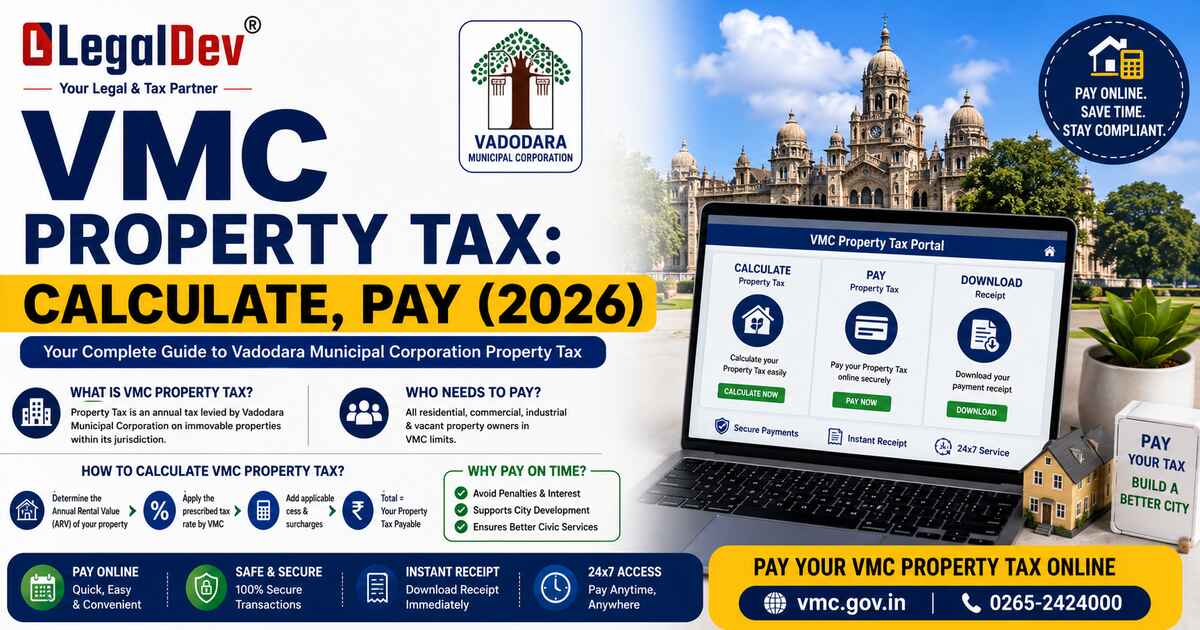
VMC Property Tax: How to Calculate, Pay, and Avoid Penalties in Vadodara
If you own property in Vadodara, the VMC property tax is something you simply cannot ignore. The Vadodara Municipal Corporation collects this local tax from property owners across the city — and whether you pay it online from your phone or walk into their office, the process is simpler than most people expect.
Here's everything you need to know.
Vadodara Property Tax Due Dates — Mark These in Your Calendar
Property tax in Vadodara is paid semi-annually. The two due dates are 31st March and 15th October every year.
Miss either of these, and you're looking at penalties. More on that below.
How to Pay VMC Property Tax Online
The online route is the faster one, and most people prefer it. Here's how to do it:
Step 1: Go to the official Vadodara Municipal Corporation website.
Step 2: Scroll down and click on "Citizen Services."
Step 3: From the options on the next page, select "Property Tax."
Step 4: Enter your 16-digit census number in the search box and click "Search."
Step 5: Your property details will appear — check the owner's information and the outstanding tax dues carefully.
Step 6: Click "Pay" and complete the payment using whichever mode suits you — credit card, debit card, net banking, UPI, whatever works.
Step 7: Once payment is done, head to the "Owner Details" tab to verify the transaction.
After that, you can opt for the VMC property tax receipt download directly from the portal. Keep it. You'll need it for future reference.
How to Pay VMC Property Tax Offline
Not everyone wants to deal with websites. The offline mode works just as well.
Visit the Vadodara Municipal Corporation office, ask the official for your property tax details and the amount due, submit your documents, and pay. They'll hand you an acknowledgement receipt — don't walk out without it.
How Is Vadodara Property Tax Calculated?
The VMC property tax calculation follows a specific formula:
VMC Property Tax = R × M × A
Breaking it down:
R is the annual tax rate applicable to your property. Residential properties are taxed at ₹16 per sq. metre per annum. Non-residential properties — shops, offices, commercial spaces — are taxed at ₹30 per sq. metre per annum.
M is a composite multiplier made up of four factors:
M = Age Factor × Location Factor × Usage Factor × Occupancy Factor
The age factor depends on how old the property is — older buildings typically get a lower factor. The location factor reflects where exactly the property sits within Vadodara. The usage factor tells the system whether your property is residential or commercial. And the occupancy factor depends on whether the property is self-occupied or rented out.
A is the total taxable area of your property. Under Vadodara tax measurement rules, this means the full property area excluding internal and external walls.
Put it together, and that's your annual Vadodara property tax figure.
Penalties for Late Payment — Don't Let This Sneak Up On You
Missing your VMC property tax due date is an expensive mistake.
The penalty is 18% annual interest on the unpaid amount. On top of that, a notice fee of 0.50% applies, along with a 25% Education Cess on the overdue tax.
So you're not just paying what you owed — you're paying significantly more. The penalty is an addition to the original tax, not a replacement. Pay on time. It's genuinely not worth the extra cost.
Are There Any Property Tax Exemptions in Vadodara?
Yes. The Vadodara Municipal Corporation extends property tax exemptions to Charitable Educational Institutions and Medical Institutions, within prescribed limits. If your property falls under either category, it's worth checking directly with VMC on the exact exemption applicable to your case.
How to Check Your VMC Property Tax Payment History
Already paid and want to verify? Go back to the Vadodara Municipal Corporation website, enter your 16-digit census number, and check the payment history under the Owner Details section. Everything you've paid gets recorded there.
How to Challenge a VMC Property Tax Assessment
If you think your property has been assessed incorrectly — maybe the area is wrong, or the usage factor doesn't apply — you can formally dispute it.
First, review your assessment carefully and identify exactly what's incorrect. Gather whatever supporting documents you have. Then file a written complaint with the Vadodara Municipal Corporation, including all relevant evidence.
VMC will schedule a hearing. You'll need to attend and present your case. If the Corporation agrees that your property was over-assessed, they may revise the assessment — and refund any amount you overpaid.
It takes some effort, but it works.
When Does a Property Get Removed From Assessment?
A property is delisted from assessment when it's completely unoccupied or has been destroyed — by fire, earthquake, or any other calamity. That said, the residual open plot still remains liable for applicable taxes.
FAQs
Q: What is the VMC property tax census number, and where do I find it?
A: The 16-digit census number is the unique identifier assigned to your property by the Vadodara Municipal Corporation. You'll find it on any previous VMC property tax bill or receipt. Without it, you can't search for your property details on the VMC portal — so keep that number handy.
Q: How do I download my VMC property tax receipt after paying online?
A: After completing your payment on the Vadodara Municipal Corporation website, go to the "Owner Details" tab and verify the transaction. From there, you can download the VMC property tax receipt directly. It's advisable to save a digital copy as well as a printed one.
Q: Can I pay VMC property tax in installments?
A: VMC property tax is structured as a semi-annual payment — due on 31st March and 15th October each year. There's no formal monthly installment option. However, paying on each due date effectively splits your annual tax into two payments, which many property owners find manageable.
Q: What documents do I need to pay VMC property tax offline?
A: When visiting the Vadodara Municipal Corporation office for offline payment, carry your 16-digit census number, a valid ID proof, and any previous tax receipts if available. The official will pull up your property details and guide you through the payment process.
Q: Who pays property tax if the property is under dispute or co-owned?
A: In the case of rented property, the legal owner is always responsible for paying the VMC property tax — not the tenant. For co-owned properties, liability is typically shared between owners, but VMC holds all registered owners jointly accountable. It's best to sort out the internal arrangement separately from your VMC obligations.
Q: Can NRIs or absentee property owners pay VMC property tax online?
A: Yes. The VMC property tax online payment system is accessible to anyone with the correct census number and internet access, regardless of location. NRIs or owners living outside Vadodara can complete the full payment process from anywhere — and download the receipt digitally once done.
Q: What happens if I miss the 15th October property tax due date in Vadodara?
A: Missing the October due date triggers the same penalty structure as any other default — 18% annual interest on the unpaid amount, a 0.50% notice fee, and a 25% Education Cess. These charges are added on top of the original tax liability, so the final amount owed can grow significantly if left unresolved.
Q: Is there a helpline or contact number for VMC property tax queries?
A: The Vadodara Municipal Corporation has a dedicated citizen services desk and an official website where tax-related queries can be raised. For specific disputes or assessment-related issues, a written complaint to the Corporation is the recommended formal route.
Q: Can the VMC property tax amount change year over year?
A: Yes. The calculation factors — particularly the location factor, usage factor, and applicable tax rates set by the Corporation — can be revised. Any changes in the property's usage (say, converting residential to commercial) also directly affect the Vadodara property tax calculation under the R × M × A formula.
Q: What is the Education Cess charged on VMC property tax penalties?
A: The Education Cess is an additional charge of 25% levied by the Vadodara Municipal Corporation on the overdue property tax amount — specifically in cases of default. It applies alongside the 18% interest and 0.50% notice fee, making delayed payments considerably more expensive than paying on time.