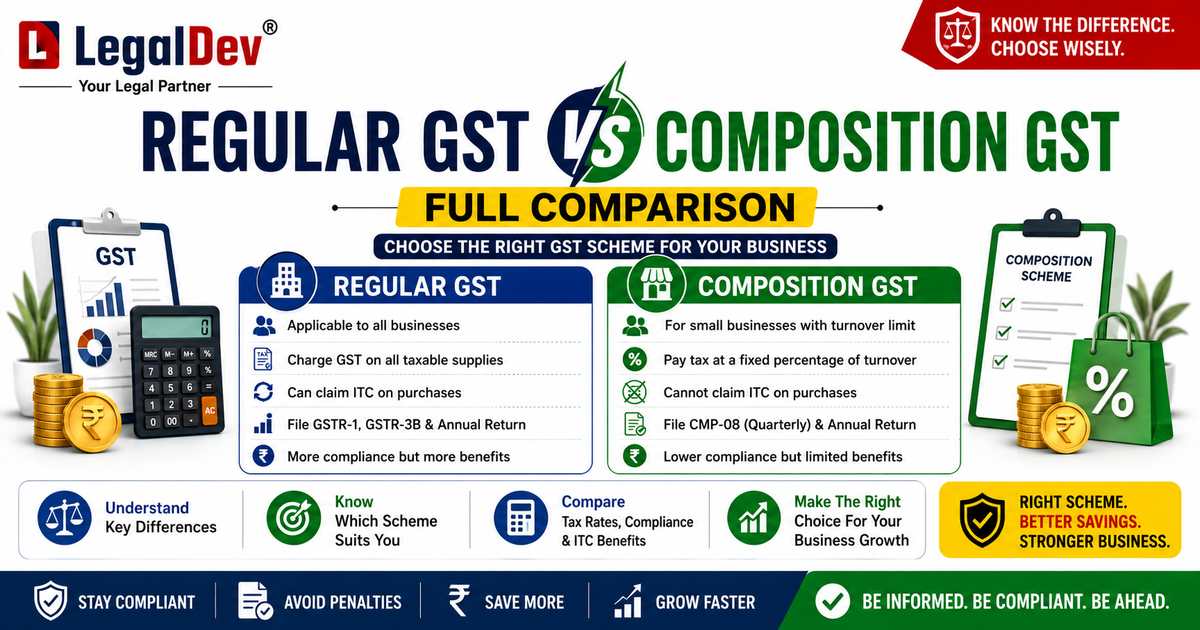
Regular GST vs Composition GST
Regular GST is the default framework every registered business falls into unless it specifically opts otherwise: standard slab rates (5%, 12%, 18%, or 28%), full input tax credit, and monthly or QRMP-based return filing. Composition GST, available under Section 10 of the CGST Act to businesses with turnover up to Rs. 1.5 crore (Rs. 75 lakh in special category states, Rs. 50 lakh for service providers), trades all of that for a flat 1% to 6% rate on turnover, filed quarterly, with no input tax credit and no inter-state sales allowed. The lower rate looks like the obvious win on paper. Whether it actually is depends almost entirely on how much GST you'd otherwise be claiming back as credit.
This page sits at the intersection of two clusters: our GST Registration guide, which covers registering a business for GST in the first place, and our GST Return Filing guide, which covers the filing obligations both schemes eventually lead to. This page exists to compare the two schemes head-on, since the choice between them affects registration, invoicing, and every return filed afterward, not just one part of the process.
Quick Answer: Regular vs Composition at a Glance
|
|
Regular GST
|
Composition GST
|
|
Turnover limit
|
No upper cap
|
Rs. 1.5 crore (Rs. 75 lakh special category states); Rs. 50 lakh for services
|
|
Tax rate
|
Standard slabs: 5%, 12%, 18%, 28%
|
Flat 1% (traders/manufacturers), 5% (restaurants), 6% (services)
|
|
Input tax credit
|
Full ITC on eligible purchases
|
Not available at all
|
|
Inter-state supply
|
Allowed
|
Not allowed
|
|
Selling via e-commerce
|
Allowed
|
Blocked for most notified services; restricted generally
|
|
Invoice type
|
Tax invoice, GST charged separately
|
Bill of Supply, no GST charged to the buyer
|
|
Returns filed
|
GSTR-1 and GSTR-3B monthly (or quarterly under QRMP)
|
CMP-08 quarterly, GSTR-4 annually
|
|
Buyer's ITC on your supply
|
Buyer can claim ITC
|
Buyer gets no ITC on your invoice
|
|
Best suited for
|
B2B businesses, inter-state sellers, high input-cost businesses
|
Small, local, B2C businesses with low input GST
|
What Regular GST Actually Means
Regular GST is the standard scheme every business registers under by default. Section 9 of the CGST Act governs the levy, and tax is charged at the applicable slab rate for whatever goods or services you supply, collected from the buyer, and remitted to the government after netting off input tax credit on your own purchases.
The defining feature is full input tax credit: GST paid on raw materials, inventory, rent, professional services, and most other business inputs can be claimed back against your output tax liability. This is what makes the regular scheme genuinely cost-neutral for a well-run business with meaningful input costs, the tax burden falls on the final consumer, not on the business itself, at least in principle.
Regular taxpayers file GSTR-1 (outward supplies) and GSTR-3B (summary and payment) every month, or quarterly under the QRMP scheme for businesses with turnover up to Rs. 5 crore. For the mechanics of how these two returns interact, including a 2025 change that tightened the relationship between them, see our GSTR-1 vs GSTR-3B guide.
What Composition GST Actually Means
The Composition Scheme, under Section 10 of the CGST Act, is an optional, simplified alternative built for small businesses that mostly sell locally to end consumers and don't have significant input tax credit to claim in the first place. Instead of standard slab rates, eligible businesses pay a flat percentage of turnover:
-
1% (0.5% CGST + 0.5% SGST) for traders and manufacturers.
-
5% (2.5% + 2.5%) for restaurant services not serving alcohol.
-
6% (3% + 3%) for other service providers, under the separate scheme introduced by Section 10(2A).
In exchange for this lower, simpler rate, composition taxpayers give up input tax credit entirely, can't make inter-state supplies, and can't collect GST from customers on their invoices at all, they issue a Bill of Supply, not a tax invoice.
Turnover Limits, in Detail
-
Traders, manufacturers, and restaurants (without alcohol): up to Rs. 1.5 crore in aggregate turnover, reduced to Rs. 75 lakh in special category states (the North-Eastern states and Himachal Pradesh).
-
Service providers, under the separate Section 10(2A) scheme introduced specifically to extend composition benefits to small service businesses: up to Rs. 50 lakh.
-
Mixed suppliers (goods plus a limited amount of services): a composition dealer whose primary business is goods can still supply services up to 10% of turnover, or Rs. 5 lakh, whichever is higher, without losing eligibility.
Turnover is calculated on an aggregate, PAN-wide basis, across every GSTIN registered under the same PAN, the same principle that applies to the standard GST registration threshold.
Who Cannot Opt for the Composition Scheme
Eligibility for composition isn't just about staying under the turnover cap. Section 10(2) specifically excludes several categories, regardless of turnover:
-
Manufacturers of notified goods such as ice cream, pan masala, and tobacco products.
-
Any business making inter-state outward supplies, even a single transaction.
-
Casual taxable persons and non-resident taxable persons.
-
Businesses supplying through an e-commerce operator, for most notified service categories, where the platform itself is liable to collect tax.
-
Suppliers of goods or services not leviable to tax under GST, or those making exempt supplies beyond specified limits.
A business that technically stays under Rs. 1.5 crore but occasionally ships an order to a customer in another state doesn't qualify for composition at all, this is a common miscalculation, since founders sometimes treat the turnover limit as the only test that matters.
The Real Trade-off: No Input Tax Credit
This is the decision that actually matters, more than the headline tax rate. A composition dealer pays GST on turnover regardless of how much GST they themselves paid on purchases, rent, raw materials, equipment, professional fees, none of it is recoverable. A regular taxpayer nets all of that off before arriving at what's actually owed.
For a business with genuinely low input costs, a small local service provider working mostly with their own labour, for instance, this rarely matters much, and the flat, low rate is close to a straightforward win. For a business with substantial input costs, a trader buying inventory that already carries 18% GST, or a manufacturer with significant raw material purchases, giving up ITC can make the "lower" composition rate more expensive in real terms than it looks on paper.
There's a second, often underweighted cost: your buyers lose ITC too. A composition dealer can't issue a tax invoice or charge GST separately, which means a business customer buying from a composition dealer gets no input tax credit on that purchase at all. For a supplier trying to sell into a B2B market, this alone can rule out composition regardless of the rate, corporate buyers often simply won't purchase from a vendor whose invoice provides no credit.
Invoicing: Bill of Supply vs Tax Invoice
A regular taxpayer issues a tax invoice, GST shown as a separate line item, which the buyer can use to claim credit. A composition taxpayer issues a Bill of Supply instead, which doesn't show GST separately at all, since the flat rate is absorbed into the price rather than charged on top of it. Composition invoices are also required to carry the specific declaration "composition taxable person, not eligible to collect tax on supplies", prominently displayed, so customers know upfront that no credit is available on the purchase.
Return Filing: A Genuinely Lighter Load
This is where composition's compliance appeal is most concrete. A regular taxpayer files up to 24 or more returns a year across GSTR-1 and GSTR-3B (monthly filers) or a mix of quarterly and monthly obligations under QRMP. A composition taxpayer files just five:
-
CMP-08, a simple, self-assessed quarterly statement of tax payable, due by the 18th of the month following each quarter.
-
GSTR-4, the annual return, due by 30 June following the financial year (extended from the earlier 30 April deadline).
Neither return requires invoice-level reconciliation against GSTR-2B the way regular filing does, since there's no ITC to reconcile in the first place. For a small business without dedicated finance staff, this difference in filing burden is often the single biggest reason composition gets chosen, sometimes even ahead of the tax-rate comparison itself.
Opting In, Opting Out, and What Happens When You Switch
-
Opting into composition, for an existing regular taxpayer, is done by filing Form CMP-02, typically before the start of the financial year (commonly by 31 March for the following year). New registrations can select composition at the point of registration itself.
-
Switching from composition back to regular, whether voluntary or triggered by crossing the turnover threshold, is filed through Form CMP-04. A voluntary exit can happen anytime; a mandatory exit due to breaching the turnover limit must be filed within seven days of the breach.
-
On exit, Form ITC-03 must be filed within 60 days, reversing the input tax credit position and declaring stock of inputs, semi-finished goods, finished goods, and capital goods as of the switch date, since the business now needs to re-establish an ITC baseline under the regular scheme.
-
On switching into composition from regular, the opposite happens: any ITC previously claimed on stock in hand has to be reversed, since composition dealers can't hold input credit going forward.
Timing matters here. A mid-year switch, particularly a mandatory one triggered by crossing the turnover cap, changes invoicing, tax collection, and return filing from the exact effective date, not from the start of a filing period, so getting the transition date right avoids a mismatch between what was actually charged to customers and what the return later shows.
Which One Should You Actually Choose?
-
Choose Regular GST if: you sell to other businesses that need ITC on their purchases, you supply inter-state, you sell through e-commerce platforms, or your input costs are high enough that ITC materially reduces your effective tax burden.
-
Choose Composition GST if: you sell mostly to individual, local, end consumers, your input costs are low relative to turnover, you're within the applicable turnover limit, and simpler quarterly filing is worth more to your business than ITC would be.
-
Reassess as you grow. A business that starts as a small, local composition dealer and later wins its first inter-state or B2B client needs to switch to regular GST at that point, not treat composition as a permanent structural choice. See our GST Registration for Service Providers guide if inter-state or platform-based service sales are part of your growth plan, since several service-specific exemptions interact with these same eligibility questions.
Common Mistakes When Choosing Between the Schemes
-
Picking composition purely for the lower headline rate, without modelling what's actually lost in unclaimed ITC.
-
Not realising a single inter-state sale disqualifies composition eligibility, even well within the turnover cap.
-
Selling to B2B clients under composition and then losing those clients once they realise no ITC is available on the purchase.
-
Missing the CMP-04 seven-day window after crossing the turnover threshold, and continuing to file as a composition dealer past the point of mandatory exit.
-
Forgetting to file ITC-03 when switching schemes in either direction, leaving the credit position on stock unreconciled.
Frequently Asked Questions
Can a business selling both goods and services opt for the composition scheme?
Yes, within limits. A primarily goods-based composition dealer can supply services up to 10% of turnover, or Rs. 5 lakh, whichever is higher, without losing eligibility. A primarily service-based business follows the separate Rs. 50 lakh, 6% scheme under Section 10(2A) instead.
Is the composition scheme always cheaper than regular GST?
Not necessarily. The flat rate is lower than standard slab rates, but composition dealers can't claim input tax credit at all. For businesses with high input costs, this lost credit can make the effective tax burden under composition higher than it appears from the rate alone.
Can a composition dealer sell to customers in another state?
No. Making any inter-state outward supply disqualifies a business from the composition scheme entirely, regardless of turnover. This is one of the most commonly overlooked eligibility conditions.
What happens if my turnover crosses the composition limit mid-year?
You must switch to the regular scheme, filing Form CMP-04 within seven days of crossing the threshold, and begin issuing tax invoices and filing GSTR-1 and GSTR-3B from that effective date. Form ITC-03 is also required within 60 days to reconcile the ITC position on existing stock.
Do composition dealers charge GST to their customers?
No. Composition dealers issue a Bill of Supply, not a tax invoice, and the flat rate is absorbed into the price rather than charged separately. The invoice must carry a declaration stating the seller is a composition taxable person not eligible to collect tax.
How many GST returns does a composition dealer file compared to a regular taxpayer?
A composition dealer files five returns a year: CMP-08 each quarter, plus one annual GSTR-4. A regular monthly filer can file 24 or more returns a year across GSTR-1 and GSTR-3B, though QRMP filers reduce this somewhat through quarterly filing with monthly tax payments.
Not Sure Which Scheme Fits Your Business?
The right choice depends on your customer mix, input costs, and growth plans, not the tax rate alone, and getting it wrong costs real money either way, either in unclaimed ITC under composition or unnecessary compliance overhead under the regular scheme. LegalDev helps businesses evaluate both schemes and handles registration and return filing for whichever one fits. See our GST Registration guide to register under either scheme, or our GST Return Filing service for ongoing CMP-08, GSTR-4, GSTR-1, or GSTR-3B filing support.