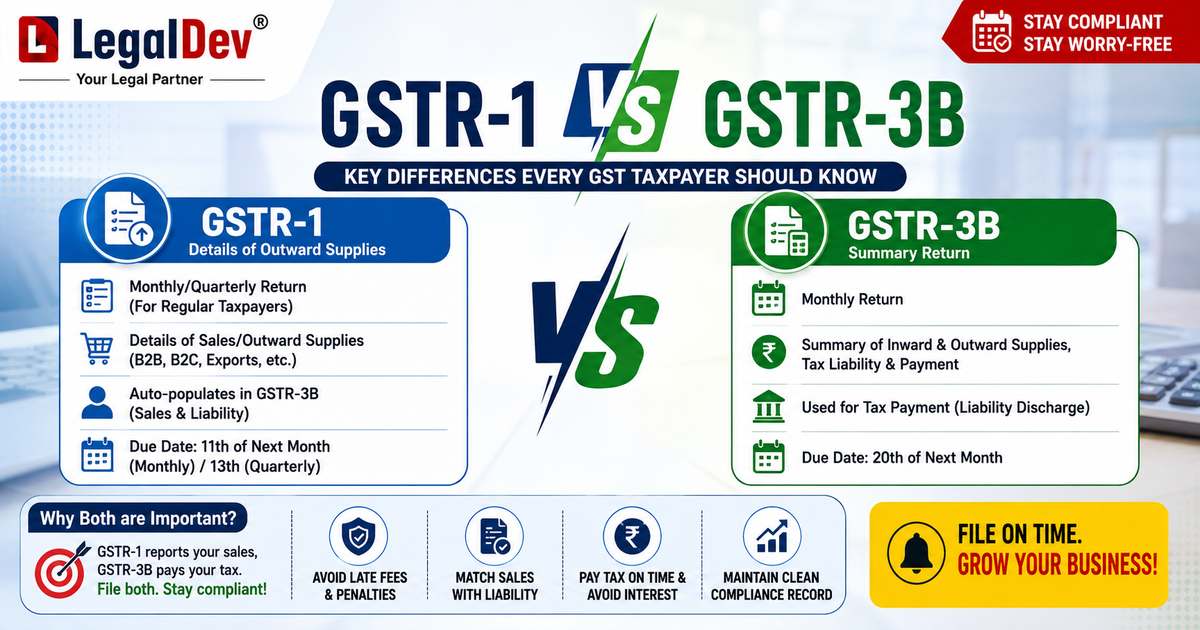
GSTR-1 vs GSTR-3B: What's the Difference?
GSTR-1 and GSTR-3B report the same underlying business activity, but they answer two different questions. GSTR-1 is an invoice-wise statement of every outward supply you made in a period, filed to tell the GST system, and your buyers, exactly what you sold. GSTR-3B is a summary return where you self-assess and actually pay your net tax liability. Both are mandatory for almost every regular taxpayer, both are filed monthly or quarterly depending on your scheme, and since July 2025, the two are locked together more tightly than ever: figures reported in GSTR-1 now flow into GSTR-3B as non-editable values, which changes how carefully GSTR-1 needs to be filed the first time.
This page sits inside the same cluster as our GST Return Filing guide, which covers every return type and the full filing process. If you're looking for a complete standalone walkthrough of GSTR-3B specifically, filing steps, format, and penalties, our GSTR-3B guide covers that in depth. This page exists purely to compare the two: what each one actually reports, how they connect, and the recent rule change that makes understanding that connection more important than it used to be.
Quick Answer: GSTR-1 vs GSTR-3B at a Glance
|
|
GSTR-1
|
GSTR-3B
|
|
What it reports
|
Outward supplies (sales), invoice-wise
|
Summary of outward supply, ITC claimed, and net tax payable
|
|
Level of detail
|
Invoice-level, transaction by transaction
|
Consolidated totals only
|
|
Tax payment
|
No tax is paid through this return
|
Tax is actually paid when this return is filed
|
|
Due date (monthly filers)
|
11th of the following month
|
20th of the following month (staggered to 22nd/24th for some states under QRMP)
|
|
Due date (QRMP filers)
|
Quarterly, with optional monthly IFF
|
Quarterly, by the 22nd or 24th depending on state category
|
|
Editable after filing?
|
Corrections go through GSTR-1A before GSTR-3B is filed
|
Auto-populated liability fields have been non-editable since July 2025
|
|
Feeds into
|
Buyers' GSTR-2B (their ITC claim) and your own GSTR-3B liability
|
Nothing downstream; it's the final payment step
|
|
Late fee basis
|
Per day of delay, based on turnover slab
|
Per day of delay, plus interest on unpaid tax
|
What GSTR-1 Actually Is
GSTR-1 is a statement of outward supplies, every sale, every invoice, credit note, and debit note you issued during the period, reported individually rather than as a lump sum. It doesn't involve a tax payment; its entire purpose is disclosure, telling the GST system exactly what you sold, to whom, and at what value and rate.
-
Monthly filers submit GSTR-1 by the 11th of the following month.
-
QRMP scheme filers (turnover up to Rs. 5 crore, opting for quarterly filing) submit GSTR-1 quarterly, but can optionally use the Invoice Furnishing Facility (IFF) in the first two months of the quarter to upload B2B invoices early, so buyers can claim ITC without waiting for the full quarter to close.
Because GSTR-1 is invoice-level, it's what your buyers' GST portals actually read from to build their own input tax credit position. An invoice missing from your GSTR-1, or entered with the wrong GSTIN, doesn't just affect your own compliance, it directly blocks your buyer's ITC claim for that invoice.
What GSTR-3B Actually Is
GSTR-3B is a self-assessed summary return. Rather than listing invoices individually, it consolidates outward supply values, eligible input tax credit, and reverse charge liability into a small set of totals, and this is the return where you actually calculate and pay net GST liability for the period.
-
Monthly filers submit GSTR-3B by the 20th of the following month in most cases, though due dates are staggered to the 22nd or 24th for certain state groups to spread portal load.
-
QRMP filers pay tax monthly through a simplified challan (PMT-06) for the first two months of the quarter, then file the actual GSTR-3B quarterly, by the 22nd or 24th depending on their state category.
Every registered taxpayer with active GST registration must file GSTR-3B for every period, including nil returns, with the notable exception of composition dealers and a small number of other categories that file separately.
Why the Filing Order Between the Two Matters
GST return filing isn't sequence-agnostic; Rule 59(6) of the CGST Rules blocks a taxpayer from filing GSTR-1 (or using the IFF) for a period if GSTR-3B for either of the two preceding periods hasn't been filed. In plain terms, falling behind on GSTR-3B doesn't just leave that period unpaid, it locks you out of filing GSTR-1 for the next period as well, which then blocks your buyers from claiming ITC on your invoices for that period too. This cascading effect is exactly why a single missed GSTR-3B tends to compound into a larger compliance backlog rather than staying an isolated, one-period problem.
The Change That Redefined the Relationship: Hard-Locking (July 2025)
For years, GSTR-3B auto-populated its outward supply figures from GSTR-1, but taxpayers could still manually edit those auto-filled numbers before submitting GSTR-3B, a safety net for catching a GSTR-1 error late. That safety net is gone. Per GSTN Advisory No. 606, dated 7 June 2025, from the July 2025 tax period onwards (returns filed from August 2025), the auto-populated liability fields in Table 3.1 and Table 3.2 of GSTR-3B became completely non-editable. A related advisory extended this to inter-state supply figures in Table 3.2 from the November 2025 tax period.
What this actually changes for filers:
-
GSTR-1 is now the single source of truth for outward supply liability. GSTR-3B exists purely to discharge whatever liability GSTR-1 (plus GSTR-1A and IFF) established, not to independently recalculate it.
-
Corrections must happen through Form GSTR-1A, a form introduced specifically for this purpose, filed after GSTR-1 but before GSTR-3B, for the same tax period. If an error in GSTR-1 isn't caught and fixed via GSTR-1A before GSTR-3B is filed, it can't be adjusted within that period's GSTR-3B at all.
-
An uncorrected error carries forward. A liability figure that should have been corrected gets reported in a later month's return instead, which can trigger interest for the delay, even though the underlying transaction happened earlier.
-
GSTR-1 accuracy now matters earlier in the process than it used to. Under the old system, a mistake in GSTR-1 could effectively be patched by adjusting GSTR-3B at the point of payment. That patch option is gone; the correction window is GSTR-1A, and it closes the moment GSTR-3B is filed.
This is the single most important shift in how GSTR-1 and GSTR-3B relate to each other in years, and it's still recent enough that plenty of published comparisons of the two returns haven't caught up with it.
How GSTR-1 Feeds Into Your Buyers' ITC (GSTR-2B)
The invoice-level detail in GSTR-1 doesn't just feed your own GSTR-3B, it also generates GSTR-2B for every buyer you invoiced, an auto-drafted statement of the input tax credit available to them based on what their suppliers reported. Since the shift to the Invoice Management System (IMS), buyers can accept, reject, or hold each invoice individually before it locks into their ITC claim. A late, missing, or incorrectly reported invoice in your GSTR-1 shows up as a gap or a rejected entry on your buyer's side, which is exactly why B2B clients tend to chase suppliers over GSTR-1 delays far more aggressively than over GSTR-3B delays; GSTR-1 accuracy is what determines whether their own credit claim goes through.
Late Fees and Interest: Different Consequences for Each Return
-
GSTR-1 late fees accrue per day of delay past the due date, based on turnover slabs, generally lower per-day amounts than GSTR-3B's, since GSTR-1 doesn't involve a tax payment. But a late GSTR-1 has a second-order cost: it delays your buyers' ITC, which can strain supplier relationships independent of the fee itself.
-
GSTR-3B late fees also accrue per day, but carry an additional cost GSTR-1 doesn't: interest on unpaid tax, generally 18% per annum, calculated on the outstanding liability from the due date until actual payment. This is usually the larger financial consequence of the two returns running late.
-
Filing GSTR-3B beyond three years from its due date is no longer permitted at all, under a time-bar restriction implemented on the GST portal effective from the July 2025 tax period. Returns that fall permanently out of reach past this window carry consequences well beyond a late fee, including potential registration cancellation.
Common Mistakes When Reconciling GSTR-1 and GSTR-3B
-
Treating GSTR-3B as an opportunity to "fix" GSTR-1 errors at payment time, an approach that no longer works for auto-populated liability fields since the July 2025 hard-locking change.
-
Missing the GSTR-1A correction window, filing GSTR-3B before catching and fixing a GSTR-1 mistake, which pushes the correction into a later period along with possible interest.
-
Filing GSTR-1 late and not realising it blocks the following period's filing too, under the Rule 59(6) sequential filing restriction.
-
Ignoring IMS action items on incoming invoices, letting supplier invoices sit unaccepted or unrejected, which distorts the buyer's own GSTR-2B-based ITC position.
-
Confusing GSTR-1's turnover-based late fee slabs with GSTR-3B's interest-plus-late-fee structure, and underestimating how much a delayed GSTR-3B actually costs compared to a delayed GSTR-1.
Frequently Asked Questions
Do I need to file both GSTR-1 and GSTR-3B every period?
Yes, for almost every regular taxpayer. GSTR-1 discloses what you sold; GSTR-3B is where you pay the tax on it. They serve different legal purposes and neither one substitutes for the other, including in periods with no sales, where a nil return for both is still required.
Which return has the tax payment, GSTR-1 or GSTR-3B?
GSTR-3B. No tax is paid when filing GSTR-1, it's purely a disclosure of outward supplies. Actual tax liability is calculated and paid through GSTR-3B.
Can I still edit GSTR-3B if I find an error in GSTR-1 after filing it?
Not for the auto-populated liability fields, since the July 2025 hard-locking change. Corrections have to go through Form GSTR-1A before GSTR-3B is filed for that period. Once GSTR-3B is filed, an uncorrected GSTR-1 error carries into a later period instead.
What happens if I file GSTR-3B late?
A late fee accrues per day, and separately, interest, generally 18% per annum, accrues on any unpaid tax from the due date until actual payment. A late GSTR-3B also blocks GSTR-1 filing for the following period under Rule 59(6).
Does a delay in my GSTR-1 affect my customers?
Yes. Your GSTR-1 data feeds directly into your buyers' GSTR-2B, which determines their eligible input tax credit. A delayed or inaccurate GSTR-1 can hold up your customers' ITC claims, independent of any late fee you personally pay.
What is GSTR-1A, and when do I use it?
GSTR-1A is the correction form introduced specifically to fix errors in a GSTR-1 already filed for the same period, before GSTR-3B is filed. It's the only route left to adjust outward supply figures once hard-locking took effect, since GSTR-3B itself can no longer be manually edited for these values.
Get Both Returns Filed Accurately, Every Period
With hard-locking now in effect, a small GSTR-1 mistake can no longer be quietly absorbed at the GSTR-3B stage, it has to be caught in the GSTR-1A window or it carries forward. LegalDev's team reconciles GSTR-1, GSTR-2B, and GSTR-3B every period before filing, so nothing slips through into a locked liability figure. See our complete GST Return Filing service for GSTR-1, GSTR-3B, and GSTR-9 filing support, or check your GST filing status instantly by GSTIN.