What Are the Jan Suraksha Schemes? (Quick Answer)
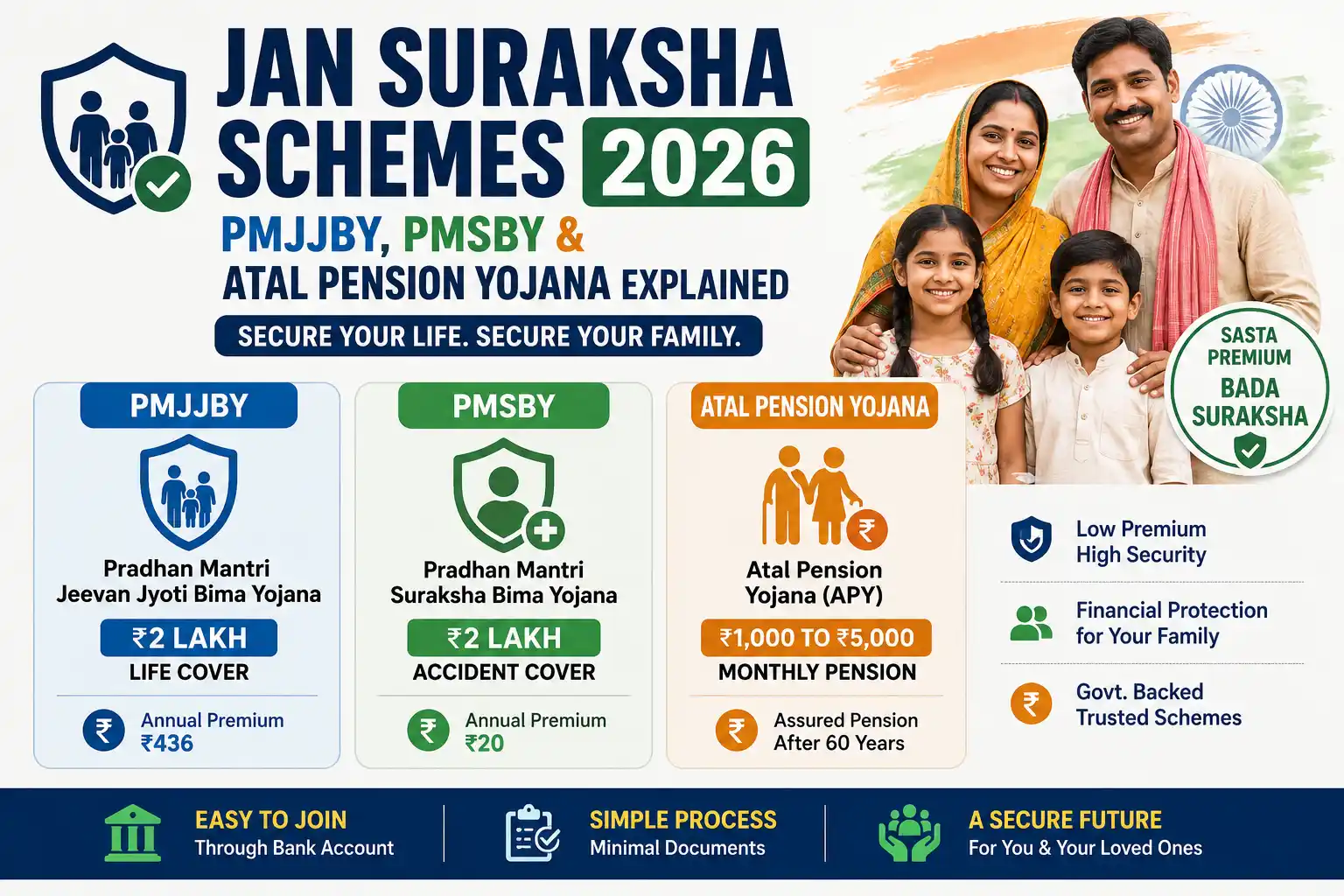
The Jan Suraksha Schemes are a set of three government-backed social security programmes: Pradhan Mantri Jeevan Jyoti Bima Yojana (PMJJBY) for life insurance, Pradhan Mantri Suraksha Bima Yojana (PMSBY) for accident insurance, and Atal Pension Yojana (APY) for retirement pension. Launched on 9 May 2015, any savings bank or post office account holder can enrol through auto-debit, and the combined premium for the two insurance schemes can run under ₹500 a year.
When a family's earning member dies suddenly or is disabled in an accident, most Indian households have no financial cushion to absorb the shock. That is the gap these schemes were built to close, for people who had never held an insurance policy or a pension account before.
As of 29 April 2026, the three schemes together have crossed 94 crore cumulative enrolments: 27.43 crore under PMJJBY, 58.09 crore under PMSBY, and 9.04 crore under APY. This guide walks through each scheme separately, its eligibility, premium, claim process, and the regulatory changes that came into effect in 2026.
PMJJBY: The Life Insurance Component
Pradhan Mantri Jeevan Jyoti Bima Yojana is a one-year renewable life insurance cover that pays out on death from any cause, whether illness, natural causes, or an accident. LIC and other participating life insurers run it in partnership with banks and post offices.
Key details:
Entry age: 18 to 50 years
Continued cover: subscribers who join before 50 can keep paying premiums and stay covered up to age 55
Annual premium: ₹436, auto-debited from the linked bank account
Sum assured: ₹2 lakh to the nominee, for death due to any cause
Policy year: runs from 1 June to 31 May
The premium was originally ₹330 when the scheme launched in 2015. It was revised to ₹436 from 1 June 2022, to keep the scheme financially sustainable. If you come across older content quoting ₹330, treat it as outdated.
One condition many people miss: first-time subscribers face a 30-day waiting period. During this window, only accidental death is covered, not natural or illness-related death. The waiting period applies again every time a member exits the scheme and later rejoins, which is why staying continuously enrolled matters.
As on 29 April 2026, PMJJBY had recorded 27.43 crore cumulative enrolments, and settled ₹21,512.50 crore across more than 10.75 lakh claims. Female enrolments stood at 12.72 crore, with 8.09 crore enrolments coming through Jan Dhan (PMJDY) accounts.
PMSBY: The Accident Insurance Component
Pradhan Mantri Suraksha Bima Yojana covers only accidental death and disability, not illness or natural death. That is why it is usually taken alongside PMJJBY rather than in place of it, since together they give more complete coverage.
Key details:
Entry age: 18 to 70 years
Annual premium: ₹20, auto-debited
Accidental death or total disability: ₹2 lakh
Partial disability (such as loss of one eye or one limb): ₹1 lakh
General insurance companies administer the scheme in partnership with banks and post offices
The premium was ₹12 at launch and was later revised to ₹20. As on 29 April 2026, cumulative enrolments had crossed 58.09 crore, making it one of the largest accident insurance schemes in the world. More than 1.84 lakh claims worth ₹3,667.52 crore have been settled. Female enrolments stood at 27.45 crore, and 19.30 crore enrolments came through Jan Dhan accounts.
Atal Pension Yojana: The Pension Component
APY is different from the other two because it is not insurance, it is a pension-building scheme. A subscriber makes a small monthly contribution during their working years and receives a guaranteed fixed pension after age 60. The Pension Fund Regulatory and Development Authority (PFRDA) regulates it under the National Pension System framework.
Key details:
Entry age: 18 to 40 years
Guaranteed monthly pension after 60: ₹1,000, ₹2,000, ₹3,000, ₹4,000, or ₹5,000, depending on the subscriber's chosen slab
Contribution frequency: monthly, quarterly, or half-yearly
Death before 60: the spouse can continue contributions or withdraw the accumulated corpus
Death after 60: the spouse continues receiving the same pension; once both have passed away, the corpus goes to the nominee
Age-wise monthly contribution chart (indicative):
|
Entry Age
|
₹1,000 pension
|
₹2,000 pension
|
₹3,000 pension
|
₹4,000 pension
|
₹5,000 pension
|
|
18
|
₹42
|
₹84
|
₹126
|
₹168
|
₹210
|
|
25
|
₹76
|
₹151
|
₹226
|
₹301
|
₹376
|
|
30
|
₹116
|
₹231
|
₹347
|
₹462
|
₹577
|
|
35
|
₹181
|
₹362
|
₹543
|
₹722
|
₹902
|
|
40
|
₹291
|
₹582
|
₹873
|
₹1,164
|
₹1,454
|
These figures are based on PFRDA's published contribution chart and are worth verifying live for your exact age, since intermediate ages carry slightly different figures.
As on 30 April 2026, APY had more than 9.04 crore subscribers, with women making up close to 49 percent, a sign that pension planning participation among women is rising.
Comparison Table: PMJJBY vs PMSBY vs APY
|
Feature
|
PMJJBY
|
PMSBY
|
APY
|
|
Covers
|
Death, any cause
|
Accidental death / disability
|
Old-age pension
|
|
Benefit
|
₹2 lakh to nominee
|
₹2 lakh / ₹1 lakh
|
₹1,000-₹5,000 a month
|
|
Yearly cost
|
₹436
|
₹20
|
Varies by age and pension chosen
|
|
Entry age
|
18-50
|
18-70
|
18-40
|
|
Regulator/admin
|
LIC and life insurers
|
General insurers
|
PFRDA
|
|
Waiting period
|
30 days (non-accidental)
|
None
|
Not applicable
|
|
Income-tax payers eligible?
|
Yes
|
Yes
|
No, since October 2022
|
Eligibility at a Glance
An active savings bank account or post office account is mandatory for all three schemes
PMJJBY: ages 18 to 50
PMSBY: ages 18 to 70
APY: ages 18 to 40, and since October 2022 income-tax payers cannot enrol
Even with multiple accounts, a person can hold only one PMJJBY and one PMSBY policy
Aadhaar and a registered mobile number should be linked to the account, for auto-debit and SMS updates
Documents Required
|
Document
|
PMJJBY / PMSBY
|
APY
|
|
Savings bank or post office account
|
Required
|
Required
|
|
Aadhaar card
|
Required (for KYC)
|
Required
|
|
Registered mobile number
|
For auto-debit consent
|
For auto-debit and SMS updates
|
|
Nominee details
|
Required
|
Required
|
|
Self-declaration of good health
|
Sometimes, on rejoining
|
Not applicable
|
|
Income-tax status declaration
|
Not applicable
|
Required, since October 2022
|
How to Apply: Step by Step
Online route: log in to your bank's net banking or mobile app, find the insurance or social security section, and select PMJJBY, PMSBY, or APY.
Confirm your Aadhaar and nominee details, then authorise the auto-debit mandate so the premium is deducted automatically.
Offline route: visit a bank branch, Business Correspondent point, or post office, fill the one-page consent-cum-auto-debit form, and submit it with your Aadhaar and a photo ID.
Regional-language forms can be downloaded from the Jan Suraksha portal (jansuraksha.gov.in) and submitted at your bank.
Keep the Certificate of Insurance you receive after the first deduction; it is your proof of cover.
How to Claim: Scheme-Wise Process
PMJJBY claim
Inform the bank branch where the account is linked, as soon as possible after the death.
Collect the claim form from the bank or the Jan Suraksha portal.
Attach the death certificate, the completed claim form, a discharge receipt, and a cancelled cheque or bank details.
The bank forwards the claim to the insurer, and settlement generally takes 2 to 4 weeks.
PMSBY claim
Inform the bank as soon as possible after the event.
Along with the death certificate, an accident proof is needed, such as an FIR or post-mortem report, and a disability certificate for disability claims.
Documents move from the bank to the insurer for settlement.
APY
APY does not work like an insurance claim. Once the subscriber turns 60, the pension starts automatically. If death occurs after 60, the spouse continues receiving the same pension; after both the subscriber and spouse have passed away, the accumulated corpus is transferred to the nominee.
Why Claims Get Rejected (and How to Avoid It)
Competitor pages mostly skip this topic or cover it in a single line. Some real reasons claims get delayed or rejected:
A name or spelling mismatch between the bank account, Aadhaar, and death certificate. Cross-check these details carefully at the time of enrolment.
A non-accidental death occurring within PMJJBY's 30-day waiting period, where the claim is not payable.
The renewal premium auto-debit failing because the account had insufficient balance, which lapses the policy, often without the family realising the cover has ended.
Rural families struggling to gather documents like an FIR or post-mortem report in time, causing the claim filing window to lapse.
Not updating nominee details after a life event such as marriage or the birth of a child.
2026 Updates You Should Know
APY extended till FY 2030-31: the Union Cabinet approved extending Atal Pension Yojana on 21 January 2026, so the scheme continues for both new and existing subscribers.
Income-tax payers excluded from APY: since October 2022, no income-tax payer can newly enrol in APY. If someone is later found to be a taxpayer, the account is closed and only the accumulated savings are returned.
11-year enrolment milestone: all three schemes completed 11 years on 9 May 2026, with combined enrolments crossing 94 crore.
Digitisation: the Jan Suraksha Portal now allows enrolment without a bank branch visit, and a digital claims process is speeding up settlements.
Common Mistakes People Make
One common misconception is that a ₹2 lakh payout will take care of a family's entire financial future. In reality it is only a starting cushion for the immediate shock, not enough for a home loan or a child's education expenses. Treat Jan Suraksha as a base layer, not the whole roof.
Another common mistake is forgetting the renewal date. Since the premium is auto-debited once a year (before 1 June), an account without enough balance lets the cover lapse quietly, and the family often only finds out when a claim is needed.
A third mistake is picking an APY pension slab without doing any real calculation. A lower contribution means a lower pension, which can look quite small against inflation 30 to 40 years down the line. Choose a slab based on your age and how much you can realistically set aside each month.
Jan Suraksha Schemes and Business Owners
If you run an MSME or are self-employed, the Jan Suraksha Schemes are useful for both you and your employees, since a formal employer-backed pension or group insurance is rare at smaller businesses. PMJJBY and PMSBY give employees basic protection without extra HR overhead, and APY can serve as an affordable starting point for retirement planning.
If your business handles international transactions or large-value dealings with banks, you may also need an LEI (Legal Entity Identifier) registration. On LegalDev, we cover the LEI registration process in detail, and if you need to verify an existing LEI, our LEI verification tool can help. If you work in the microfinance sector, our microfinance software compliance guide is also worth a read.
Frequently Asked Questions
What are the three Jan Suraksha Schemes?
PMJJBY provides life insurance, PMSBY provides accident insurance, and Atal Pension Yojana (APY) provides a retirement pension. Together they make up the Pradhan Mantri Jan Suraksha Yojana umbrella.
What is the premium for PMJJBY?
PMJJBY's annual premium is ₹436, auto-debited from the linked bank account. It provides ₹2 lakh of life cover for death due to any cause.
What is the premium for PMSBY?
PMSBY's annual premium is only ₹20. Full accidental disability or death pays ₹2 lakh, and partial disability pays ₹1 lakh.
What is the age limit for joining APY?
Bank account holders aged 18 to 40 can join APY. Since October 2022, income-tax payers are not eligible for this scheme.
What is the difference between PMJJBY and PMSBY?
PMJJBY covers death from any cause, including illness. PMSBY covers only accidental death or disability. Most people take both together, since the combined premium comes to just ₹456 a year.
How many Jan Suraksha policies can one person hold?
A person can hold only one PMJJBY policy and one PMSBY policy, even with multiple bank accounts. Enrolling separately in all three schemes is allowed.
What happens if my bank account has insufficient balance?
If the auto-debit fails on the renewal date, the policy lapses. You would need to re-enrol, and for PMJJBY a fresh 30-day waiting period would apply again.
How much pension does APY give?
Depending on the slab chosen, subscribers receive a fixed monthly pension between ₹1,000 and ₹5,000 after age 60. Joining earlier means a lower monthly contribution for the same pension.
What is the 30-day waiting period in PMJJBY?
For the first 30 days after enrolment, only accidental death is covered, not death from natural causes or illness. This period applies again on every fresh enrolment or rejoining.
Can NRIs join the Jan Suraksha Schemes?
NRIs can take PMJJBY if they hold an eligible bank account with a branch in India. PMSBY and APY are generally meant for resident Indians; it is best to confirm exact eligibility with your bank.
Is there a tax benefit for APY?
Yes, APY contributions qualify for deduction under Section 80CCD of the Income Tax Act, within the applicable limits.
How long does a PMJJBY claim take to settle?
Once the correct documents are submitted, PMJJBY claims are usually settled within 2 to 4 weeks through the bank and insurer.
How do I apply for a Jan Suraksha Scheme online?
Log in to your bank's net banking or mobile app, go to the insurance section, select the scheme, confirm your Aadhaar and nominee details, and authorise the auto-debit mandate.
Can I join APY at age 40?
Yes, APY's maximum entry age is 40, so account holders can join at that age too, provided they are not an income-tax payer.
What happens to APY if the subscriber dies before age 60?
The spouse can either continue contributions until the original subscriber would have turned 60, or withdraw the accumulated corpus.
What counts as partial disability under PMSBY?
Permanent loss of one eye or one limb counts as partial disability, which pays ₹1 lakh. Loss of both eyes or both limbs counts as total disability, which pays ₹2 lakh.
Should I keep a regular term insurance plan alongside PMJJBY?
Yes, PMJJBY is a base-level cover. Most financial planners suggest adding an adequate separate term insurance plan, since ₹2 lakh is rarely enough for larger families.
What is the Jan Suraksha portal?
jansuraksha.gov.in is the official government portal where enrolment forms, scheme details, and regional-language documents are available. It has simplified both enrolment and the claims process.
Can post office account holders enrol too?
Yes, post office savings account holders are eligible for all three schemes, on the same terms as bank account holders.
If I have multiple bank accounts, which one should I use to enrol?
Pick just one account for auto-debit, since enrolling through more than one account can invalidate the second policy and complicate the claims process.
How often do I need to contribute to APY?
Subscribers can choose to contribute monthly, quarterly, or half-yearly, whichever suits their income pattern.
Where can I file a complaint about a Jan Suraksha Scheme?
Start with the bank branch where the account is linked. If it isn't resolved, use the Jan Suraksha portal or the relevant insurer's or PFRDA's grievance redressal channel.
Can small business owners recommend Jan Suraksha Schemes to their employees?
Yes, since the premium is low and enrolment is simple, small businesses can recommend these schemes to employees as a low-cost social security benefit, as an alternative to formal group insurance.