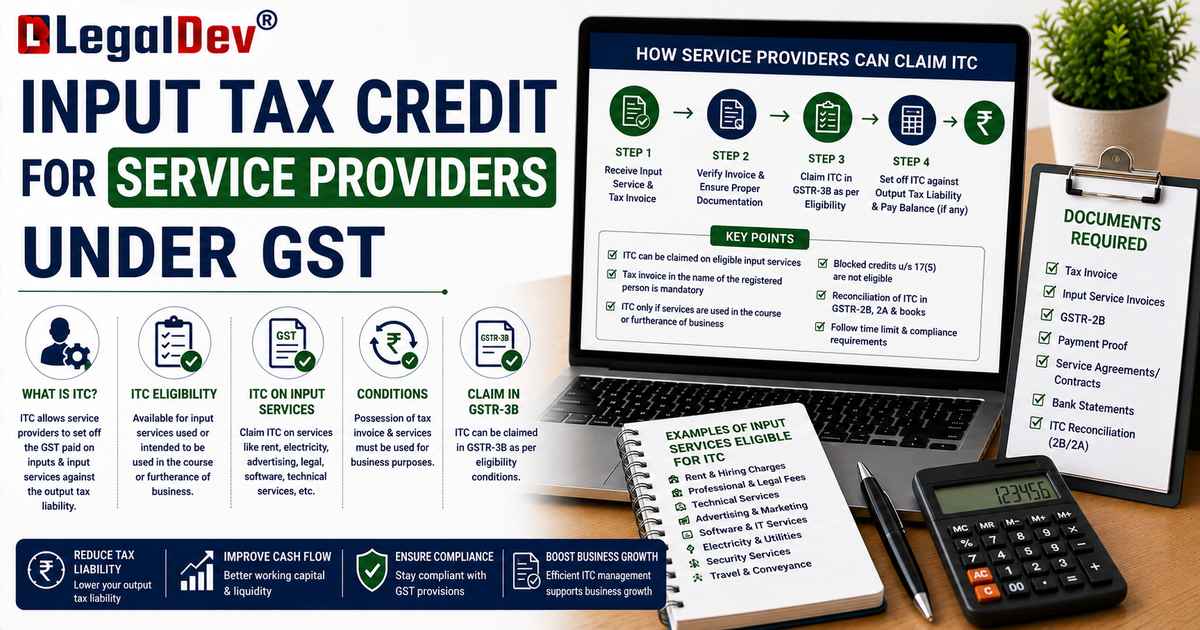
Input Tax Credit for Service Providers Under GST
Service businesses generally don't deal with inventory, raw material cycles, or physical stock reversals, which removes a big chunk of the ITC complexity that goods businesses face. What's left is mostly about input services, reverse charge, and a handful of office-expense categories that trip up service providers specifically.
Input services are the bulk of the claim
Where a manufacturer's ITC is dominated by raw material and a trader's by resale stock, a service provider's ITC mostly comes from input services — professional fees, software subscriptions, rent, telecom, marketing, and outsourced services used to deliver the core service. There's no equivalent of a "purchase register" tracking physical goods movement; the reconciliation instead centres on vendor invoices for services rendered.
Reverse charge is more common here than in most other business types
Several categories of input services attract GST under reverse charge mechanism (RCM) — legal services from an advocate, services from a director to the company, and certain services from unregistered vendors, among others. Under RCM, the service recipient (you) pays the GST directly instead of the supplier charging it, and then claims ITC on that self-paid tax, subject to the normal conditions. Service-heavy businesses tend to encounter RCM far more often than goods businesses, simply because so many professional and outsourced services fall into RCM categories.
A common mistake: forgetting that RCM ITC can only be claimed once the tax has actually been paid by you and the corresponding return is filed — it isn't automatic just because the RCM liability was recorded.
Office overheads: where eligibility gets uneven
Service businesses tend to run leaner on physical assets but heavier on office and employee-related expenses, and this is exactly where Section 17(5) restrictions bite:
-
Rent for office premises — generally eligible, since it's a straightforward business input
-
Employee health insurance and life insurance — blocked unless mandated by law for the category of employee, or provided as part of an outward taxable supply
-
Food and beverages for staff, canteen services — blocked unless it's a statutory obligation or resold as part of a taxable outward supply
-
Membership of clubs, gyms, and similar facilities — blocked outright, regardless of whether it's framed as an employee benefit
-
Telecom, internet, and software subscriptions used for delivering the service — generally eligible, since these are core operational inputs for most service businesses
Cross-border and export-heavy service businesses
IT services, consulting, and professional services exported outside India are zero-rated the same way goods exports are, and accumulated ITC becomes refundable under the same LUT or with-tax-payment routes covered on our ITC refund pages. Service exporters should pay particular attention to the FIRC/BRC documentation proving receipt of payment in convertible foreign exchange, since that's the piece regulators scrutinise most closely for services (there's no shipping bill equivalent to lean on).
Why service providers see steadier ITC than goods businesses
Without inventory write-offs, job work timelines, or capital-heavy machinery cycles, a service provider's month-to-month ITC tends to track more closely with actual operating expenses. The exceptions are large one-time capital purchases — office fit-outs, IT infrastructure, or a new office lease with significant upfront costs — which can temporarily spike ITC the same way a machinery purchase does for a manufacturer.
FAQs
Is ITC available on co-working space subscriptions?
Yes, this is treated as an input service the same way traditional office rent is, subject to normal conditions.
Can a consulting firm claim ITC on client entertainment expenses?
No — expenses in the nature of client entertainment generally fall outside eligible business input categories and are frequently challenged during scrutiny even when businesses attempt to claim them.
Does ITC apply to software-as-a-service subscriptions used to deliver client work?
Yes, SaaS subscriptions are treated as input services and are eligible in the period the invoice is booked and conditions are met, unlike capitalised one-time software licences which follow the capital goods route instead.
What if a service provider pays RCM tax but forgets to claim the corresponding ITC?
The RCM tax liability still has to be paid regardless, but the missed ITC follows the same Section 16(4) time limit as any other credit — it isn't automatically restored once missed.