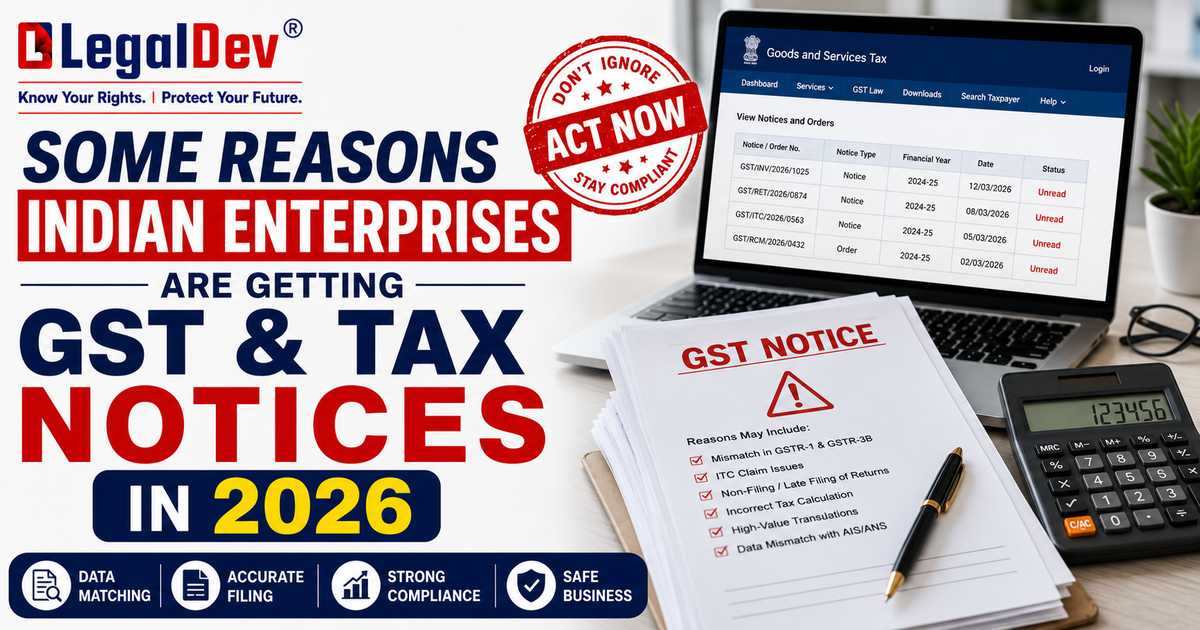
Some Reasons Indian Enterprises Are Getting GST & Tax Notices in 2026
If your finance team has started treating tax notices like Monday morning emails expected, annoying, and piling up you are not alone.
In 2026, GST and income tax notices are no longer a sign that something went seriously wrong. They land in the inboxes of companies that file on time, maintain decent books, and genuinely try to stay compliant. The system has changed. What used to require a tax officer to spot has been handed over to automated engines that work around the clock, cross-checking your data against every source they can reach.
This post breaks down the five most common reasons Indian enterprises are getting hit with notices right now, with the actual legal hooks involved and what you can do to reduce the frequency before your GSTR-1 gets blocked or a demand order drops.
1. Your Vendors Are Filing Late And You Are Paying the Price
This is the one that catches most finance teams off guard.
When you purchase goods or services from a GST-registered vendor, your Input Tax Credit (ITC) shows up in GSTR-2B only after that vendor files their GSTR-1. If they delay, file incorrectly, or skip a month entirely, your GSTR-2B simply does not reflect those invoices. And if you claim ITC in GSTR-3B based on your purchase register which is how most companies work you now have a mismatch.
The tax department does not chase your vendor for this. They come after you.
Under the current Invoice Management System (IMS), ITC availability is directly tied to vendor behaviour. The GSTR-3B liability fields are increasingly pre-computed based on GSTR-1 data, which narrows the room for manual adjustments when a supplier defaults. Companies that are not actively tracking vendor filing compliance before claiming ITC are sitting on a ticking DRC-01C.
What to do: Run a vendor filing status check every month before you file GSTR-3B. If a supplier has not uploaded their GSTR-1, park that ITC and claim it only after it appears in GSTR-2B. Yes, this requires a process change. It is still easier than a notice.
2. The ITC Mismatch Notice (DRC-01C) Is Now Fully Automated
The DRC-01C is the most common GST notice Indian enterprises receive in 2026.
Here is exactly how it works. After you file GSTR-3B, the GST portal automatically compares the ITC you claimed in Table 4 against the ITC available in your GSTR-2B. If the gap exceeds Rs. 1 lakh or 20% of your GSTR-2B ITC whichever is lower the system generates a DRC-01C intimation under Rule 88D of the CGST Rules without any human review.
You get seven days to respond. If you do not, the system blocks your GSTR-1 filing for the next period. Keep ignoring it and the matter moves toward a tax demand under Section 73 or 74 of the CGST Act and that is when it gets expensive.
Some mismatches are structural and legitimate IGST on imports does not always flow into GSTR-2B cleanly, prior-period ITC claims can create timing gaps, and transitional credits carry their own reconciliation burden. The system does not care. It flags them all. The burden is on you to explain the difference within the window.
A partial response is better than no response. Even if you cannot fully resolve a DRC-01C in seven days, submitting something keeps your GSTR-1 live and demonstrates good faith.
3. ADVAIT and BIFA Are Profiling Your Business Whether You Know It or Not
Most tax professionals know about DRC-01C. Far fewer have thought seriously about ADVAIT.
ADVAIT (Advanced Analytics in Indirect Taxes) is CBIC's AI and machine learning platform. It does not wait for you to make a mistake. It builds a risk profile on every registered taxpayer using filing history, ITC patterns, turnover trends, and sector benchmarks. If your numbers look statistically unusual even if they are entirely legitimate ADVAIT flags your business for scrutiny.
BIFA (Business Intelligence and Fraud Analytics) works alongside ADVAIT at the state level, tracking supply chains across multiple layers of buyers and sellers. A 2026 expert session confirmed that GSTN processes roughly three billion API calls per month to feed these systems.
At the Parul University Expert Session in March 2026, a CBIC IRS Officer from the Vadodara Commissionerate said the system identifies anomalies in filing history and ITC trends and sends them out for scrutiny notices even when the filings appear correct on the surface.
What does this mean for you? If your ITC claimed in a particular quarter jumped significantly compared to the same quarter last year, ADVAIT may flag it. If your turnover growth does not match the sector average, it may flag it. If a supplier in your chain is marked as a risky taxpayer, it can implicate you through network analysis.
There is no public score, no dashboard you can check. The output of ADVAIT feeds directly into enforcement. The only way to manage this risk is to keep your reconciliations tight and be ready to explain any data anomaly with documented backup.
4. AIS Is Cross-Checking Your ITR in Real Time
On the income tax side, the Annual Information Statement (AIS) has fundamentally changed how mismatch notices are generated.
Every bank, employer, broker, mutual fund house, property registrar and TDS deductor reports your financial transactions to the Income Tax Department. This data flows into AIS, which is updated throughout the year. When you file your ITR, the Centralised Processing Centre automatically compares what you declared against what AIS shows.
Any gap triggers an intimation under Section 143(1). No officer needs to review it. The system does it.
Common enterprise triggers include: interest income on fixed deposits not declared in the return, capital gains showing in AIS that were not reported in the ITR, property transactions appearing in the registry data, and TDS mismatches where what the deductor reported does not match what you claimed.
Under the Income Tax Act, 2025 (effective April 2026), this framework has been strengthened. Form 26AS is now renamed Form 168 under the new rules though for ITR filing covering FY 2025-26 (AY 2026-27, due July 31, 2026), Form 26AS still applies and Form 168 kicks in for Tax Year 2026-27 onwards.
One specific trap that catches enterprise finance teams: if your vendor or a deductor filed their TDS return with an incorrect PAN, that TDS credit will not show up in your Form 26AS at all. You lose the credit and still get a notice for the mismatch.
Pre-filing reconciliation matters more than post-notice corrections. Download AIS, compare it against your books, and submit feedback on any incorrect or duplicate entries through the portal before you file. A mismatch you catch before filing takes 30 minutes to address. A mismatch the department catches after filing can take months.
5. Your ERP and Your Tax Filing System Are Not Talking to Each Other
This is the most overlooked reason for notices and arguably the most preventable.
Large enterprises often run their billing, inventory, procurement, and accounting on different systems. The ERP captures one number. The tax team pulls a different extract for filing. The same invoice, processed through two systems that do not sync, produces two different figures. Both get reported in different contexts and the GST portal's reconciliation engine spots the inconsistency.
Internal data hygiene issues are now a direct source of external compliance risk. GSTR-1 and GSTR-3B are checked against each other, against GSTR-2B, and increasingly against e-invoice data from the IRP. If your billing team uploads invoices to the IRP in a batch at month-end but your sales register captures them on invoice date, the timestamps create detectable gaps.
For businesses with annual aggregate turnover above Rs. 10 crore, the 30-day rule for IRP upload is not optional. Any invoice not uploaded within 30 days is legally invalid. The buyer loses ITC on it. The penalty is 100% of tax due or Rs. 10,000 per invoice, whichever is higher.
The fix is an integration problem, not a tax problem. If your billing workflow does not generate the IRN at the point of invoicing, you will keep accumulating e-invoicing failures. Solve the process first; the compliance follows.
Quick Reference: Notice Types and Consequences
|
Notice
|
What Triggers It
|
Response Window
|
Risk if Ignored
|
|
DRC-01C (GST)
|
ITC in GSTR-3B > GSTR-2B by >Rs. 1L or 20%
|
7 days
|
GSTR-1 blocked; Sec 73/74 demand
|
|
DRC-01B (GST)
|
GSTR-3B liability < GSTR-1 liability
|
7 days
|
Recovery without show-cause notice
|
|
Section 143(1) (I-T)
|
AIS vs ITR income gap
|
15–30 days
|
Underreporting penalty + interest
|
|
E-invoicing default
|
Missing IRN or 30-day upload breach
|
Immediate
|
Invoice void; 100% tax or Rs. 10K/invoice
|
|
ADVAIT scrutiny
|
AI risk-score anomaly
|
Variable
|
Full GST audit
|
|
TDS/TCS default
|
Short deduction or non-deposit
|
15–30 days
|
Assessee-in-default under Sec 201
|
What Actually Helps
On the GST side:
Reconcile GSTR-2B against GSTR-3B every month before filing, not after. Automate the comparison if your volume makes manual checks unreliable. Complete all IMS acceptance actions for eligible invoices before claiming ITC. Generate e-invoices at the point of billing batch uploads create IRN timestamp problems. If you operate multiple GSTINs and share input services across them, the ISD registration requirement from April 2025 applies to you. Check your setup.
On the income tax side:
Download AIS and review it two to three weeks before your ITR due date. Use the feedback mechanism on the portal to flag any incorrect or duplicate entries these corrections update TIS, which is what pre-fills your return. Verify TDS credits in Form 26AS against your books and confirm that your deductors have filed their 24Q/26Q returns correctly before you file. A TDS credit that appears in AIS but not in Form 26AS cannot be claimed until the deductor corrects their return.
Operationally:
|
Action
|
Frequency
|
Owner
|
|
GSTR-2B vs GSTR-3B reconciliation
|
Monthly
|
GST / Finance team
|
|
Vendor filing compliance check
|
Monthly
|
Procurement / Tax
|
|
AIS vs ITR reconciliation
|
Pre-filing
|
Finance / Tax
|
|
E-invoice upload status review
|
Weekly (Rs. 10Cr+ entities)
|
Billing / ERP team
|
|
DRC-01C / DRC-01B notice tracker
|
Monthly
|
Compliance team
|
Final Thought
The notices hitting Indian enterprises in 2026 are not a signal that the tax department has turned hostile. They are a signal that the compliance infrastructure has caught up to a level where data inconsistencies that used to go unnoticed now get flagged automatically, often within days of filing.
Companies that still treat GST and income tax compliance as a once-a-month filing exercise will keep getting notices. Companies that build real-time reconciliation into their finance workflow and fix the data integration gaps between their systems will see the frequency drop sharply.
The underlying tax law has not changed that much. The enforcement machinery around it has.
Frequently Asked Questions
Why is my company getting GST notices even though we file on time?
Timely filing is one input. The GSTN's AI systems also examine ITC patterns, vendor filing compliance, the relationship between GSTR-1 and GSTR-3B liability, and sector benchmarks. If any of those data points look unusual, ADVAIT can flag your business for a closer look even with a clean filing record.
What is ADVAIT and what does it actually do?
ADVAIT is CBIC's central AI platform for indirect tax analytics. It uses machine learning to build risk profiles across all registered taxpayers and generates risk alerts that field formations act on. The platform operates continuously, not just during filing season, and it feeds directly into scrutiny and notice proceedings.
What is the fastest way to reduce GST notice frequency?
Three steps address most automated triggers: automate GSTR-2B vs GSTR-3B reconciliation before filing, pre-screen vendor compliance before claiming ITC, and integrate e-invoice generation into your billing workflow so no invoice misses the IRP.
How does AIS lead to income tax notices?
AIS collects third-party reported data from banks, brokers, employers, and registrars. When you file your ITR, the system automatically compares your declared income against AIS. Any unexplained gap triggers a Section 143(1) intimation. Reviewing AIS before filing and using the feedback mechanism for incorrect entries is the most effective way to prevent these notices.
What happens if I do not respond to a DRC-01C within 7 days?
Your GSTR-1 filing for the next return period gets blocked. If the matter remains unresolved, it escalates toward a tax demand under Section 73 (in cases of negligence or genuine error) or Section 74 (in cases involving fraud or suppression). Responding even partially keeps the filing live and avoids escalation.