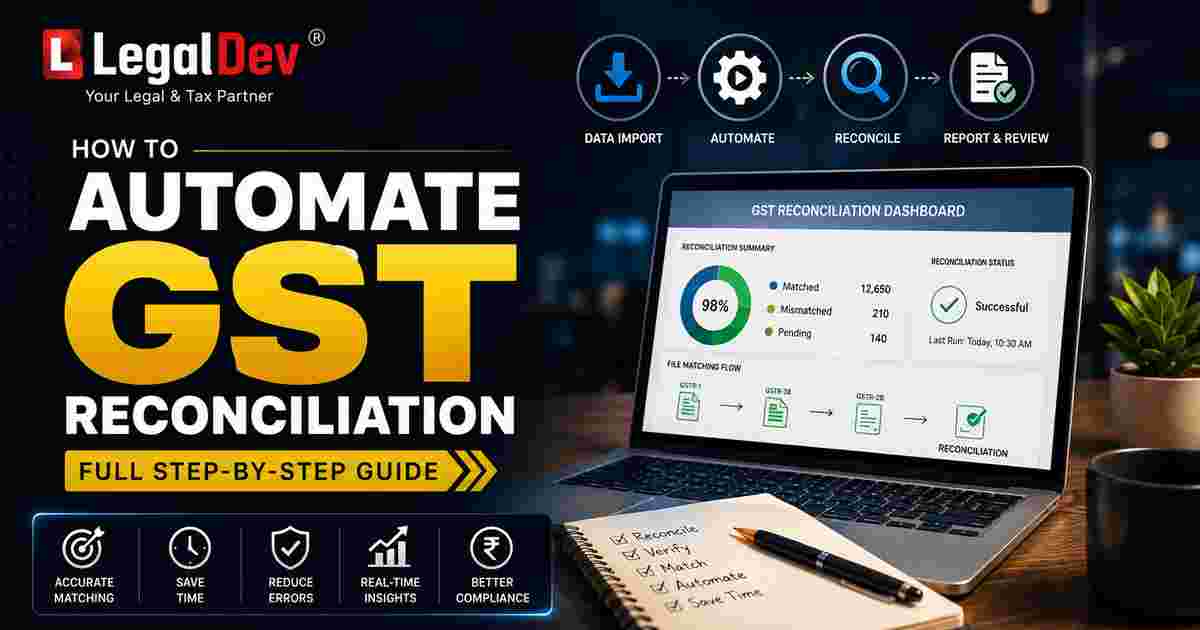
How to Automate GST Reconciliation — The Complete Process Guide
Manual GST reconciliation is a trap. You spend days cross-checking invoices, running VLOOKUPs, and still miss something — and then the notice arrives.
Automating your GST reconciliation fixes this. Not just by saving time, but by catching mismatches before they become compliance problems. Here's exactly how to do it — from understanding what reconciliation covers, to setting up the right automation layers, to knowing what AI-powered tools should be doing for you by 2026.
What GST Reconciliation Means
At its core, GST reconciliation is a matching exercise. You compare what's recorded in your books against what's been filed — or what's reflected — in GST returns. The goal: both sides say the same thing.
Simple enough in theory. The complications come from scale — thousands of invoices, multiple vendors, different tax rates, and a system where your supplier's mistakes directly affect your ITC eligibility.
Here's why that matters in practice:
Whatever you report as sales in GSTR-1 shows up as ITC for your customers in their GSTR-2B. Any error on your end hits their credit claims — and their business relationship with you. Meanwhile, the purchases you make from registered taxpayers appear in your own GSTR-2B based on your supplier's GSTR-1 filings. If they haven't filed, or filed incorrectly, your 2B looks wrong.
Reconciliation gives you visibility across three things — GST liability reported, GST actually paid, and ITC that's legitimately eligible. Get this right and you avoid excess ITC claims, short tax payments, interest, penalties, and notices. Get it wrong — even once — and you're explaining yourself to the department.
GSTR-2B vs purchase register reconciliation, sales reconciliation, and GSTR-1 vs GSTR-3B alignment are the core areas where most errors show up.
Types of GST Reconciliations You're Probably Already Doing — Manually
Before building automation, you need to know which reconciliations are in scope. These are the four categories that matter:
Purchase vs GSTR-2B — Matching your purchase invoices against auto-populated 2B data. Missing invoices, value differences, and vendors who haven't filed show up here.
Sales vs GSTR-1 — Verifying that every sales invoice is correctly captured in GSTR-1 and matches your sales register. Under-reporting and over-reporting both create liability problems.
Books vs GSTR-3B — Checking that the ITC and tax liability figures flowing from your books are exactly what's reported in 3B. This is where short payment and excess ITC claim issues get caught — or missed.
Vendor GSTIN verification — Identifying unregistered vendors, cancelled GSTINs, and incorrect GSTIN entries before they create ineligible ITC headaches downstream.
Each of these can be automated. But the automation only works if your data foundation is clean.
Why Businesses Are Moving to GST Reconciliation Automation
The volume argument alone is enough. If you're processing hundreds or thousands of invoices monthly — handling it manually isn't just inefficient, it's genuinely risky.
GST reconciliation automation handles invoice matching in real time, syncs data across sources, and flags discrepancies the moment they appear — not three days before the filing deadline. No manual VLOOKUP. No cross-checking spreadsheets at 11 PM before a due date.
There's an integration case too. A proper GST automation software connects directly to your existing ERP or accounting system, pulls data automatically, and eliminates the extraction step entirely. That alone saves hours per cycle.
And the compliance argument is actually the strongest one. Automation doesn't just reconcile — it identifies ITC mismatches, value discrepancies, and missing invoices continuously. If something's off, you know before you file, not after you receive a notice. That's a fundamentally different compliance position.
How to Automate GST Reconciliation — Step-by-Step
The first thing to understand: the starting point isn't buying software. It's process clarity. Organizations that jump straight to tool procurement usually end up with expensive automation that produces messy outputs — because garbage in, garbage out applies here more than anywhere else.
Work through these questions before you start:
What reconciliations are you currently performing monthly — and how often do mismatches occur? What's your invoice volume? Where exactly are the errors coming from — vendor GSTIN issues, value mismatches, missing invoices, timing differences? And what's your reconciliation scope — just 2B vs purchase register, or the full stack including GSTR-1 vs GSTR-3B and annual return validation?
Get answers to these first. Then execute.
Step 1: Make Your Data Automation-Ready
This is the foundation step. If your data isn't structured correctly going in, the automation produces garbage outputs.
Your ERP or accounting system needs to be GST-compliant — not just in theory but in practice. Invoice numbering should be consistent. Purchases need correct classification: B2B, RCM, imports — every category mapped properly. Vendor and customer GSTINs need to be verified and accurately recorded in the system.
Getting this right eliminates ambiguity before it reaches the reconciliation engine. Think of it as the cleanup you do once, so you never have to do it mid-cycle again.
Step 2: Build the Data Integration Layer
Data for GST reconciliation comes from two distinct places.
Internal sources — your ERP, accounting software, purchase and sales registers, journal entries.
External sources — GSTR-1, GSTR-2B, GSTR-3B, the e-invoicing portal, and e-way bill data.
Getting these two to talk to each other is the integration challenge. There are four main approaches, and the right one depends on your business size and ERP setup:
API-based integration via GSP connects your system directly to the GST portal through a GST Suvidha Provider. Data from GSTR-1, 2B, 3B is pulled automatically and synced with ERP data in real time or on a schedule. This is the most robust method and suits medium to large businesses with high invoice volumes.
Direct ERP connectors use pre-built integrations for SAP, Oracle, Tally, and similar systems. They pull from purchase and sales registers and map data to tax fields automatically. Works well for businesses with structured ERP environments — though connector compatibility matters.
SFTP (Secure File Transfer Protocol) moves files automatically between systems. ERP exports are uploaded to a server where the reconciliation tool processes them. Useful for multi-location businesses where data consolidation is the main challenge.
JSON upload — the GST portal method — involves downloading a JSON file from the portal and uploading it to the reconciliation system. Requires some manual touchpoints but is practical and accessible for small to medium businesses.
Step 3: The Data Processing Layer — Where Errors Get Caught Early
This is the most underappreciated stage in GST reconciliation automation, and also the most critical.
Before any actual matching begins, the system standardizes and validates incoming data. Every invoice goes through structural checks: GSTIN format validity, invoice number uniqueness (duplicate detection), date validation, and completeness of mandatory fields. Tax validation runs simultaneously — CGST and SGST must equal total tax for intra-state transactions, IGST must apply correctly to interstate supplies, and tax rates must align with taxable values.
Then transaction-level validation: invoice value = taxable amount + taxes, credit and debit notes linked to original invoices, RCM applicability, correct classification for exports and imports.
Finally, compliance validation — vendor GSTIN active status, matching against GST return data, and identification of ineligible ITC before it gets claimed.
All of this happens before the actual reconciliation runs. That's what separates structured automation from a spreadsheet macro.
Step 4: The Reconciliation Layer — Matching at Scale
Now the system does the actual comparison. Using unique identifiers — GSTIN, invoice number, invoice date, taxable amount, tax value — it matches invoices across sources and categorizes every result.
Matched. Mismatched. Missing in 2B. Missing in books. Value mismatch. Tax mismatch.
Each category tells you something different about where the problem sits — with you, with the vendor, or with the portal data.
After categorization, the system applies GST compliance rules: Section 16 ITC eligibility, blocked credits (motor vehicles, personal expenses), time limits for ITC claims, and RCM liability validation. ITC mismatch automation at this layer means you're not just finding the mismatches — you're understanding whether they're fixable, claimable in the next period, or permanently lost.
Step 5: Return Filing and Reporting Output
Once reconciliation is complete, the system computes net tax payable, generates a detailed ITC report — eligible, ineligible, claimed, pending — and flags reversals and amendments needed before filing.
This output feeds directly into your GSTR-3B preparation. No recomputation. No manual transfer of figures. The reconciliation output becomes the filing input.
Where AI Changes the Reconciliation Game
AI-powered GST compliance tools do more than match invoices. That distinction matters.
Standard automation matches — AI learns. It validates e-invoices in real time, flags invalid GSTINs, detects duplicate vendor entries, and catches incorrect Place of Supply classifications before data even hits the reconciliation engine. Across the entire return filing cycle — GSTR-1, 2B, 3B — it identifies inconsistencies before submission.
The compliance monitoring angle is where AI earns its keep long-term. GST law changes. Rate notifications, new compliance requirements, changes to ITC eligibility rules — AI-powered tools track these updates and continuously check existing transactions for impact. A rate change doesn't catch you mid-cycle anymore.
For audit readiness, AI analyzes bulk data — returns, e-way bills, invoice trails — and surfaces anomalies, unusual transaction patterns, and high-risk entries. The difference between a business that breezes through a GST audit and one that struggles is usually how well they can explain their reconciliation process. Automation with AI makes that explanation almost automatic.
And beyond compliance, AI generates something genuinely useful: business insights. Vendor risk profiles. Abnormal trends in purchase or sales volumes. Reconciliation gaps by supplier category. Data that helps finance teams make decisions, not just file returns.
What to Look for in GST Reconciliation Automation Tools in 2026
Not all tools are built the same. Here's what the checklist should look like for any serious evaluation:
Direct API integration with the GST portal — mandatory, not optional. Seamless ERP connectivity with your existing systems. Automatic data cleaning and normalization built into the processing layer. A compliance rule engine that covers ITC eligibility, blocked credits, and RCM logic. Filing deadline alerts and time-limit reminders for ITC claims. Automated mismatch categorization — not just flagging, but labeling the type and likely cause. E-invoice and e-way bill integration for full transaction coverage. Real-time ITC visibility and live tax liability computation. Vendor compliance monitoring — active GSTIN status checks, return filing frequency. And secure, role-based access with data encryption, because this is sensitive financial data.
Missing even two or three of these in a tool you're evaluating is a signal to look elsewhere.
The Real Outcome of Getting This Right
GST reconciliation automation shifts compliance from something reactive — scrambling before due dates, fixing errors after notices — into something structured and proactive. Businesses running mature reconciliation automation spend less time on compliance and more time using the data it generates.
Time efficiency, accuracy, compliance confidence, reduced litigation risk, and better financial control — these aren't soft benefits. For any business filing monthly returns at scale, they translate directly to cost and risk reduction.
The manual alternative isn't a viable long-term option. The invoice volumes, the compliance requirements, and the consequences of errors have all moved in the same direction. Automation isn't ahead of the curve anymore — it's catching up.
FAQs
Q: Can GST reconciliation be fully automated?
A: Yes — GST reconciliation automation can cover the entire workflow from data extraction and validation to invoice matching, ITC determination, and filing support. AI-powered tools connect directly to ERP systems and the GST portal, reconcile data automatically, and categorize every mismatch without manual intervention. The caveat is that your underlying data needs to be structured and clean for automation to produce reliable outputs.
Q: Which GST returns can be reconciled automatically using automation tools?
A: Most automation platforms handle GSTR-2B vs purchase register reconciliation, GSTR-1 vs sales register, GSTR-1 vs GSTR-3B, and annual return reconciliation (GSTR-9). Some tools also cover e-invoice and e-way bill matching, which is increasingly important as reporting requirements tighten.
Q: What is GSTR-2B vs purchase register reconciliation and why does it matter?
A: This reconciliation compares the auto-populated ITC data in your GSTR-2B against your internal purchase records. It identifies invoices missing from 2B (usually because the supplier hasn't filed), value mismatches, duplicate entries, and ineligible ITC. Getting this right directly impacts how much ITC you can legitimately claim — and getting it wrong creates interest and penalty exposure.
Q: How does ITC mismatch automation reduce GST notices?
A: ITC mismatch automation continuously compares purchase data with GSTR-2B before returns are filed. It flags excess ITC claims, unmatched invoices, and suppliers with cancelled GSTINs — all before submission. Catching these discrepancies in the reconciliation stage rather than post-filing is what prevents the department from issuing notices in the first place.
Q: What is the difference between API integration and JSON upload for GST reconciliation automation?
A: API integration via a GST Suvidha Provider (GSP) creates a direct, real-time connection between your ERP and the GST portal — pulling GSTR-1, 2B, and 3B data automatically at set intervals. JSON upload is a semi-manual method where you download portal data as a JSON file and upload it to the reconciliation tool. API suits high-volume businesses needing real-time sync; JSON works for smaller businesses with lower invoice volumes and more manual oversight.
Q: What data needs to be clean before automating GST reconciliation?
A: Before running automation, your ERP must have consistent invoice numbering, correct purchase classifications (B2B, RCM, imports), and verified GSTIN entries for all vendors and customers. Missing or incorrect GSTINs, inconsistent invoice formats, and unclassified transactions are the most common causes of failed or inaccurate automated reconciliations. Fixing data quality issues upfront saves significant rework later.
Q: How does AI help in GST return filing automation?
A: AI-powered GST compliance tools go beyond basic matching. They validate e-invoices in real time, detect anomalies in transaction patterns, track changes in GST law, and cross-check datasets across GSTR-1, 2B, and 3B before filing. The result is fewer last-minute corrections, fewer discrepancies flagged by the department, and better audit readiness.
Q: What is vendor compliance monitoring in GST automation software?
A: Vendor compliance monitoring tracks the GSTIN status and return filing frequency of your suppliers automatically. If a vendor's registration is cancelled or they stop filing returns, the system alerts you — because purchases from such vendors create ineligible ITC. Catching this proactively means you can take corrective action before the ITC claim is made.
Q: How long does it take to implement GST reconciliation automation software?
A: Implementation timelines vary by complexity. Businesses with structured ERP systems and clean data can be up and running within a few weeks using direct connectors. Organizations requiring custom API integration or significant data cleanup typically need two to three months for a stable, production-ready setup. The pre-implementation data readiness work is usually what determines the actual timeline.
Q: What happens to e-invoice and e-way bill data in automated GST reconciliation?
A: A well-built automation platform reconciles e-invoices against GSTR-1 to ensure all reported sales match the invoices generated at the portal level. E-way bill data is matched against GST returns to verify that the movement of goods is correctly reflected in filings. Discrepancies between invoicing and reporting — a common audit trigger — get caught at this layer before returns are filed.