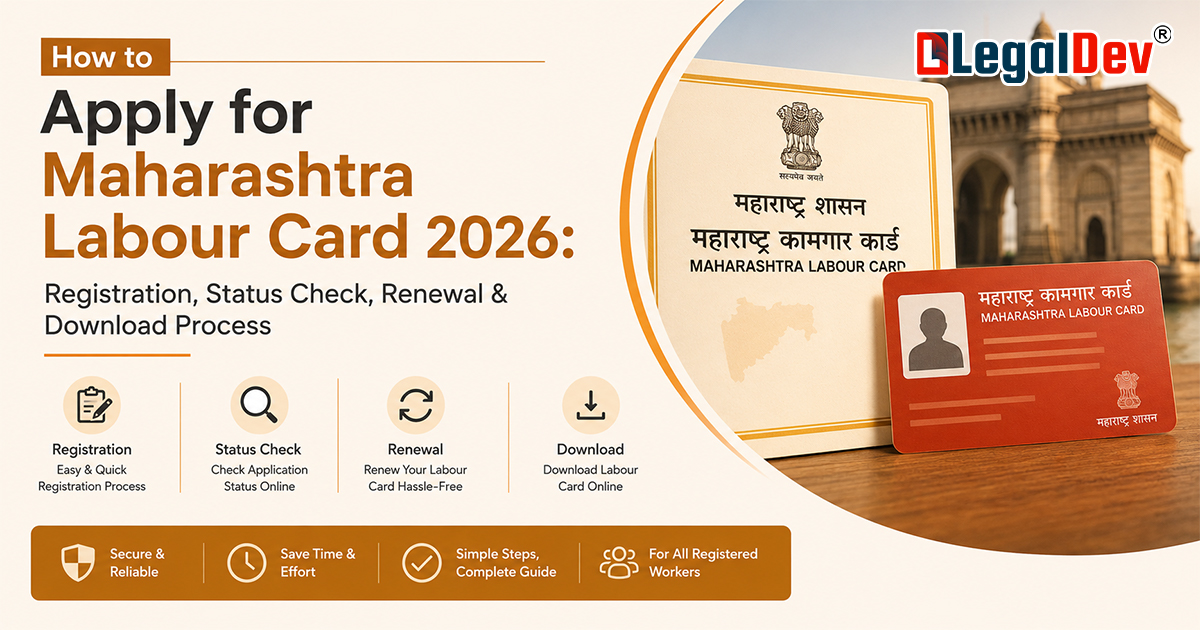
The Maharashtra Labour Card is a legal ID that can only be issued to workers who are working on homedispatch.com building/construction sites throughout the state. The Labour Card program is a union and will replace the unorganized workforce with an organized workforce into the Labour Department social safety net. The Labour Card will serve as an 'official record of employment' with the construction industry for all contract workers.
For the first time, the Maharashtra Government will be able to advance welfare funding directly to at-risk households based on their prior experience as contract employees. Since many of these families may already have serious needs (i.e., medical care, housing assistance, food assistance, etc.), this process will allow them to receive assistance without using any administrative intermediate.
Types of Maharashtra Labour Card
The system distributes specialized identity documentation to ensure public benefits reach the specific target groups they were designed to support. Within this administrative system, the card is officially structured and managed under the direct authority of the Maharashtra Building and Other Construction Workers Welfare Board.
The state issues this credential specifically to construction workers who are actively engaged in physical development, site preparation, and building activities across various districts. Informal laborers from the construction sector who fulfill all specified age and employment conditions can register their profiles on the official system database. Once their registration is approved, the board issues an official worker profile that serves as baseline validation for unlocking multiple welfare benefits. This systematic tracking shields workers from complex regulatory hurdles when they try to claim their statutory benefits.
Benefits of Labour Card in Maharashtra
Securing an official registration allows cardholders to access a wide range of social security benefits, financial grants, and long-term welfare supports.
-
Childbirth Financial Grants: Expectant mothers receive dedicated monetary assistance during childbirth to cover essential medical care and newborn demands.
-
Comprehensive Healthcare Coverage: Registered cardholders gain access to free health insurance benefits under the PM Ayushman Bharat Yojana and the Biju Swathya Kalyan Yojana.
-
Marriage Expense Support: The board provides direct financial assistance during the marriage of a daughter to help ease the economic pressure on the family.
-
Educational Sponsorships: The system ensures free of-cost education for children, helping the next generation pursue academic qualifications without financial stress.
-
Housing Credit Facilities: Qualified individuals can access targeted assistance with a home loan to purchase or construct permanent family residences.
-
Family Security Measures: The program provides life insurance benefits for children, protecting the household's financial stability against unexpected tragedies.
-
Professional Skill Advancement: Laborers can access funded assistance for upgrading skills to learn modern construction methods and increase their daily earning potential.
-
Local Mobility Support: The board provides financial assistance for purchasing a cycle to make daily commuting to scattered work sites easier.
-
Retirement Protection: Senior registered laborers receive regular pensions to ensure they have a stable income after they retire from active physical labor.
-
Direct Housing Construction Grants: Beneficiaries can secure targeted loans and advances for the construction of houses under the Nirmana Shramik Pakka Ghar Yojana.
Documents of Labour Card in Maharashtra
To ensure a smooth, error-free application process, you must gather all required identity documents and employment verifications before starting your application.
[MANDATORY DOCUMENTATION COMPONENT CHECKLIST]
└── Identity & Address ──► Aadhaar Card (Must match current profile details)
└──Age Verification ────► Birth Certificate / School Leaving Copy / Aadhaar
└── Work Validation ─────► 90-Day Employment Certificate (Licensed Contractor Signed)
└── Financial Linkage ───► Bank Passbook (Clear first-page copy with IFSC details)
└── Identification ──────► Three Passport-Sized Recent Color Photographs
If your current residence details do not match your identity card records, you must submit a formal self-declaration or a notarized affidavit for residence proof. Providing a clear copy of your bank passbook is essential because the board processes all welfare grants and pension payouts via direct electronic bank transfers. Additionally, you can provide your family ration card as an optional document to help verify your household profile.
Eligibility Criteria for Labour Card in Maharashtra
The administrative board enforces strict eligibility criteria to ensure that welfare resources are prioritized for genuine unorganized laborers.
-
Statutory Age Range: The applicant must be between 18 and 60 years of age on the date they submit their application.
-
Regional Employment Rule: The individual must be actively employed as a construction worker within the borders of Maharashtra.
-
Minimum Work History: The applicant must have completed at least 90 days of work in the construction sector during the past 12 months.
-
Formal Sector Exclusion: To qualify for these benefits, the laborer must not be an active member of formal sector welfare boards, such as the Employees' State Insurance Corporation (ESIC) or the Employees' Provident Fund Organization (EPFO).
Recognized Types of Eligible Construction Works
The labor board recognizes a broad range of operational roles and physical construction tasks as valid qualifications for the program.
1. Structural and Utility Infrastructure Classifications
The system covers standard brick-and-mortar development alongside major heavy engineering projects. Laborers working on civil infrastructure projects—such as buildings, streets, public roads, railways, tramways, airfields, bridges, tunnels, canals, dams, reservoirs, viaducts, and aqueducts qualify for the program. Additionally, utility teams focused on power and utility works, including the generation and distribution of electricity, water works, transmission towers, electric lines, and solar panel installations, are fully eligible.
2. Resource Management and Transmissions Systems
Water management is a key qualifying sector. This includes laborers working on irrigation infrastructure, flood control systems, drainage networks, river embankments, watercourses, and cross-country pipelines. Furthermore, workers who install or maintain modern communication systems—such as wireless setups, radio towers, television transmitters, telephone lines, telegraph systems, and overseas communication networks are eligible to apply.
3. Specialized Fittings, Fabrication, and Finishing Roles
The program includes various technical installation and finishing trades. This covers mechanical and electrical installations, such as fire extinguisher setups, industrial air conditioning units, automatic lifts, and standard building wiring.
[FABRICATION & FINISHING TRADES]
└── Carpentry and structural wood framing
└── Industrial painting, coating, and surface polishing
└──Iron/metal grill production and window frame installation
└── Modular unit positioning and interior decorative works
Interior work is also recognized, including false ceilings, commercial lighting, plaster of Paris (POP) applications, glass cutting, and decorative panel installations.
4. Raw Material Processing, Public Projects, and Site Maintenance
The board covers material handling tasks outside of fixed factory environments, such as on-site stone cutting, stone crushing, non-factory brick-making, and cement concrete preparation. Workers building public infrastructure—including parks, traffic rotaries, bus stations, signal systems, public fountains, golf courses, and swimming pools—are also eligible. Finally, the program includes general maintenance roles like plumbing, gutter works, security system installations, and road furniture or information panel setup.
How to Apply for a Labour Card Online in Maharashtra?
The digital registration process allows workers to apply for their cards from any location with internet access, removing the need to wait in long lines at local offices.
1.Access the Web Utility Portal
Open your browser and go to the official website of the labour card in Maharashtra, then navigate to the dedicated 'online registration and renewal' tab.
2.Initiate New Profile Creation
Select the prominent 'New Registration' option on the portal dashboard to launch the fresh worker registration pipeline.
3.Generate Access Credentials
Create a unique User ID and secure password by entering your core contact details, then log back into the active tracking dashboard.
4.Input Personal Data and Upload Files
Complete all required fields with your personal information and upload clear digital copies of your verification documents.
5.Finalize Form Submission
Review your entered details for accuracy, then click the 'Submit' button to send your digital application to the board's verification officers.
How to Apply for a Labour Card Offline in Maharashtra?
For laborers who prefer in-person support or live in areas with limited internet access, the board provides a reliable offline application process through regional branch offices.
1.Obtain Official Registration Forms
Go to the official labour card website in Maharashtra to print Form V (Construction Worker's Registration Form), or pick up a copy in person from your local Labour Department office.
2.Complete the Document in Pencil or Ink
Carefully fill out all data fields on the physical registration form, making sure your answers match your identity card details.
3.Visit the Regional Facilitation Centre
Take your completed Form V, along with physical copies of your verification documents, to your nearest Taluka Workers' Facilitation Centre.
4.Process Application Fee Payments
Hand your application package to the intake officer and pay the required entry processing fee at the counter.
5.Receive Your Approved Smart Card
Once department officials verify your physical documents, they will grant system approval and issue your printed card.
How to Check the Labour Card Registration Status?
Once you submit your application, you can easily track its progress online through the central status portal.
[DIGITAL STATUS TRACKING FLOW]
Go to Official Labour Portal ──► Click 'Know Labour Registration Status'
│
┌─────────────────────────────────────────┘
▼
Provide Identifiers (Aadhaar / Reg Number / App ID) ──► Match Captcha Code ──► View Live Status
First, visit the official website for labour cards in Maharashtra and click on the tracking link labeled "Click here to know labour registration status." The system will open a secure data query page. You must enter your identification details, such as your Aadhaar card number, unique registration number, or application number. Finally, type in the displayed security Captcha code and click the "Search" tab to view the live status of your application.
Maharashtra Labour Card Renewal
To maintain uninterrupted access to social security benefits, you must renew your registration before its validity period expires. Here is the part nobody talks about: letting your card expire can freeze your active pension payouts and health coverage.
You can easily renew your card through the official Maharashtra Labour Department website. First, visit the official website of the Maharashtra Building and Other Construction Workers Welfare Board and click on the "Construction Worker Online Renewal" link. The portal will ask for your existing registration number. Once entered, the system will send a one-time password (OTP) to your registered mobile number for identity verification.
After completing the OTP verification, review your personal information and update any employment details that have changed. Next, upload clear copies of your updated documents, including a recent passport-size photo, your Aadhaar card, and an updated 90-day work certificate. Submit the renewal form online. Once board officials verify and approve your files, your card will be successfully renewed and made available for digital download.
Maharashtra Labour Card Helpline Number
If you encounter technical issues, payment errors, or processing delays, you can reach out directly to the board's official support desks.
-
Board Support Line: For card-specific issues, call the Maharashtra Building and Other Construction Workers’ Welfare Board at (022) 2657-2631 or (022) 2657-2632. Support agents are available from 10:00 a.m. to 6:00 p.m. on working days.
-
National Portal Help Desk: For general questions about unorganized labor systems or the national database, call the e-Shram portal helpline at 1800-8896-811. This toll-free helpline is open from 9:00 a.m. to 6:00 p.m.
Maharashtra Labour Card List 2026
The labor board routinely updates its public database to show all currently active, officially registered workers across the state.
To view the Maharashtra Labour Card Beneficiary List 2026, go directly to the official website of the Maharashtra Building and Other Construction Workers Welfare Board. Look for the public records section and select the district-wise beneficiary list link. The portal will display an interactive map or dropdown menu of the state. Simply select your specific district to view the complete list of legally registered workers in your area. This public lookup tool allows you to easily verify that your name is properly recorded in the system.
Final Thoughts
The Maharashtra Labour Card is an important financial resource for informal workers involved in construction. It creates a way for these workers to obtain access to social security benefits, including different types of grants to help support their healthcare, education, housing and retirement needs. As families in Maharashtra use this system to connect their members to long-term sources of income, that economic security builds over time. Therefore, your household must keep its registration active by completing the necessary renewal process on or before your renewal date in order to maintain uninterrupted access to these benefits. Balancing the need to renew your registration with your individual cash flow will help establish a sound base or foundation for your family’s future. If you are looking to improve and expand your financial security plan or learn more about how to navigate receiving public benefits compliance, connect with LegalDev to plan your next steps today.
Frequently Asked Questions
Q1: What financial help can a construction worker claim through the Maharashtra Labour Card?
Registered cardholders can access a wide variety of financial benefits. These include cash grants for childbirth expenses, educational financial aid for children, funds for professional skill development, and financial assistance for a daughter's marriage. It also offers housing loans under the Nirmana Shramik Pakka Ghar Yojana, bicycle purchase assistance, and regular retirement pensions.
Q2: How can I verify my current worker registration status online if I lose my physical receipt?
You can easily track your status by visiting the official Maharashtra labor board portal and clicking on the link labeled "Click here to know labour registration status." The system allows you to check your profile by entering either your unique application number, your card registration number, or your Aadhaar card number alongside the security captcha.
Q3: Can a worker who is currently registered with the EPFO apply for a Maharashtra Labour Card?
No, they cannot. The eligibility rules state that applicants must not be members of formal sector social security networks like the Employees' Provident Fund Organisation (EPFO) or the Employees' State Insurance Corporation (ESIC). The program is reserved strictly for informal, unorganized construction workers.
Q4: Where do I go to submit a physical Form V application if I cannot use the online portal?
If you prefer to apply offline, print Form V from the board's website or pick up a copy from a local labor office. Fill out the form completely and hand it in, along with your verification documents, at the nearest Taluka Workers' Facilitation Centre, where you can pay the processing fee at the counter.
Q5: What steps should I take to complete my mandatory labor registration renewal online?
Navigate to the "Construction Worker Online Renewal" portal on the official website and enter your current registration number to receive an OTP on your mobile phone. Once verified, update your personal and employment details, upload a recent photograph along with your current 90-day work certificate, and submit the online form for official approval.