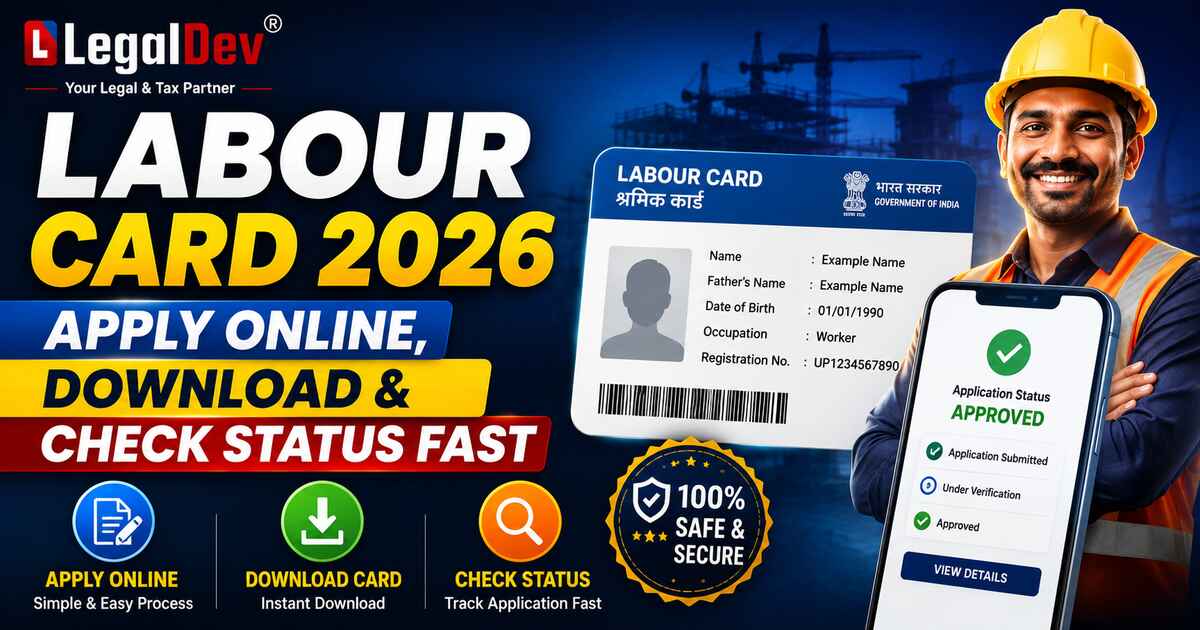
Labour Card 2026: How to Apply Online, Check Status & Download Your Card
Millions of unorganised workers across India still don't have a Labour Card — and they're missing out on real money. Health cover, accident insurance, pension support, scholarship money for kids, maternity benefits. All of it sitting unclaimed. If you haven't done your labour card registration yet, this guide walks you through the whole thing — apply, check status, download, renew. State by state.
What Is a Labour Card?
It's an official government ID — issued by state labour departments and the Ministry of Labour & Employment — that recognises you as a worker in India's unorganised sector. Once you have this card, you're eligible for a whole range of central and state welfare schemes.
The card carries your name, photo, age, type of work, employer details (if any), registration number, and validity period. Registration is voluntary. But honestly — if you're eligible, skipping it doesn't make sense.
Two Types of Labour Cards You Should Know About
State governments typically issue two kinds:
BOCW Card — Building and Other Construction Workers Card
This one is for people working in construction — masons, carpenters, plumbers, painters, electricians. It falls under the Building and Other Construction Workers (Regulation of Employment and Conditions of Service) Act, 1996. Benefits include accident insurance, pension, healthcare, maternity support, and education help for children.
Social Security Card — Unorganised Workers Card
Not in construction? This is your category. Street vendors, agricultural workers, domestic helpers, tailors, fishermen — anyone in the informal sector outside construction. Registered under the Unorganised Workers' Social Security Act, 2008. Gets you access to PM-JAY health insurance, PM-SYM pension, and scholarship benefits.
Who Is the Labour Card Meant For?
The majdoor card is specifically designed for:
If you fall into any of these categories and haven't done your labour card online registration — you're leaving benefits on the table.
Eligibility Criteria for Labour Card
Before you apply, make sure you meet these conditions:
-
Age: 18 to 40 years (varies slightly by state)
-
Must be an Indian citizen
-
Must work in the unorganised sector
-
Not employed in the organised sector or a member of EPF, NPS, or ESIC
-
Monthly income should not exceed ₹15,000
-
Must not be an income taxpayer
-
Must be a resident of the state you're applying in
Eligibility rules can vary by state and scheme. Always cross-check on your state's official portal.
Documents Required for Labour Card
Keep these ready before starting your application:
-
Aadhaar card (mandatory)
-
Aadhaar numbers of family members
-
Bank account number
-
Contact number and Email ID
-
Passport-size photographs
-
Ration card (optional, but useful)
That's it. The documentation process is genuinely simple — most people overthink it.
How to Apply for a Labour Card Online
The labour card apply process is straightforward. Here's how it goes:
-
Step 1: Go to the official website of your state's labour department (links listed below).
-
Step 2: Find the "New Labour Card Registration" option.
-
Step 3: Select your district from the dropdown menu.
-
Step 4: Enter your name, contact number, and email address.
-
Step 5: Enter your Aadhaar card number.
-
Step 6: Verify your mobile number and email.
-
Step 7: Submit the application form.
The process to apply labour card online can differ between states — some have fully digital systems, others still involve a visit to the local office. Check your state's portal for the exact steps.
How to Check Labour Card Status
Once you've applied, here's how to check labour card status online:
-
Step 1: Visit your state's official labour department website.
-
Step 2: Look for "Check Labour Card Status" or "Application Status."
-
Step 3: Enter your registration number, Aadhaar number, or mobile number.
-
Step 4: Submit and view your current application status.
Some states send SMS or email updates automatically. Make sure your contact details are correct when you apply — missed updates are more common than people realise. You can also do a labour card online check through the e-Shram portal if your state is integrated with it.
Labour Card Download — Step-by-Step
After approval, you can do your labour card download directly from your state's portal in most cases. Here's how:
-
Step 1: Go to your state's official labour department website.
-
Step 2: Click on "Download Labour Card" or "Print Labour Card."
-
Step 3: Enter your registration ID, Aadhaar number, or mobile number.
-
Step 4: Enter the OTP sent to your registered mobile.
-
Step 5: Download the PDF. Save it somewhere safe.
Not all states offer the online download option yet. If yours doesn't, you'll need to collect the physical card from your district's labour office.
Benefits of a Labour Card
This is why the labour card online registration matters. Once you're in the system:
-
Access to government health insurance, maternity benefits, and pension schemes
-
Accident and disability insurance for workplace injuries
-
Financial aid for housing, tool purchase, and skill development training
-
Funeral assistance and survivor benefits for dependents
-
Low-cost food grains under state-run schemes
-
Emergency relief support during natural disasters
-
Legal protection against exploitation and unfair labour practices And the one most people don't know about — educational scholarships for children.
Labour Card Scholarship — What You Need to Know
The labour card scholarship is a financial support scheme run by the Ministry of Labour and Employment and state-level labour welfare boards. It helps children of registered workers pursue education — school, college, or technical training — without the family going broke trying to fund it.
Scholarship amounts typically range from ₹1,000 to ₹25,000 per year, depending on the state and the level of education.
Who Is Eligible?
-
The child or dependent of a registered labour card holder
-
The labourer must be registered with the respective State Labour Welfare Board
-
The student must be enrolled in a recognised institution
-
Minimum attendance and academic performance may apply
-
Family income generally should not exceed ₹1–1.5 lakh per annum
Documents Needed
-
Valid Labour Card of parent or guardian
-
Student's Aadhaar card
-
Bonafide certificate / proof of admission
-
Bank account details
-
Academic certificates and mark sheets
-
Recent passport-size photographs
For exact scholarship amounts and deadlines, visit your state's labour department website or the Central Sector Scholarship portal.
Labour Card Renewal — Don't Let It Expire
Most labour cards come with a validity of 1 to 5 years. After that, renewal is mandatory to keep receiving benefits.
The renewal process differs by state. Check your state's portal well before expiry — letting it lapse means a gap in benefits, and some states make reinstatement complicated. Once your renewal is approved, your updated shramik card will be issued. Keep it safely, and keep a digital copy too.
A Quick Word Before You Apply Labour Card
The labour card continues to be one of the most underused tools of government welfare for India's unorganised workforce. The application takes less time than most people expect. The benefits — financial aid, scholarships, insurance, pension — are real and ongoing.
Apply early. Check your labor card status after applying. Download your card the moment it's approved. And renew before the expiry date. That's the whole playbook.
Frequently Asked Questions (FAQs)
Q: How to apply for a labour card online at home?
A: Visit your state's official labour department website and look for the "New Labour Card Registration" option. Fill in your Aadhaar details, contact information, and work details, then submit. The entire labour card apply online process takes about 15–20 minutes if you have your documents ready.
Q: How to download a labour card using Aadhaar number?
A: Go to your state's labour department portal, click on "Download Labour Card" or "Print Labour Card," and enter your Aadhaar number or registration ID. After OTP verification on your registered mobile, the card downloads as a PDF. Not all states offer this — some still require in-person collection.
Q: How to check labour card status online without registration number?
A: Most state portals allow you to check labour card status using your Aadhaar number or registered mobile number instead of a registration ID. Visit your state's labour portal, click "Application Status," and try the Aadhaar or mobile number option. Some states also send SMS updates automatically.
Q: What is the difference between e-Shram card and labour card?
A: The e-Shram card is a national-level registration for all unorganised workers managed by the central government. The labour card (or shramik card) is issued by individual state labour welfare boards and is linked to specific state-level benefit schemes. You may need both — they serve different purposes and access different sets of benefits.
Q: Can a construction worker apply for labour card online in 2026?
A: Yes — construction workers can apply for the BOCW (Building and Other Construction Workers) card through their state's labour department portal. This is actually the most common type of majdoor card application. Benefits include accident insurance, pension, health cover, and children's education scholarships.
Q: Is labour card renewal free or does it cost money?
A: In most states, labour card renewal is free or involves a nominal registration fee (often ₹10–₹50). The exact fee depends on the state and whether you're renewing online or in person. Check your state's official labour department website for the current fee structure before applying.
Q: Who is not eligible for a labour card in India?
A: Anyone employed in the organised sector, income taxpayers, and members of EPF, ESIC, or NPS schemes are not eligible. The card is specifically for unorganised sector workers with a monthly income below ₹15,000.
Q: How long does labour card registration take to get approved?
A: Approval timelines vary by state. In states with fully digital systems, approval can happen within 7–15 working days. In others with manual verification, it can take 30–60 days. You can track your labor card status online through your state's portal to stay updated.
Q: Can I use a labour card from one state if I move to another state?
A: No — labour cards are state-specific and tied to the issuing state's welfare board. If you move permanently to another state, you'll need to register fresh in the new state to access local benefits. Migrant worker rights across states remain an evolving policy area.
Q: What happens if I don't renew my labour card before it expires?
A: Expired labour cards can result in a lapse of benefits — you may stop receiving insurance coverage, pension credits, or scholarship eligibility until renewal is processed. Some states allow a grace period; others require fresh registration. Renewing before expiry is always the safer approach.