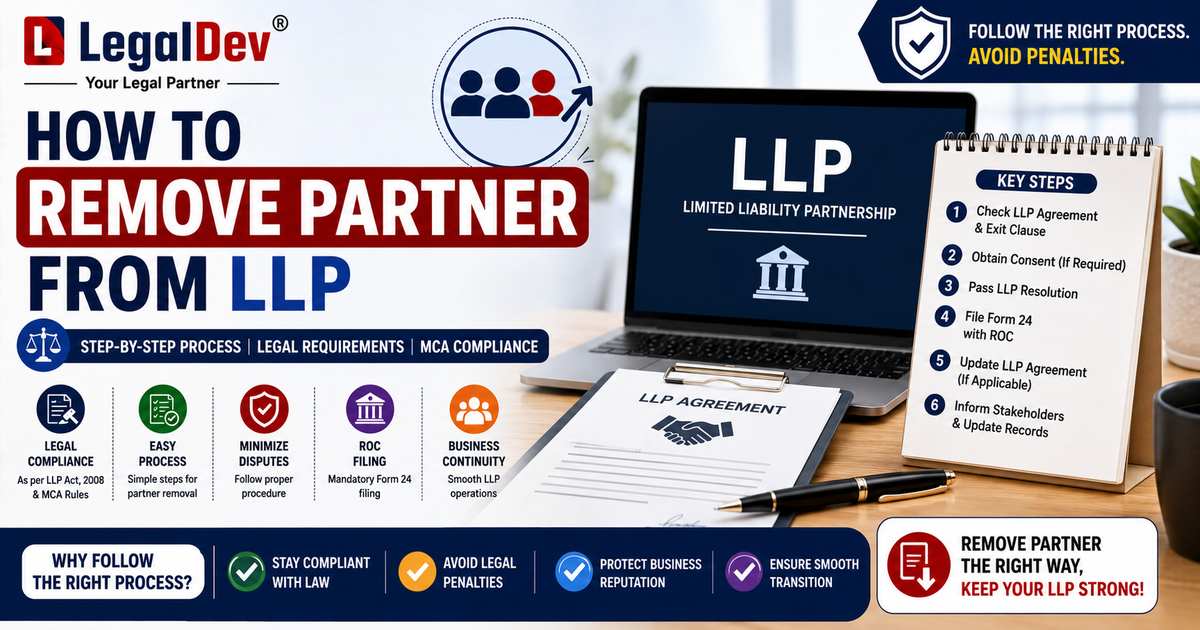
How to Remove a Partner from an LLP in India
A partner isn't pulling their weight, or the working relationship has broken down, or someone simply wants out. Whatever the reason, removing a partner from a Limited Liability Partnership isn't as simple as telling them it's over. There's a legal sequence to follow, government forms to file, and a 30-day clock that starts the moment the decision is made.
This guide walks through exactly how to remove a partner from an LLP in India: what the law actually allows, the paperwork involved, the filing deadlines, and what happens if you get it wrong.
Can You Actually Remove a Partner from an LLP?
Yes, but not arbitrarily. Under the LLP Act, 2008, a partner's exit is governed first by the LLP Agreement. If your agreement has a clause covering removal, expulsion, or resignation, that clause is what controls the process, including grounds for removal, notice period, and how the outgoing partner's capital and share of profits get settled.
If the LLP Agreement is silent on this, Section 24 of the LLP Act steps in as the default rule: a partner may cease to be a partner by giving the other partners a written notice of not less than 30 days. Beyond voluntary exit, a partner automatically ceases to be one on death, dissolution of the LLP, being declared of unsound mind by a competent court, or being adjudged insolvent.
One detail founders often miss: a former partner is still legally treated as a partner in the eyes of anyone dealing with the LLP until the LLP files notice of the cessation with the Registrar of Companies. Until that filing is done, third parties can still hold the outgoing partner (and by extension the LLP) responsible for dealings made in the LLP's name.
Step-by-Step Process to Remove a Partner from an LLP
Step 1: Check the LLP Agreement First
Before anything else, pull out the LLP Agreement and read the clause on partner exit, expulsion, or removal. Most agreements specify whether removal needs a majority vote or unanimous consent of the remaining partners, whether cause has to be shown, and how the partner's capital contribution and profit share get calculated on exit. If the agreement is silent, you fall back on Section 24's default 30-day notice rule described above.
Step 2: Get Written Resignation or Pass a Removal Resolution
If the partner is resigning voluntarily, get their resignation in writing. If the LLP is removing the partner (for breach of agreement, misconduct, or persistent disagreement, as commonly provided for in LLP agreements), the remaining partners need to hold a meeting and pass a resolution approving the removal, consistent with whatever consent threshold the agreement sets.
Step 3: Settle the Outgoing Partner's Dues
Unless the LLP Agreement says otherwise, a former partner is entitled to receive back the capital contribution they actually made, plus their share of accumulated profits after accounting for accumulated losses, calculated as of the date they ceased to be a partner. This settlement should be documented and ideally completed, or at least agreed in writing, before the MCA filings go in, since disputes over money are the most common reason a "simple" partner exit turns into a legal fight.
Step 4: Draft a Supplementary LLP Agreement
If the change affects profit-sharing ratios, capital contribution, or the responsibilities of remaining partners, draft a supplementary agreement recording the amendment. This becomes the document you file with the Registrar under Form 3.
Step 5: File Form 4 with the Registrar of Companies
Form 4 is the form that officially notifies the MCA of a change in partners, whether that's an addition, resignation, or removal. It has to be filed within 30 days of the date the change takes effect, along with the resignation letter or removal resolution, consent documents, and identity proof of any incoming partner if one is being added.
If the departing partner was also a designated partner, make sure a replacement designated partner is appointed before their exit takes effect. Every LLP is legally required to maintain a minimum of two designated partners, and letting that number drop below two, even temporarily, is a compliance gap that regularly trips up LLPs mid-transition.
Step 6: File Form 3 for the Amended LLP Agreement
Where the exit changes the terms of the LLP Agreement, whether that's profit-sharing, capital, or partner roles, Form 3 has to be filed to record the amendment with the Registrar. Form 3 and Form 4 are typically filed together, and both need to be certified by a practicing Chartered Accountant, Company Secretary, or Cost Accountant before submission.
If you'd rather not draft this yourself, LegalDev's LLP Agreement amendment service handles the drafting and filing together.
Step 7: Update Records with Banks, GST, and Other Authorities
Once the ROC filing is accepted, the partner change needs to be reflected wherever the LLP's partner details are on record: the current bank account's authorised signatory list, the GST registration if the outgoing partner was listed, and any other regulatory registrations tied to specific partners. This step gets skipped surprisingly often, and it's what causes friction later when a bank or the GST department is still showing a partner who technically left the LLP months ago.
What Documents Do You Need?
-
LLP Agreement (original and, if applicable, any earlier amendments)
-
Resignation letter from the outgoing partner, or the board resolution approving removal
-
Consent letter from any incoming partner, if one is being added at the same time
-
Supplementary LLP Agreement reflecting the change
-
PAN and address proof of the outgoing partner (and incoming partner, if applicable)
-
Digital Signature Certificate of a designated partner, to sign and file the forms
If any designated partner does not already hold one, see how to get a Digital Signature Certificate before filing.
Timelines and Penalties You Need to Know
|
Requirement
|
Timeline
|
What Happens If You Miss It
|
|
Written notice of voluntary resignation (if agreement is silent)
|
Minimum 30 days before resignation takes effect
|
Resignation may not be legally effective on the intended date
|
|
File Form 4 (partner change) with ROC
|
Within 30 days of the change
|
Late filing fees apply, and the outgoing partner may remain liable for LLP dealings until notice is filed
|
|
File Form 3 (amended LLP Agreement)
|
Within 30 days of the change
|
Same late filing fee structure as Form 4; LLP Agreement changes remain unrecorded with the Registrar
|
|
Maintain minimum 2 designated partners
|
Continuous requirement
|
The LLP falls out of compliance the moment the count drops below two
|
Late filing of Form 3 or Form 4 attracts additional government fees that scale with how many days the filing is delayed, on top of the base filing fee, which itself depends on the LLP's total capital contribution. Beyond the fee, the practical risk is bigger: until the cessation notice reaches the Registrar, the outgoing partner is still treated as a partner for anyone dealing with the LLP, which can create real liability disputes if the LLP signs contracts or takes on debt during that gap.
A partner exit is also a good checkpoint to review your LLP's annual compliance status, since a lapsed filing can slow down the ROC's approval of Form 3 and Form 4.
What Happens to the Outgoing Partner's Liability?
Removing a partner doesn't erase what happened while they were still a partner. The outgoing partner remains liable for any obligations, debts, or acts of the LLP incurred while they were a partner, but they're not liable for anything the LLP does after their cessation is properly recorded, unless the LLP Agreement states otherwise. This is exactly why filing the cessation notice with the Registrar promptly matters. It's the formal cut-off point that limits an outgoing partner's exposure going forward.
Can a Partner Be Removed Without Their Consent?
Only if the LLP Agreement expressly allows it. Removal or expulsion has to follow whatever process the agreement lays out, including any grounds that need to be shown and the consent threshold among remaining partners. An LLP can't simply vote a partner out on the spot if the agreement is silent on expulsion. In that situation, the remaining partners' realistic options are negotiating an exit, amending the agreement with everyone's consent to add an expulsion clause going forward, or, in a genuine deadlock, seeking a resolution through the LLP Agreement's dispute mechanism or the appropriate legal forum.
Frequently Asked Questions
How long does it take to remove a partner from an LLP?
The internal process (notice period, resolution, and documentation) can take anywhere from a few days to 30 days depending on the notice period in your LLP Agreement. Once the decision is finalised, Form 3 and Form 4 need to be filed with the Registrar within 30 days, and ROC processing typically takes a few additional working days after that.
Do I need the consent of all partners to remove one partner?
It depends on what the LLP Agreement specifies. Some agreements require unanimous consent of the remaining partners; others allow a majority. If the agreement doesn't address removal at all, a partner generally has to resign voluntarily rather than be removed outright.
What if the outgoing partner was a designated partner?
You need to appoint a replacement designated partner before or at the same time their exit takes effect, since every LLP must maintain a minimum of two designated partners at all times.
Is a supplementary LLP Agreement always required?
It's required whenever the partner change affects terms already recorded in the agreement, such as profit-sharing ratio or capital contribution. Even where it's not strictly required, most CAs and CS professionals recommend documenting the change formally to avoid disputes later.
Can a partner just walk away without filing anything with the ROC?
They can stop being an active partner internally, but until the LLP files the cessation notice with the Registrar, the former partner is still legally treated as a partner for anyone dealing with the LLP. This is a real liability risk for the outgoing partner, not just a paperwork formality.
What happens to the removed partner's capital contribution?
Unless the LLP Agreement says otherwise, the outgoing partner is entitled to receive back their actual capital contribution plus their share of accumulated profits (after adjusting for accumulated losses), calculated as of the date they ceased to be a partner.
Getting the Paperwork Right
Removing a partner from an LLP is a legal process with real deadlines, not just an internal decision you can settle with a handshake. Getting the LLP Agreement clause, the resolution, and the Form 3 and Form 4 filings right the first time avoids late fees and keeps the outgoing partner's liability question cleanly closed. If you'd rather have a CA/CS team handle the drafting and MCA filings end to end, talk to LegalDev's compliance team and get it filed correctly within the 30-day window.
LegalDev's Change in Partner service covers exactly this: resolution drafting, LLP Agreement amendment, and Form 3/4 filing, handled end to end.