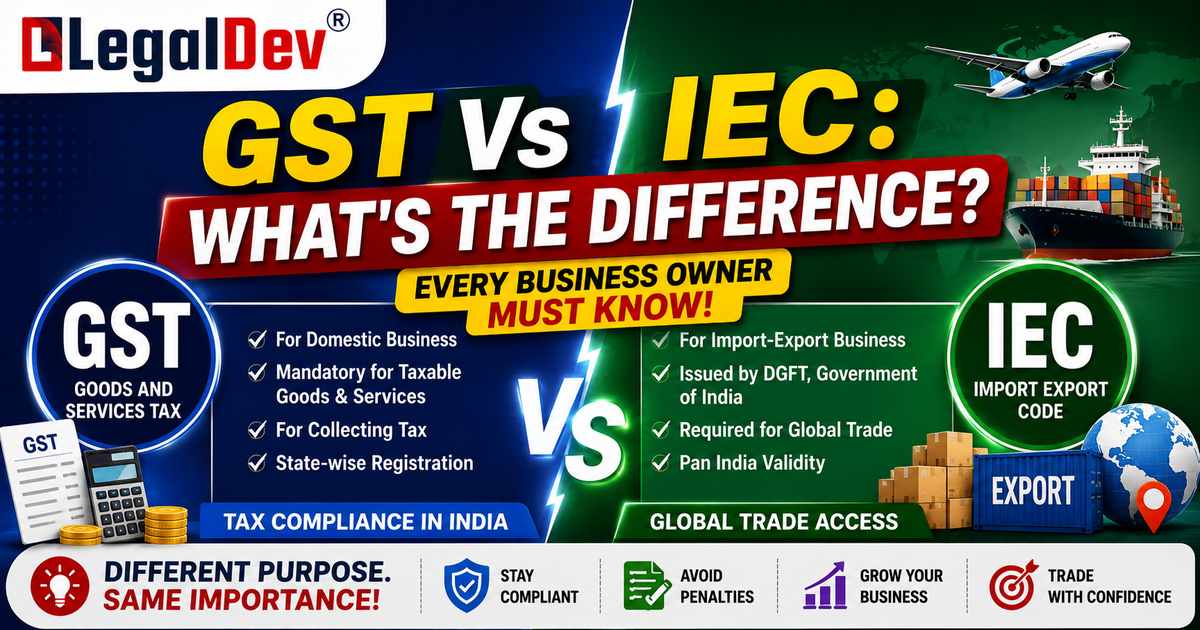
GST vs IEC: What's the Difference?
"I already have GST — do I still need an IEC?" is one of the most common questions Indian businesses ask the moment they start thinking about exporting or importing. The honest answer is yes, almost always — and the reason comes down to what each of these two registrations is actually for. They sound similar, both involve a government portal and a certificate, and both use your PAN as a base. But GST and IEC exist to answer two completely different questions, and confusing them is one of the more common reasons a first shipment gets stuck at customs.
If you've already confirmed you need an IEC and want the full DGFT application process, eligibility, and document checklist, this article picks up the specific question that trips up most first-time exporters: how GST and IEC relate to each other, when you need one, the other, or both, and what happens if you try to trade with only one.
Quick Answer: GST vs IEC in One Line
GST registration authorizes a business to collect and pay indirect tax on the sale of goods and services within India's tax system, including imports and exports. IEC (Import Export Code) is a one-time trade license issued by DGFT that permits a business to legally import or export goods and services across India's borders. GST is about tax; IEC is about trade permission. A business can have either one without the other, but any business actually shipping goods internationally needs both.
GST vs IEC: Side-by-Side Comparison
|
Parameter
|
GST Registration
|
IEC (Import Export Code)
|
|
Full form
|
Goods and Services Tax
|
Importer Exporter Code
|
|
Issuing authority
|
GST Network (GSTN), under the CBIC and State Tax Departments
|
Directorate General of Foreign Trade (DGFT), Ministry of Commerce and Industry
|
|
Purpose
|
Registers a business into India's indirect tax system
|
Grants legal permission to import or export goods/services
|
|
Legal basis
|
Central Goods and Services Tax Act, 2017
|
Foreign Trade (Development & Regulation) Act, 1992
|
|
Format
|
15-digit GSTIN, based on PAN and state code
|
10-digit code, identical to the business PAN post-GST
|
|
Mandatory for
|
Businesses crossing the turnover threshold, or making inter-state/export supplies regardless of turnover
|
Anyone importing or exporting goods; most service exporters claiming FTP benefits
|
|
Validity
|
Ongoing, subject to regular return filing
|
Lifetime, with a mandatory annual profile update
|
|
Renewal
|
Not applicable (cancellation/revocation possible for non-compliance)
|
Not required, but must be updated annually (April–June) or it gets deactivated
|
|
Used at
|
Every domestic and cross-border taxable transaction, GST returns, ITC claims
|
Customs clearance, bank fund transfers for trade, DGFT/export scheme benefits
|
|
Cost to obtain
|
Free
|
Nominal government fee (currently around ₹500)
|
|
Applies per
|
One GSTIN per state of operation
|
One IEC per PAN, valid across all locations of that entity
|
What GST Actually Does
GST registration brings a business into India's indirect tax framework. Once registered, the business charges GST on taxable supplies, files periodic returns, and can claim Input Tax Credit (ITC) on the GST it pays on its own purchases. For businesses trading internationally, GST plays a specific and unavoidable role: imports attract Integrated GST (IGST) at the point of customs clearance, and exports are treated as zero-rated supplies — taxed at 0%, but only if the exporter either files a Letter of Undertaking (LUT) or pays IGST upfront and claims a refund. Neither of those mechanisms is available without a valid GST registration.
In short: GST is what lets the tax side of an import or export transaction function correctly. Without it, an importer can't claim ITC on the IGST paid at customs, and an exporter can't access zero-rating or refunds at all.
What IEC Actually Does
IEC is a permission, not a tax mechanism. It's the code customs authorities check before releasing a shipment, and the code your bank asks for before processing an inward or outward remittance tied to a trade transaction. No IEC means no legal import or export of goods, full stop — the shipment simply cannot clear customs, and the bank won't process the foreign exchange transfer.
Since GST rolled out, DGFT made the IEC numerically identical to the applicant's PAN, which is why the two are so often confused — they can literally share the same 10 digits. But sharing a number doesn't mean sharing a function. The IEC still has to be separately applied for and issued by DGFT; having a PAN, or even a GST registration, does not automatically confer IEC status.
Do You Need Both GST and IEC?
This is the part that actually matters for a business making a decision, and it depends on what you're doing.
If you import or export goods
You need both, with very rare exceptions. IEC gets your shipment through customs. GST governs the tax treatment on both sides — IGST payable on imports, and the zero-rating/refund mechanism on exports. Trying to operate with only one leaves a gap: an IEC without GST means you can clear customs but can't claim ITC or export refunds properly; GST without IEC means you're tax-registered but customs won't release your shipment at all.
If you export only services
IEC requirements for pure service exports are narrower. Where the transaction doesn't route through customs — most cross-border service billing doesn't — IEC is not mandatory, except when the service provider wants to access benefits under the Foreign Trade Policy, such as the Service Exports from India Scheme (SEIS) or similar schemes, in which case an IEC becomes necessary to claim them. GST registration, on the other hand, is still relevant for a service exporter — most cross-border services are treated as zero-rated exports under GST law, and the LUT/refund route still applies the same way it does for goods.
If your turnover is below the GST threshold
A small business under the GST registration threshold doesn't need GST purely on account of domestic turnover — but if that same business starts exporting goods, it will still need an IEC, and it's worth checking whether the export activity itself triggers a GST registration requirement regardless of turnover, since inter-state and export supplies carry their own registration triggers under GST law independent of the standard threshold.
Common Misconceptions
"My GSTIN and IEC are the same number, so I already have both." Not automatically. Since the IEC is now PAN-based, your IEC — once issued — will show the same 10 digits as your PAN, and your GSTIN embeds that same PAN inside its 15-digit format. But the IEC itself still has to be applied for separately through the DGFT portal. Holding a GST registration does not mean DGFT has issued you an IEC.
"IEC replaces the need for GST on exports." No — IEC gets the shipment past customs; it says nothing about tax treatment. You still need GST registration to file the LUT or claim the IGST refund that makes an export genuinely zero-rated rather than fully taxed with no recovery mechanism.
"Once I have an IEC, I never have to touch it again." Also not accurate. Unlike GST, IEC doesn't need periodic returns, but DGFT does require an annual profile update between April and June each year. Skipping this doesn't cancel the IEC outright, but it does get deactivated, which functionally blocks trade until it's reactivated.
"A proprietorship can't have both." It can — and typically does, if it trades internationally. GST and IEC are both available to proprietorships, partnerships, LLPs, companies, trusts, HUFs, and societies alike; entity type isn't a barrier to holding either registration.
What Happens If You Trade With Only One
|
Scenario
|
What breaks
|
|
GST registered, no IEC
|
Shipment gets held at customs; goods cannot be cleared for import or export regardless of tax compliance
|
|
IEC issued, no GST (goods trade)
|
Customs clearance may proceed for the shipment itself, but the business cannot claim ITC on IGST paid on imports, and cannot access zero-rating or refunds on exports
|
|
Neither GST nor IEC
|
No legal import or export of goods is possible; the business is exposed to penalties under the Foreign Trade Policy in addition to being unable to operate
|
How the Two Work Together in a Real Transaction
Take a simple export of goods as an example. The exporter needs an active IEC before the shipment can be booked with customs — this is checked at the shipping bill stage. Separately, the exporter needs a valid GST registration to file the LUT that allows the export to move as a zero-rated supply without upfront IGST payment; without the LUT (or without GST registration to file one), the exporter would need to pay IGST at the time of export and then separately claim a refund, adding cost and delay. Both registrations are checked at different points in the same transaction, by different authorities, for different reasons — which is exactly why a business needs both operating correctly, not just one or the other.
Frequently Asked Questions
Can I apply for GST and IEC at the same time?
Yes. They're separate applications on separate portals — GST through the GST Network portal, IEC through the DGFT portal — but there's no requirement to have one before applying for the other, and most businesses planning to trade internationally apply for both around the same time, once the entity's PAN, bank account, and address proof are in place.
Is IEC required if I only sell on Amazon or Etsy internationally?
If the platform physically ships goods out of India to overseas customers, yes — the shipment still goes through customs, and IEC is required the same way it would be for any other export of goods, regardless of the sales channel.
Does IEC exempt me from GST on imports?
No. IEC has no bearing on tax liability. IGST is payable at customs on imports regardless of whether you hold an IEC; the IEC only governs whether customs will let the shipment through in the first place.
If my GST registration is cancelled, does my IEC also get cancelled?
Not automatically, but a cancelled GST registration will cause practical problems in trade transactions — you'd lose the ability to claim ITC or file LUTs, and depending on the reason for cancellation, it can also affect your standing with customs and banking partners even though the IEC itself remains technically valid on the DGFT record.
Which one should a new exporter apply for first?
There's no strict sequence, but most businesses find it simpler to secure GST registration first, since it's often already in place for domestic operations, and then apply for IEC once the export plan is concrete — DGFT's document checklist assumes a functioning bank account and address proof that are usually already sorted out during GST registration.
Get Both Registrations Set Up Correctly
Getting GST and IEC right at the same time — matched addresses, consistent bank details, and the correct entity classification on both portals — avoids the mismatch errors that hold up a first shipment or a first export refund claim. LegalDev's IEC registration service handles the DGFT application end to end, and can coordinate it alongside your GST registration so both records line up from day one.