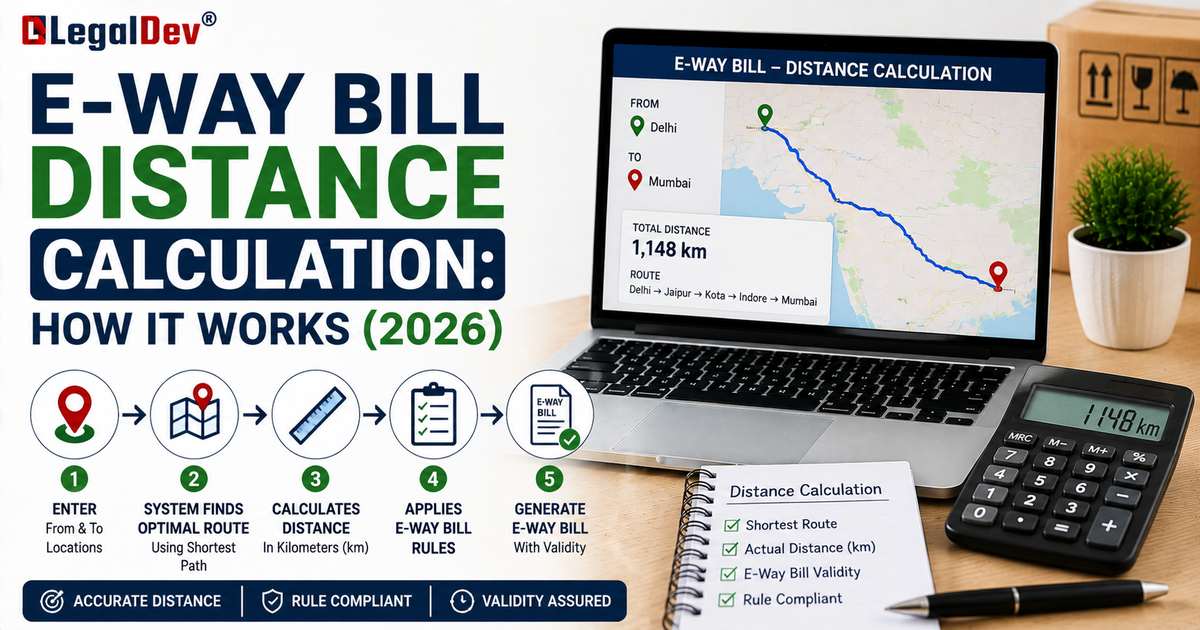
E-Way Bill Distance Calculation: How Distance and Validity Are Calculated
Distance is the single number that decides how long your e-way bill stays valid. Get it wrong, and your validity period ends up too short for your actual route, or the portal flags your entry as an error. This page explains exactly how the system calculates distance, and what to do when it doesn't match reality.
How the Portal Calculates Distance
When you enter the source and destination PIN codes while generating an e-way bill, the portal automatically calculates the approximate road distance between the two locations using its own mapping database. You don't need to measure this yourself in most cases; the system fills it in once you enter both PIN codes.
This auto-calculated figure then becomes the base number used to work out your validity period, at the rate of 1 day for every 200 km for regular cargo, and 1 day for every 20 km for Over-Dimensional Cargo.
The 10% Buffer Rule
Real routes are rarely a straight line, so the system allows you to enter up to 10% more than the auto-calculated distance. If the portal calculates 500 km between two PIN codes, you can enter anywhere up to 550 km without the system rejecting your entry.
This buffer exists specifically to account for actual road conditions, detours, and multi-stop routes, not to be used as a way to artificially extend validity beyond what your shipment genuinely needs.
When You Need to Enter Distance Manually
In a few situations, the system doesn't auto-populate the distance, and you'll need to enter it yourself:
-
When the destination PIN code is outside India, for export shipments moving to a port, airport, or land customs station.
-
When the auto-calculated distance seems clearly wrong, for example, if the PIN code database hasn't been updated for a newer locality.
-
For certain multi-leg or unusual routes where the standard mapping database can't determine a sensible road distance.
In these cases, you can manually enter the approximate distance, but be ready to justify it if questioned, since unusually large manual entries can draw scrutiny during a check.
Common Distance-Related Errors
-
Entering distance for a completely different route than the one actually being used, which can create a mismatch if the shipment is checked and the physical route doesn't match.
-
Ignoring PIN code updates. If a new locality or PIN code isn't yet reflected correctly, the calculated distance can be off; verify it makes sense before submitting.
-
Confusing straight-line distance with road distance. The portal calculates road distance, not the shortest straight-line distance, so don't manually override a correct auto-calculated figure just because it "looks too high."
-
Using the 10% buffer for reasons unrelated to actual route length. Officers can question inflated distances that don't correspond to a genuine road route.
Why Getting Distance Right Matters
The distance you enter directly decides your validity window. Enter too little, and your e-way bill can expire before the goods reach the destination, exposing the shipment to detention under Section 129 of the CGST Act. Enter too much without justification, and you risk scrutiny for a mismatch between declared and actual distance during a physical check.
Once you understand how validity itself works, distance calculation makes a lot more sense in context. See our full E-Way Bill Validity page for how the distance figure translates into your actual validity period, with worked examples.
Frequently Asked Questions
Does the e-way bill portal use Google Maps for distance calculation?
No. It uses its own internal PIN-code-based distance database maintained by the National Informatics Centre, which may differ slightly from a commercial mapping service.
Can I override the auto-calculated distance if I think it's wrong?
You can enter a different figure within the 10% buffer allowed by the system. Beyond that, the portal generally restricts the entry, since it's designed to prevent artificial inflation.
What happens if the actual travel distance is shorter than what I entered?
Nothing negative happens if your goods arrive well within the validity period. The distance entered simply sets the maximum validity window; using less time than allotted causes no issue.
Is distance calculated differently for rail, air, or ship transport?
The same PIN-code-based calculation generally applies across modes for determining validity, though actual transit times for rail, air, and ship shipments vary in practice, so plan your generation timing accordingly.
Read Next
For the full validity period rules, extension process, and worked examples by distance slab, see E-Way Bill Validity. If your shipment is delayed and you need to extend validity before it expires, go to E-Way Bill Extension.