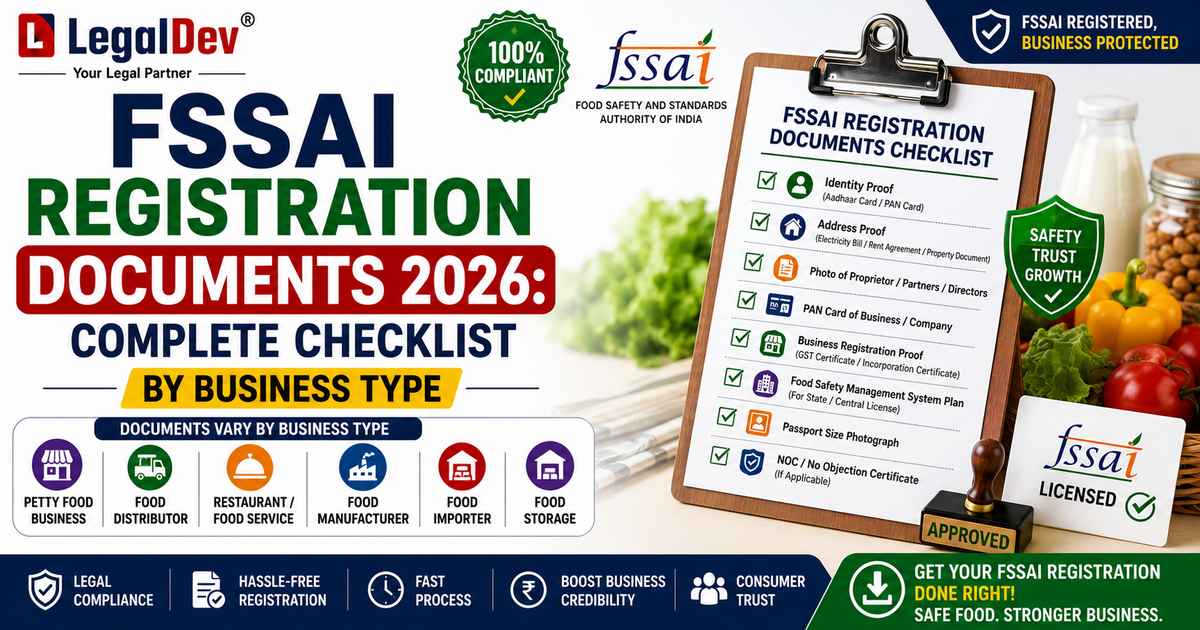
FSSAI Registration Documents 2026: The Complete Checklist by License Type and Business
Most FSSAI applications don't get rejected because the business is doing anything wrong. They get rejected because a document is blurry, expired, mismatched, or simply missing a page nobody thought to check. If you already know how to apply for FSSAI registration and which license category fits your turnover, this guide picks up exactly where that decision ends — at the document stage, where most first-time applicants actually lose time.
This checklist covers every FSSAI registration document by license type (Basic, State, Central), breaks it down further by business type (restaurant, manufacturer, home kitchen, importer, cloud kitchen), and walks through the formatting rules and rejection triggers that the FoSCoS portal enforces in 2026.
Quick Answer: What Documents Does FSSAI Registration Need?
At minimum, every FSSAI applicant needs a photo ID proof, address proof of the business premises, a passport-size photograph, and a declaration of the food business activity. State and Central License applicants need considerably more: business constitution documents, a site layout plan, a food safety management system (FSMS) plan, and activity-specific paperwork such as water test reports or an Import Export Code. The exact list depends on which of the three categories you fall into — covered in full in the FSSAI license types and turnover thresholds section of the main registration guide if you haven't confirmed your category yet.
FSSAI Basic Registration Documents (Form A)
Basic Registration is the declaration-based tier for businesses with turnover up to ₹1.5 crore under the 2026 thresholds — home bakers, small kirana stores, tea stalls, and petty food vendors. The document list is intentionally short.
|
Document
|
Notes
|
|
Photo ID proof
|
Aadhaar Card, PAN Card, Voter ID, or Passport of the applicant
|
|
Passport-size photograph
|
Recent, plain background
|
|
Proof of business address
|
Electricity bill, rent agreement, or property tax receipt
|
|
Declaration of food business activity
|
Self-declared list of food categories handled
|
|
Bank account proof
|
Cancelled cheque or passbook copy (asked for by most State Food Authorities, though not universally enforced)
|
No manufacturing unit layout, no water report, and — in most states — no physical inspection is required at this tier. That's the entire trade-off Basic Registration makes: minimal paperwork in exchange for a lower turnover ceiling and a narrower scope of permitted activity.
FSSAI State License Documents (Form B)
State License applies once turnover crosses ₹1.5 crore and stays under ₹50 crore. The document set roughly triples in size because Form B asks for a full business and premises profile, not just a declaration.
In addition to everything listed under Basic Registration, State License applicants need:
-
PAN card of the business entity or proprietor
-
Business constitution proof — partnership deed, Certificate of Incorporation, LLP agreement, or Memorandum & Articles of Association, depending on entity type
-
Shop & Establishment Certificate or Trade License, where the state mandates one
-
Layout plan of the processing/manufacturing/storage unit, showing dimensions and area allocation by operation
-
List of food category and products to be manufactured, processed, or sold — described specifically, not generically
-
Food Safety Management System (FSMS) plan or declaration, describing hygiene and quality-control practices
-
NOC from the local municipal authority or panchayat, confirming the premises can legally operate a food business
-
List of equipment and machinery, with installed capacity, for manufacturing units
-
Water test report (IS 10500 standard, from a NABL-accredited lab), mandatory if water is used as an ingredient — non-negotiable for restaurants, dairy, and beverage manufacturers
Documents that trip up State License applicants specifically
A layout plan drawn freehand and photographed on a phone is treated the same as a missing layout plan by most Food Safety Officers — it needs to be a proper scaled drawing, even if it's simple. Similarly, "food items" is not an acceptable product description; "packaged namkeen" or "milk-based confectionery" is.
FSSAI Central License Documents (Form B — Central)
Central License is mandatory above ₹50 crore turnover, and — separately from turnover — for any business that imports or exports food, operates across more than one state, supplies to central government agencies, or runs an e-commerce food platform. This is the point covered in more depth on the main FSSAI registration guide's business-type section, since several activity-based triggers apply regardless of how small the business actually is.
Central License needs everything required for a State License, plus:
-
Import Export Code (IEC), mandatory for any importer or exporter
-
Certificate of Incorporation and MoA/AoA (for companies) or the LLP agreement
-
List of Directors/Partners with photo ID, address proof, and contact details for each
-
Turnover proof — the previous year's audited financials or a CA-certified turnover declaration for new businesses
-
Food recall plan, describing how the business would trace and withdraw a product batch if a safety issue surfaced
-
NOC from the manufacturer, if the applicant is a brand owner using a third-party contract manufacturer (proprietary food/private-label category)
-
Source of milk or meat, where applicable, with supplier declarations
Central License applications are the most document-heavy of the three tiers because the risk profile — multi-state distribution, cross-border trade, or platform-scale sale — is highest.
FSSAI Documents by Business Type
License tier decides the base document list. Business activity adds to it. Here's what changes for common categories.
Restaurants, Cafes, and Cloud Kitchens
Beyond the standard State or Central License paperwork, food-service businesses typically need a scaled kitchen layout showing food-prep zones, storage, and washing areas separately, plus a water source declaration since restaurants use water directly in food preparation. Platforms generally expect cloud kitchens to carry at least a State License even if turnover alone would qualify for Basic Registration, so the documentation should be prepared for that tier from the outset rather than the cheaper one.
Home Kitchens and Home Bakers
A home address is an acceptable business premises as long as basic hygiene is maintained, and the document list stays close to the Basic Registration minimum: Aadhaar or PAN, a passport photo, a utility bill for the home address, and a self-declaration. What trips up home-based applicants most often isn't a missing document — it's assuming that occasional WhatsApp or Instagram orders don't count as a "business" and skipping registration altogether, which they legally do count as, the moment money changes hands.
Food Manufacturers
Manufacturing draws the fullest document set at any tier: the site layout plan, equipment and machinery list with installed capacity, water test report, and an FSMS plan are all effectively mandatory, not optional add-ons. A balance sheet or turnover proof is also commonly requested to confirm the correct category was selected.
Importers and Exporters
Central License applies regardless of turnover, and the IEC code is the one document that has no substitute — an application without it will be reverted every time. Import-specific businesses should also keep supplier and country-of-origin documentation ready, since Food Safety Officers frequently query it even when it isn't listed as a mandatory upload field.
E-commerce and Online Food Sellers
Selling through Zomato, Swiggy, Amazon, or a proprietary website falls under the activities that mandatorily require Central License irrespective of turnover, so document preparation should match Central License requirements from day one rather than starting at Basic and hoping to upgrade later. For the full breakdown of which platforms check what during onboarding, see the platform-specific section of the main FSSAI registration page.
Document Format Requirements on FoSCoS (2026)
The FoSCoS portal enforces stricter upload standards than the earlier FLRS system, and format issues are one of the most common — and most avoidable — causes of a reverted application.
-
File type: PDF is preferred for most fields; some accept JPEG, but PDF is safer across the board.
-
File size: Keep each document under roughly 1 MB. Oversized scans are a frequent cause of upload failure.
-
Scan quality: Use a flatbed scanner at 150–200 DPI rather than a phone photo. Portal filters and reviewing officers both reject uploads with glare, cropped edges, or unreadable text.
-
Self-attestation: Most documents need to be self-attested (signed) by the applicant or authorized signatory before upload — an unsigned scan is treated as incomplete.
-
Validity window: Rent agreements and NOCs should have at least six months of remaining validity at the time of filing. A document set to expire within three to six months is a common revert trigger.
-
Address consistency: The business address must match exactly — down to how the road name or building number is written — across the rent agreement, the FSSAI application, and any GST or Shop & Establishment documents already on file. Minor formatting differences ("Road" vs. "Rd.") can trigger a manual query.
Common Reasons FSSAI Document Submissions Get Reverted
|
Cause
|
Why it happens
|
Fix
|
|
Wrong Kind of Business (KoB) selected
|
Applicant assumes turnover alone decides the category, missing activity-based triggers (import/export, e-commerce, proprietary food)
|
Confirm KoB against the FSSAI license type table before uploading anything
|
|
Blurry or phone-photographed scans
|
Portal's clarity filters and manual reviewers both reject these
|
Use a flatbed scanner, not a camera
|
|
Expired or soon-to-expire rent agreement
|
Filed too close to the agreement's own expiry date
|
Renew or extend before applying; keep 6+ months headroom
|
|
Missing NOC from municipal authority/panchayat
|
Most frequently forgotten by first-time and home-based applicants
|
Request it early — this document alone often has the longest lead time
|
|
Generic product description
|
"Food items" instead of a specific, listed food category
|
Match the exact food category names used in the FSSAI Master List
|
|
Missing water test report
|
Common at manufacturing and restaurant applications where water is used in preparation
|
Get the IS 10500 report from a NABL-accredited lab before filing, not after a query
|
|
Address mismatch across documents
|
Different spelling/format of the same address on different papers
|
Standardize the address exactly as it appears on the utility bill or rent deed
|
A "reverted" application isn't a rejection — it's a query asking you to fix a specific document and resubmit. Reading the officer's remarks carefully before resubmitting saves another cycle of back-and-forth; guessing which document was the problem usually costs more time than the original delay.
Document Checklist: What to Keep Ready Before You Start
Whether you're applying for Basic Registration or a Central License, gathering these five categories of documents before you open the FoSCoS portal will cover the vast majority of the application, regardless of tier:
-
Identity — Aadhaar, PAN, Voter ID, or Passport of the applicant/authorized signatory
-
Address — a current utility bill or rent agreement with 6+ months' validity
-
Business identity — incorporation certificate, partnership deed, or equivalent constitution document (State/Central only)
-
Premises and process — layout plan, equipment list, water test report (State/Central, and activity-dependent)
-
Declarations — food category list, FSMS plan, self-attested Form A/Form B
If any of these five buckets is incomplete, budget extra time before filing rather than submitting and hoping for the best — a revert typically adds one to two weeks to the timeline versus getting it right the first time.
Once your documents are in order, the step-by-step FoSCoS application process walks through account creation, form filling, upload, and payment in sequence.
Frequently Asked Questions
Are FSSAI registration documents different for renewal vs. a fresh application?
Under the 2026 rules, licenses issued from 1 April 2026 carry perpetual validity, so there's no fixed renewal filing in the old sense — see the validity and renewal changes on the main FSSAI page for the full detail. Existing licenses still running on the older 1–5-year cycle need the same core document set at renewal as at original filing, plus updated proof if the address, ownership, or product list changed.
Can I use a mobile-scanned PDF instead of a flatbed scan?
Technically the portal will accept it if the file meets size and format limits, but clarity is judged the same way either method is captured. A well-lit, flat, high-resolution phone scan can pass; a tilted, shadowed, or low-resolution one is one of the most common causes of a revert.
Do I need a notarized affidavit for FSSAI documents?
Not for most Basic Registration filings. Self-attestation (signing the document yourself as the applicant or authorized signatory) is sufficient in the majority of cases. Some states ask for a notarized affidavit specifically for the "constitution of business" declaration in partnership or proprietorship filings — check your state's FoSCoS-linked requirements before assuming either way.
What if I don't have a water test report yet?
For food categories where water is used directly (beverages, dairy, restaurants), the report is treated as mandatory rather than optional, and applications are commonly queried for it if it's missing at filing. Getting it from a NABL-accredited lab before you submit, rather than after a portal query, avoids losing a cycle.
Is a digital signature required for FSSAI documents?
A physical signature scanned into the PDF is generally accepted for Basic Registration and most State License filings. Some Central License categories and larger corporate applicants use a Digital Signature Certificate (DSC) for signing Form B, particularly where the authorized signatory is filing remotely on behalf of a company.
Get Your FSSAI Documents Reviewed Before You File
A document that looks fine to you can still trigger a query if it doesn't match what a Food Safety Officer expects to see for your specific Kind of Business. LegalDev's FSSAI registration service reviews your document set against the current category rules before anything goes on the FoSCoS portal, so the address-proof, layout-plan, and NOC issues that cause most reverts get caught before submission rather than after.'