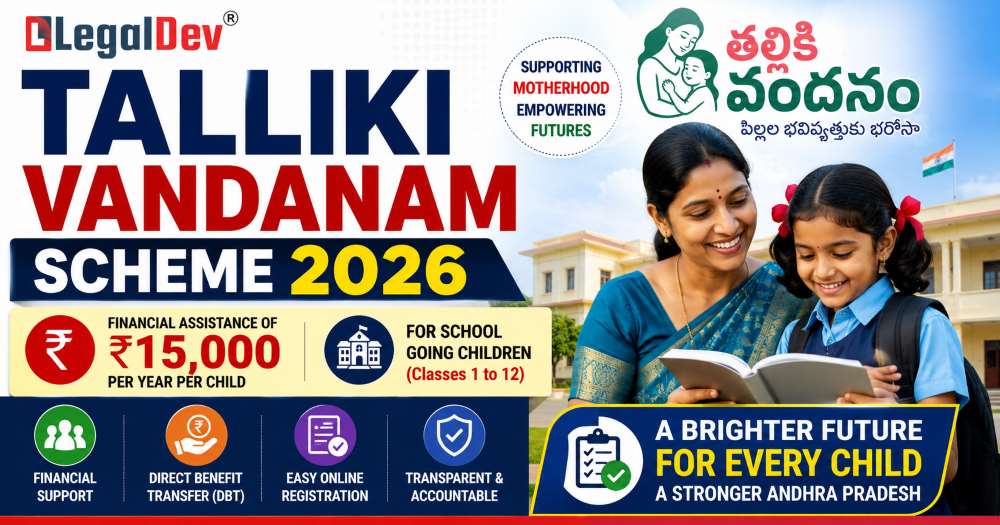
Thousands of mothers across Andhra Pradesh are checking their phones right now, waiting to see if the ₹13,000 has landed in their accounts yet.
The Talliki Vandanam Scheme for the 2026-27 academic year is one of the most widely searched government welfare topics in AP right now and for good reason. For many families, this amount covers school bags, books, uniforms, and fees for the full year. Missing out because of a wrong bank detail or an NPCI mapping error is something no one wants.
This guide covers everything you need: what the scheme is, who qualifies, when the money is expected, how to check your status online using your Aadhaar number, and what to do if your name is not showing up in the beneficiary list.
Talliki Vandanam Scheme
Apply online and check your Talliki Vandanam Scheme application status with the latest updates.
Apply Now → Check Status →
What is the Talliki Vandanam Scheme?
The Talliki Vandanam Scheme (also written as Thalliki Vandanam) is a state government education welfare programme launched by the Andhra Pradesh Government in June 2025 under its Super Six welfare commitments.
The word "Talliki Vandanam" means "salute to the mother" and the scheme lives up to that name. Instead of sending money through schools or education departments, the government sends it straight to the mother's bank account. The idea is simple: give the money to the family and let them use it for what their child actually needs.
Under the scheme:
-
₹15,000 per student is sanctioned annually
-
₹13,000 goes directly into the mother or guardian's Aadhaar-linked bank account through DBT
-
₹2,000 is kept by the government for school sanitation and maintenance
The scheme covers students from Class 1 to Class 12, including Intermediate. Importantly, unlike the earlier Amma Vodi scheme which gave benefits for only one child per household, Talliki Vandanam covers every eligible child in the family. A mother with three children in school can receive ₹13,000 for each of them.
Talliki Vandanam Release Date 2026 – When Will the Money Come?
For the 2026-27 academic year, multiple reports point to payments being released in the first week of July 2026 or the third week of July 2026 at the latest, aligned with the state's Mega Parent-Teacher Meeting (PTM) calendar.
The School Education Department has confirmed the schedule. The delay from the earlier June 2025 release date is because authorities need time to complete backend verification checking that all Aadhaar numbers are correctly seeded to bank accounts and that every account is NPCI-mapped for DBT.
|
Academic Year
|
Payment Period
|
Status
|
|
2025-26
|
12 June 2025 to 5 July 2025
|
Fully Disbursed
|
|
2026-27
|
First to Third Week of July 2026
|
Confirmed – Awaiting Official Release
|
Important: Do not rely on social media dates. The AP government releases official confirmation through the NBM portal and local Sachivalayam offices. Check the official portal or your Ward/Gram Sachivalayam for the final date.
Talliki Vandanam Eligibility 2026 – Who Qualifies?
To receive the scheme benefit, both the student and the family must meet specific conditions.
Student Eligibility
-
Studying in Class 1 to Class 12 (government, aided, private unaided, or residential schools)
-
Intermediate students are also covered
-
Must have a minimum of 75% attendance in the previous academic year
-
Should be enrolled in a recognised school
-
Must be from a family listed in Andhra Pradesh's eligible household database
Family Income Limits
|
Area
|
Maximum Monthly Household Income
|
|
Rural Areas
|
₹10,000 per month
|
|
Urban Areas
|
₹12,000 per month
|
Other Conditions
-
Family must hold a valid Rice Card
-
Should not own disqualifying levels of land or four-wheelers
-
No family member should be a government or PSU employee
-
Mother's bank account must be Aadhaar-seeded and NPCI-mapped
Special Category
Children who are orphans or living in highly vulnerable conditions and studying through recognised voluntary organisations may qualify under special provisions even if normal family criteria do not apply.
Who is NOT Eligible for Talliki Vandanam?
The following categories are excluded even if other conditions are met:
-
ITI students
-
Polytechnic students
-
RGUKT (IIIT) students
-
Students already covered under specific fee reimbursement programmes
-
Families that do not meet income or asset criteria
Documents Required for Talliki Vandanam 2026
You do not submit these documents manually the verification happens through government databases. But all of these must be correct and updated before payment is released:
-
Aadhaar card of the mother or guardian
-
Aadhaar card of the student
-
Valid Rice Card
-
Bank account details of the mother or guardian (Aadhaar-seeded and NPCI-mapped)
-
Bank passbook showing account number and IFSC code
-
Student's school enrolment and admission details
-
Mobile number linked with both Aadhaar and bank account
One thing many families miss: Your bank account must be mapped on the NPCI portal. Even if your Aadhaar is seeded to your bank, if NPCI mapping is not done, the DBT payment will not reach you. Visit your bank branch and ask specifically about NPCI-Aadhaar mapping for DBT.
How to Apply for Talliki Vandanam Scheme 2026?
There is no separate public application form for this scheme. You do not go online and fill in your details yourself.
Here is how the process actually works:
Step 1: The school Headmaster updates student records in the UDISE/Child Info system at the start of the academic year.
Step 2: This data is matched against the AP household eligibility database maintained by GSWS.
Step 3: GSWS (Government System for Welfare and Services) officials conduct field verification for each eligible household.
Step 4: Eligibility is confirmed and the beneficiary is added to the payment list.
Step 5: Approved beneficiaries receive DBT directly to the mother's or guardian's bank account.
If your child's school records are not updated or there is a mismatch in Aadhaar details, the process can stall at step 2 or 3. That is why it is important to check with the school Headmaster at the start of the year and confirm that your child's records are correctly entered.
How to Check Talliki Vandanam Status Online 2026
The official way to check your eligibility and payment status is through the Navasakam Beneficiary Management (NBM) portal at bm-sgsw.ap.gov.in.
Step 1: Open the NBM portal at bm-sgsw.ap.gov.in
Step 2: Click on "Application Status" or "Scheme Eligibility" on the home page
Step 3: Select Academic Year as 2026-27
Step 4: From the scheme list, choose "Talliki Vandanam"
Step 5: Enter the Aadhaar number of the mother or guardian
Step 6: Enter the captcha and click "Get OTP"
Step 7: Enter the OTP sent to your registered mobile number
Step 8: Click "Submit" your eligibility status and payment details will appear on screen
What Do the Status Messages Mean?
|
Status Shown
|
What It Means
|
|
Eligible / Satisfied
|
Your details are verified and you qualify for payment
|
|
Unsatisfied
|
Eligibility conditions are not met, or verification is still pending
|
|
Payment Processed
|
DBT transfer has been initiated by the government
|
|
Payment Credited
|
₹13,000 has been successfully credited to your bank account
|
If your status shows "Unsatisfied", do not panic. It could be because:
-
Aadhaar is not linked to the bank account
-
NPCI mapping is incomplete
-
Name mismatch between Aadhaar and school records
-
Student attendance below 75%
-
Income or Rice Card criteria not met in the database
Visit your nearest Gram/Ward Sachivalayam and ask the Welfare and Education Assistant (WEA) to check your specific issue.
Offline Status Check – Other Ways to Verify
Not everyone has access to a phone or internet to check the portal. Here are the offline options:
-
Visit your Gram Sachivalayam or Ward Sachivalayam the WEA has access to the beneficiary list
-
Contact your School Headmaster they can check the school's submission and student eligibility records
-
Ask the Village or Ward Welfare Assistant directly
-
The WhatsApp helpline +91 95523 00009 is also available for quick status queries
Talliki Vandanam Beneficiary List 2026 – How to Check If Your Name Is Included
The beneficiary list is prepared by GSWS and school authorities after the verification process is complete. It is not published publicly on a website but you can verify your inclusion through:
-
The NBM portal (status check steps above)
-
Gram/Ward Sachivalayam notice boards, where printed lists are sometimes posted
-
School Headmaster's records
-
Local welfare officials
If your name is missing from the list:
Do not wait or assume it will be corrected automatically. Go to your Gram/Ward Sachivalayam and request a correction through GSWS verification channels. Bring your Aadhaar, Rice Card, and bank passbook. The WEA can raise a correction request on your behalf.
Why Payments Sometimes Fail or Get Delayed
Several things can block or delay your Talliki Vandanam payment even when you are eligible:
NPCI mapping not done: Your Aadhaar must be linked to your bank account through NPCI for DBT to work. Visit your bank and confirm this is active.
Bank account dormant or frozen: If your account has had no transactions for a long time, it may have been made dormant. Visit your bank to reactivate it before the payment date.
Aadhaar-bank seed mismatch: If you changed your bank account or number recently but did not update it in GSWS records, the payment goes to the old account.
Name mismatch in UDISE records: If the student's name in school records does not exactly match Aadhaar, the GSWS system may not link them correctly during verification.
Mobile number not linked: OTP verification during status check and some DBT processes require a mobile number linked to your Aadhaar. Update this at your nearest Aadhaar centre if needed.
Quick Reference Summary
|
Detail
|
Information
|
|
Scheme Name
|
Talliki Vandanam (Thalliki Vandanam)
|
|
Launched By
|
Government of Andhra Pradesh
|
|
Launch Year
|
June 2025
|
|
Annual Benefit
|
₹15,000 per student
|
|
Amount to Mother's Account
|
₹13,000 via DBT
|
|
Retained by Government
|
₹2,000 (for school sanitation)
|
|
Classes Covered
|
Class 1 to Class 12 + Intermediate
|
|
Payment Mode
|
Direct Benefit Transfer (DBT)
|
|
2026-27 Expected Release
|
First to Third Week of July 2026
|
|
Official Portal
|
bm-sgsw.ap.gov.in
|
|
WhatsApp Helpline
|
+91 95523 00009
|
Frequently Asked Questions
What is the Talliki Vandanam scheme amount in 2026?
The government sanctions ₹15,000 per student per year. Out of this, ₹13,000 is transferred directly to the mother's or guardian's Aadhaar-linked bank account. The remaining ₹2,000 is kept for school sanitation and maintenance.
What is the Talliki Vandanam release date for 2026-27?
Payments for the 2026-27 academic year are expected in the first to third week of July 2026, confirmed by the AP School Education Department. Check the NBM portal or your local Sachivalayam for the final confirmed date.
Is Thalliki Vandanam and Talliki Vandanam the same scheme?
Yes. Both are the same scheme. "Thalliki Vandanam" and "Talliki Vandanam" are different spellings of the same Andhra Pradesh welfare programme.
How do I check Talliki Vandanam status using Aadhaar?
Go to bm-sgsw.ap.gov.in, select Scheme Eligibility, choose the 2026-27 academic year, select Talliki Vandanam, enter the mother's Aadhaar number, complete OTP verification, and your status will appear.
What does "Unsatisfied" mean in the Talliki Vandanam status?
It means your eligibility conditions are either not met or the verification is still pending. Common reasons include incomplete NPCI mapping, Aadhaar not linked to the bank, name mismatch in school records, or income criteria not matching. Visit your Gram/Ward Sachivalayam to get the specific reason.
Can both my children get the benefit if they both go to school?
Yes. Unlike the earlier Amma Vodi scheme, Talliki Vandanam covers every eligible child in the family separately. If you have two or three children studying in Classes 1 to 12, each one qualifies for a separate ₹13,000 payment.
What if my name is missing from the beneficiary list?
Visit your nearest Gram/Ward Sachivalayam with your Aadhaar, Rice Card, and bank passbook. The Welfare and Education Assistant can check the reason and raise a correction request through GSWS channels.
Is the Talliki Vandanam scheme for private school students too?
Yes. Students enrolled in government, government-aided, private unaided, and residential schools all qualify, as long as income, attendance, and other criteria are met.
What is the income limit to qualify for Talliki Vandanam?
Monthly household income must be below ₹10,000 for rural families and below ₹12,000 for urban families.
Do ITI or polytechnic students get this benefit?
No. ITI students, polytechnic students, and RGUKT (IIIT) students are not eligible under this scheme.