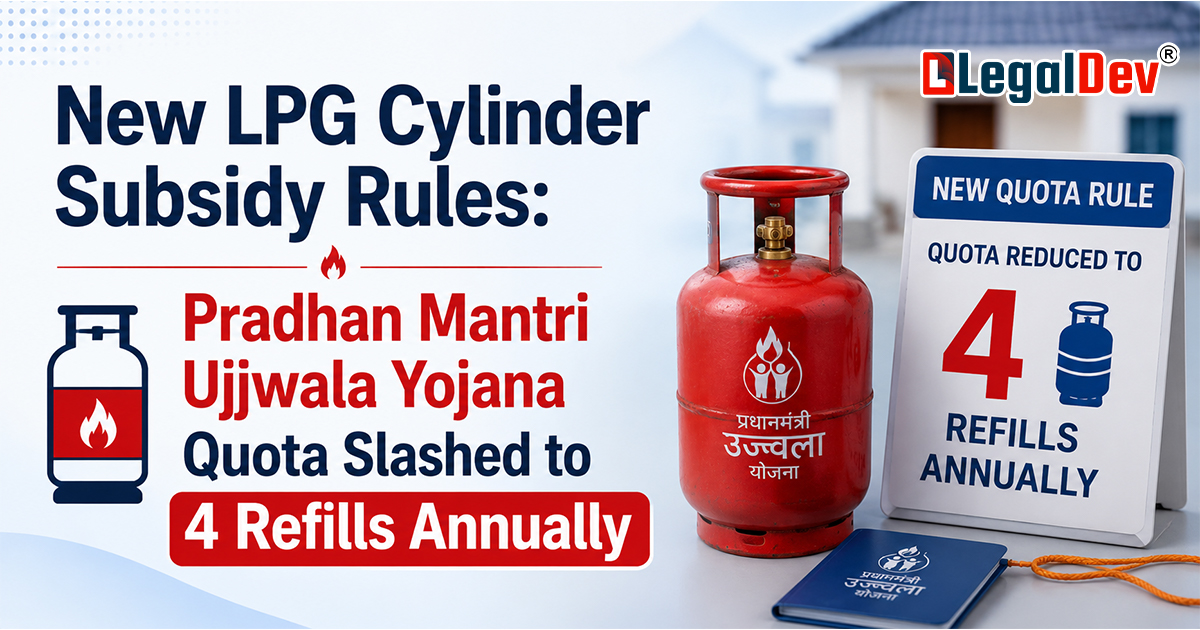
 The Ministry of Petroleum and Natural Gas has made adjustments to the domestic cooking gas subsidy system through structural reforms. Under the adjusted guidelines, Pradhan Mantri Ujjwala Yojana (PMUY) beneficiaries will receive a much larger reduction in their total annual subsidized LPG upto 9 to 4 cylinder including 14.2 Kg.
There has been an adjustment in the size of the subsidy on each of the 14.2 Kg cylinders given to eligible beneficiaries and the maximizing of fiscal support based on the reported average number of cylinders that households consume (based on actual consumption) located outside the metro areas for low-income households.
Major Policy Shift: Subsidised LPG Cylinder Limit Trimmed
The core restructuring introduced by the ministry centers on a sharp drop in the annual allocation of discounted household gas bottles. To optimize public spending, the central administration has realigned its direct benefit framework to match observed baseline consumption metrics.
This change represents a shift from general open-ended assistance to a highly targeted social safety net. Government planners have re-engineered the program to focus public resources entirely on essential primary cooking needs. This policy transition changes how low-income families manage their fuel use throughout the fiscal cycle.
Transition from Nine to Four Refills
Previously, registered families under the flagship safety net were legally entitled to receive financial assistance covering up to nine refills across a single fiscal year. Under the newly implemented framework, this eligibility threshold has been reduced to just the first four refills per annum.
[QUOTA LIFECYCLE BREAKDOWN]
• Refills 1 to 4: Eligible for ₹300 direct benefit transfer support
• Refills 5 onwards: Billed at standard market retail prices (Zero assistance)
The moment a household consumes these initial four purchases, every subsequent bottle bought across the remaining months will accrue standard market retail prices completely devoid of central support. For many families, this structural change requires a careful realignment of monthly energy use. It marks a clear end to the previous multi-bottle subsidy cushion.
Aligning Policy with Average Household Consumption
Administrative representatives clarified during public briefings that this reduction is not an arbitrary fiscal withdrawal but a metric-driven adjustment. Data monitored by state-run oil marketing entities reveals that an average low-income household utilizes approximately four cylinders annually for domestic cooking requirements.
By capping the direct benefit framework at four refills, the administration aims to optimize public treasury spending while ensuring basic cooking energy security is maintained for vulnerable populations. The policy ensures that baseline necessity remains fully covered while eliminating excess fiscal spending on surplus consumption.
Current Financial Breakdown of PM Ujjwala Yojana Cylinders
The real-world financial impact of this decision depends on the interplay between retail prices and the existing direct benefit transfer framework. Recent pricing trends have introduced additional pressure for end consumers.
|
Pricing Component
|
Rate Details (Delhi Benchmark)
|
|
Standard Domestic Retail Price
|
₹942 per 14.2 kg Cylinder
|
|
Ujjwala Direct Benefit Transfer
|
₹300 per Cylinder (First 4 Refills Only)
|
|
Effective Net Cost (Refills 1–4)
|
₹642 per Cylinder
|
|
Effective Net Cost (Refills 5+)
|
₹942 per Cylinder
|
Direct Benefit Transfer Mechanics
The financial framework supporting the system relies entirely on an automated Direct Benefit Transfer (DBT) mechanism to distribute public funds. To acquire a refill, eligible consumers must first pay the prevailing retail market price upfront to their local gas distribution agency.
Once the centralized network successfully validates the physical delivery to the household, the fixed assistance sums of ₹300 is processed and deposited directly into the beneficiary's linked bank account. This financial support remains locked at ₹300 per bottle, representing an updated valuation scaled up from the initial ₹200 threshold provided during the mid-2022 policy term.
Retail Price Trajectory in Metro Markets
The overall financial impact on families is heightened by consecutive increases in raw domestic retail rates initiated by public oil marketing enterprises. A recent price correction added ₹29 to the cost of a standard 14.2 kg domestic cylinder, pushing the benchmark retail price in New Delhi to ₹942.
This update succeeds a sharp ₹60 hike implemented earlier in the trimester, reflecting a cumulative upward trend in base fuel pricing across domestic retail points. These combined adjustments mean consumers face higher out-of-pocket expenses when purchasing non-subsidised cylinders.
Exploring the Catalysts: Why International Triggers Reshaped Domestic Subsidies
Domestic policy shifts rarely happen in isolation. The adjustment to the clean cooking fuel support structure is directly linked to intense pressures in global energy markets.
The Role of Geopolitical Friction in Energy Corridors
Global energy supply lines have faced intense operational strain due to widening geopolitical friction. Disruptions across prominent maritime corridors, particularly around Western Asian trade routes and strategic bottlenecks like the Strait of Hormuz, have radically altered supply risk profiles.
As standard commercial shipping traffic diverted or paused due to heightened security concerns, the baseline logistical insurance, freight procurement costs, and spot-market premiums for liquefied gas cargo surged worldwide. These compounding international variables created a direct inflationary wave that hit landing ports across the country.
Understanding the 46% Surge in Global LPG Benchmarks
India remains fundamentally dependent on external energy procurement, importing nearly 60% of its total domestic LPG requirements. The baseline landing cost for these shipments is determined by the Saudi Contract Price (CP), an international index updated monthly by Saudi Aramco.
[GLOBAL PRICING ESCALATION PATH]
Global Supply Bottlenecks ➔ Saudi CP Index Rises ➔ Domestic Import Costs Increase
Due to the trade lane constraints emerging in early 2026, the global Saudi CP benchmark escalated rapidly from approximately $543 per metric ton to a peak of $790 per metric ton by June. This represents an explicit 46% surge in raw international product procurement costs, heavily driven by sharp individual increases in global propane and butane trading values.
The Financial Reality of Oil Marketing Companies
The vast difference between soaring international procurement costs and capped domestic retail prices has created a heavy financial imbalance for state-run oil marketing enterprises.
Balancing the Burden of Under-Recoveries
When state-aligned oil corporations sell refined petroleum or liquefied gas products within the domestic market at rates lower than their actual net import and processing costs, the resulting financial deficit is termed an under-recovery. This deficit represents a massive financial hit taken to protect the public from extreme global price shocks.
Despite recent domestic price updates, the true landing cost of a domestic gas cylinder has broken past the ₹1,600 mark. Consequently, oil marketing firms are absorbing a heavy deficit of approximately ₹700 on every single domestic cylinder distributed to consumers.
Public Treasury Interventions and Compensation Allocations
The scale of these operational deficits has reached historic levels. By the conclusion of the previous financial term, the total accumulated under-recovery across domestic LPG operations climbed to an extraordinary ₹60,000 crore, up sharply from the ₹41,338 crore recorded during the preceding annual cycle.
[OMC DEFICIT ACCUMULATION]
[Previous Fiscal Cycle] ₹41,338 Crore Deficit
│
▼ (Surging Global Procurement Costs)
[Closing Fiscal Term] ₹60,000 Crore Deficit
To prevent a structural breakdown within these essential energy public sectors, the Central Cabinet approved a dedicated financial compensation package worth ₹30,000 crore to partially offset the losses borne by the corporations. This fiscal relief operates parallel to, and separate from, the direct benefit allocations credited to retail households.
Broader Economic Impacts: Commercial Gas, Diesel, and Petrol Trends
The financial strains reshaping the domestic gas sector are also visible across the wider consumer fuel market, indicating a systemic shift in the energy economy.
Commercial Cylinder Adjustments
Unlike the controlled pricing framework applied to domestic cooking gas, commercial-grade LPG cylinders operate under a deregulated pricing structure. These prices self-correct dynamically at the start of every month based on international spot market movements.
Following five consecutive upward revisions during the Western Asian energy crisis, the price of a 19 kg commercial cylinder utilized across hotels, restaurants, and catering enterprises has reached ₹3,113.50 in the capital. This translates to an open market rate of approximately ₹164 per kilogram, starkly contrasting with the heavily shielded domestic consumer rate of roughly ₹66 per kilogram.
Systemic Inflation Across Key Energy Sectors
The underlying pressures affecting LPG are also driving up prices for other vital transportation and industrial fuels:
-
Petrol and Diesel Adjustments: Retail pricing for automobile fuels has shifted upward, marked by a cumulative increase of ₹7.50 per liter across recent weeks.
-
Corporate Under-Recoveries on Fuel: Oil distribution companies continue to absorb substantial losses on liquid fuels, facing deficits of nearly ₹11 per liter on petrol and roughly ₹33.60 per liter on diesel.
-
CNG Market Movements: Compressed Natural Gas, a critical fuel source for public transport networks and urban commuters, has similarly seen a retail increase of about ₹6 per kilogram.
Strategic Government Initiatives to Safeguard Energy Supplies
To counter these severe international market pressures, the Ministry of Petroleum and Natural Gas has deployed multi-pronged supply chain and distribution strategies to ensure long-term energy security.
Navigating Strategic Maritime Trade Lanes
The Strait of Hormuz serves as a vital maritime passage, handling nearly one-third of the world’s liquefied energy shipments and over 54% of India’s inbound LPG supply. Despite major commercial shipping pullbacks along this route due to regional security risks, the administration maintained stable supply flows through active high-level coordination.
[MARITIME SUPPLY SECURITY DEFENSE]
Strait of Hormuz Conflict ➔ High-Risk Routing ➔ India Deploys Monitored Corridors ➔ Zero Supply Gaps
By utilizing dedicated naval escorts, real-time threat tracking, and choosing secure deep-sea shipping corridors, Indian-flagged tankers successfully moved through the high-risk zones. This managed to deliver vital energy supplies to domestic ports without structural gaps.
Diversifying Import Channels and Boosting Domestic Output
Recognizing the risks of relying too heavily on a single geographical source, supply networks have been strategically diversified to source gas from nations outside the immediate conflict zone. Long-term procurement agreements have expanded to include producers across North America, Canada, and North Africa.
Simultaneously, domestic production infrastructures received significant upgrades. These interventions boosted domestic LPG output by over 60%, raising supply levels from a previous baseline of 32 thousand Metric Tons (TMT) to an enhanced capacity of 52 TMT.
Enforcing Strict Anti-Diversion Protocols
To protect subsidized fuel resources, the administration has tightened distribution oversight to eliminate illegal black-market diversion into commercial sectors. The primary defense has been the widespread expansion of OTP-based delivery verification systems.
[SECURE DISTRIBUTION VERIFICATION]
LPG Delivery Attempt ➔ Secure OTP Generated ➔ Customer Validation ➔ Real-time Deficit Prevention
This verification network now covers over 90% of all domestic distributions. By requiring real-time, digital authentication at the point of delivery, the system ensures that subsidized cylinders reach their intended households, preserving public funds during a challenging economic period.
Conclusion
The recent modifications to the PM Ujjwala Yojana have clearly moved toward the more targeted distribution of public welfare. With an annual subsidy capped at four refills a year, the government has aligned public resources with verified average household consumption metrics to help alleviate the burden on the public treasury. Rising global procurement costs and cost increases in retail will create significant challenges for families to budget for energy; however, understanding how to leverage the direct benefit transfer setup can help families to optimize their energy expenditures. Adapting to this new structure will require planning at the household level and paying attention to how much energy is consumed. Registered families should be closely monitoring their delivery validation and ensure their linked bank account is correct so they can maximize their savings.
Frequently Asked Questions
Q1: How many subsidised LPG refills can a PM Ujjwala Yojana family claim now?
Under the newly revised rules, registered beneficiaries can receive a direct benefit subsidy on their first four refills per fiscal year. Any additional cylinders purchased beyond this four-bottle limit will be billed at standard market retail rates without central assistance.
Q2: What is the current value of the financial subsidy provided for Ujjwala cylinders?
The central subsidy is fixed at ₹300 per cylinder for the first four refills of the year. This represents an increase from the initial ₹200 financial support rate established during the mid-2022 policy adjustment.
Q3: Why did the central government reduce the annual allocation from nine cylinders to four?
Data collected from state-run oil marketing enterprises showed that an average low-income household uses approximately four cylinders per year for domestic cooking. The quota was adjusted to match this baseline consumption metric, optimizing public treasury spending while maintaining core energy security.
Q4: How do the direct benefit transfer mechanics work when purchasing a refill?
Beneficiaries pay the full prevailing retail market price upfront to their local gas distribution agency. Once the delivery is validated on the centralized network, the ₹300 subsidy is automatically processed and deposited directly into the customer's linked bank account.
Q5: What factors caused the sharp increase in international procurement costs for cooking gas?
The surge was driven by geopolitical friction along major maritime corridors, particularly around Western Asian trade routes and the Strait of Hormuz. These disruptions caused the international Saudi Contract Price benchmark to climb from $543 to $790 per metric ton, a 46% increase in raw procurement costs.