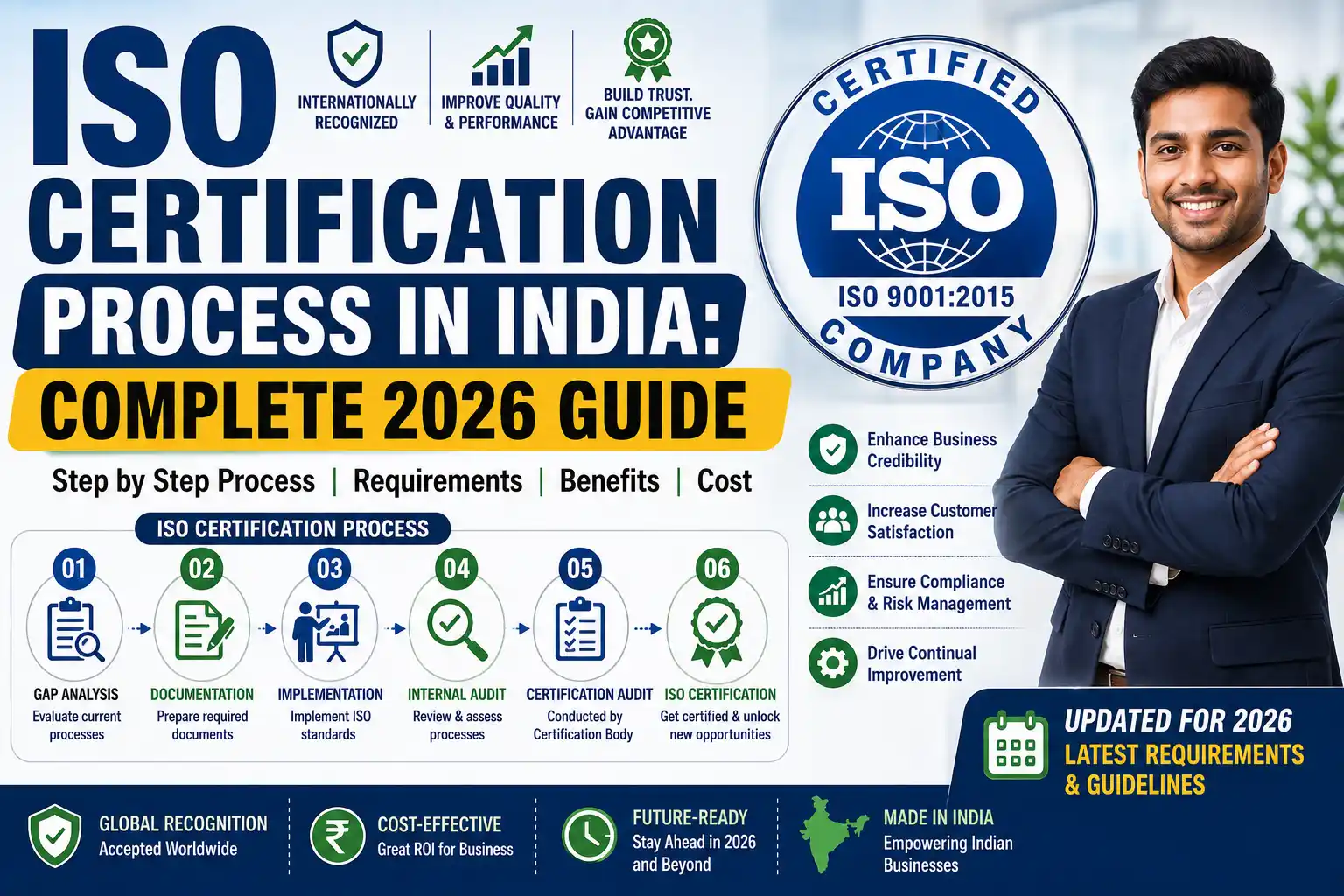
How to Get ISO Certification in India: A Complete Process Guide for Businesses
If a client has ever asked your business for an ISO certificate before signing a contract, you already know the problem this guide solves. ISO certification is formal proof, issued by an accredited certification body, that your organization's systems meet a recognized international standard. In India it is not legally required for most sectors, but it has become the quiet entry ticket to government tenders, export contracts, and corporate vendor lists. This guide walks through the entire process: which standard to pick, what the audit stages actually involve, what documents you need, what it costs, and how it turns into more client trust and more closed deals.
What Is ISO Certification and Why Does It Matter for Business
ISO, the International Organization for Standardization, writes the standards. It does not certify anyone directly. That job belongs to independent, third-party certification bodies that audit your organization against the standard you choose and issue the certificate if you pass. In India, the National Accreditation Board for Certification Bodies (NABCB) accredits these certification bodies, which is why checking a certifier's NABCB accreditation matters before you sign anything.
The business case is straightforward. ISO certification is a globally recognised, third-party verified standard confirming that an organisation's products, services, or management systems meet specific international requirements. Certified companies find it easier to qualify for public tenders, pass vendor audits from larger corporate clients, and enter export markets where buyers simply will not sign without proof of a working quality or safety system. Certified Indian organizations also gain advantages in government tender qualification, international supply chain approval, export market credibility, and investor confidence. None of that happens automatically. The certificate opens the door; consistent execution of what you documented is what keeps clients coming back.
Which ISO Standard Fits Your Business
Most Indian businesses do not need every ISO standard that exists. Pick the one that matches what your clients or regulators actually ask for.
-
ISO 9001 (Quality Management System): The default starting point for almost any business, from manufacturing to services and consulting. It formalizes how you deliver consistent quality and handle customer complaints.
-
ISO 14001 (Environmental Management System): Relevant for manufacturing, construction, and energy-heavy operations that need to show environmental compliance and waste control.
-
ISO 45001 (Occupational Health and Safety): Fits manufacturing, logistics, and construction firms where workplace injury risk is real and clients or regulators want proof of a safety system.
-
ISO 27001 (Information Security Management System): Increasingly demanded of IT, SaaS, fintech, and any business handling client data, particularly with India's Digital Personal Data Protection Act raising the bar on data governance.
-
ISO 22000 (Food Safety Management System): Close to mandatory for food processing units, packaged food sellers, and restaurants supplying institutional clients.
Startups and small firms rarely need more than one certification to begin. You don't need all types of ISO certifications at once; start with a simple, high-impact one like ISO 9001. Add a second standard later, once the first one is running smoothly and a client or tender specifically calls for it.
types of ISO certification
Step-by-Step ISO Certification Process in India
Step 1: Choose the Right Standard and Scope
Decide which ISO standard applies, and just as importantly, define the scope: which locations, departments, and processes the certificate will cover. A narrow, accurate scope audits faster and cheaper than a vague one that tries to cover everything.
Step 2: Pick an Accredited Certification Body
Confirm the certification body you hire is NABCB-accredited (or accredited by an equivalent recognized accreditation board if the client specifically wants a foreign one, such as UKAS). Verify legitimacy through the National Accreditation Board for Certification Bodies directory before signing anything. Get quotes from two or three bodies since pricing and audit scheduling vary.
Step 3: Gap Analysis and Documentation
This is the step businesses most often underestimate. You need to compare your current processes against what the chosen standard requires, then build the documentation: a quality manual, standard operating procedures, records of past corrective actions, and evidence that staff actually follow these procedures day to day. Many businesses bring in a consultant for this stage since writing documentation that an auditor will actually accept takes experience.
Step 4: Implement and Train
Documentation on paper is not enough. Staff need to be trained on the new procedures, and the system needs to run for a reasonable period, usually a few weeks to a couple of months, so there is real operational evidence for the auditor to review, not just a freshly printed manual.
Step 5: Internal Audit and Management Review
Before the external audit, run an internal audit to catch gaps yourself. Fix what you find and document how you fixed it. Auditors expect to see this internal review as proof the system is genuinely working, not built purely for the certificate.
Step 6: Stage 1 Certification Audit
The Stage 1 auditor reviews your documented systems and procedures against the standard and flags possible non-conformities, splitting them into minor and major issues. You then need to resolve those gaps through changes to your actual processes before the next stage.
Step 7: Stage 2 Certification Audit
Once the required changes are complete, the Stage 2 auditor checks whether every non-conformity from Stage 1 has been eliminated and confirms the system meets the standard. This typically includes on-site or remote interviews with staff, a facility walkthrough, and a review of live records.
Step 8: Certificate Issuance and Surveillance Audits
If the Stage 2 audit passes, the certification body issues your certificate, generally valid for three years. It is not a one-time event after that: certification bodies run annual (or sometimes more frequent) surveillance audits to confirm you are still following the system, and you go through a fuller reassessment before the three years are up.
ISO 9001 certification services
Documents Required for ISO Certification
Requirements vary slightly by certification body and standard, but most applications need:
-
Business registration proof (incorporation certificate, GST registration, or MSME/Udyam certificate)
-
PAN and address proof of the business
-
Organization chart and details of key personnel
-
Quality manual and standard operating procedures for the chosen standard
-
Records of internal audits and any corrective actions taken
-
List of applicable legal and regulatory requirements relevant to your operations
-
Site details for every location included in the certification scope
Udyam/MSME registration assistance
ISO Certification Cost and Timeline in India
Cost depends on company size, chosen standard, number of locations, and the certification body's fee structure. Costs typically range from roughly ₹30,000 to ₹2,00,000 or more, depending on company size, the standard chosen, and the certification body selected. Consultant fees, if you use one for documentation and gap analysis, sit on top of the certification body's own audit fee.
On timeline, the full process usually takes three to six months, depending on how prepared the organization already is. A business with reasonably organized processes and a small scope can move faster; a larger organization with multiple sites and thin documentation will take longer.
MSME ISO Certification Reimbursement Scheme
Micro and small enterprises registered under Udyam can recover part of what they spend. The Ministry of MSME reimburses 75% of certification expenses, up to a maximum of ₹75,000 per unit, as a one-time reimbursement for businesses that have acquired ISO 9001, ISO 14001, or HACCP certification. The application goes through the Development Commissioner (MSME) office, and you will need the certification body's invoice and a chartered accountant's certificate of expenses to claim it.
ISO certification cost calculator/consultation
How ISO Certification Boosts Client Trust and Sales
Certification changes conversations with buyers in a few concrete ways.
It removes a filtering step before it starts. Many government tenders and large corporate RFPs list ISO certification as a mandatory qualifier. Without it, your bid gets filtered out before anyone reads the pricing.
It shortens vendor onboarding. Corporate procurement teams run their own supplier audits. A live ISO certificate answers most of their standard questionnaire in one document, which speeds up onboarding and reduces the back-and-forth that stalls new deals.
It signals operational discipline to buyers who cannot inspect your factory or office themselves, which matters most in export deals where the client is overseas and has no other way to judge whether your quality control is real.
It reduces internal costs that eventually show up in pricing. A certified business improves internal efficiency, promotes better management practices, reduces waste, and improves performance tracking, all of which make it easier to hold competitive pricing without cutting corners.
None of this replaces good sales work. It removes a specific, common objection before the sales conversation even starts.
Common Mistakes to Avoid
-
Choosing scope too broadly. Certifying every department when only one client-facing process actually needs it slows the audit and inflates the cost.
-
Treating documentation as a one-time paperwork exercise. Auditors check whether staff actually follow the documented procedure, not just whether the manual exists.
-
Skipping the accreditation check. A cheap certificate from a non-accredited body will not satisfy a tender committee or a corporate client's procurement team, and you will end up paying for the process twice.
-
Letting the system lapse after certification. Surveillance audits catch this quickly, and a failed surveillance audit can suspend your certificate.
FAQs
Is ISO certification mandatory for businesses in India?
No. ISO certification is not mandatory for all businesses in India, though it is often required for government tenders, exports, and industries where quality or safety compliance is closely scrutinized.
Which ISO certification should a new business start with?
ISO 9001 is the most common starting point for businesses across sectors. Add a sector-specific standard, such as ISO 27001 for data-heavy businesses or ISO 22000 for food businesses, once the client or tender you are targeting specifically asks for it.
How long does ISO certification take in India?
Typically three to six months from the gap analysis stage through the Stage 2 audit, depending on how prepared your organization already is and how many locations are in scope.
How much does ISO certification cost in India?
Costs generally range from about ₹30,000 to ₹2,00,000 or more, based on the standard, company size, and certification body chosen. Micro and small enterprises can claim up to 75% back through the MSME reimbursement scheme, capped at ₹75,000.
How do I check if a certification body is legitimate?
Confirm its accreditation through the National Accreditation Board for Certification Bodies (NABCB) directory before signing an agreement. A certificate from a non-accredited body carries far less weight with tenders and corporate clients.
Does ISO certification expire?
Yes. Certificates are generally valid for three years, subject to passing annual or periodic surveillance audits, followed by a recertification audit before the three years end.
Talk to an ISO certification expert
Getting Started
The process rewards preparation more than speed. A business that spends real time on gap analysis and documentation before the Stage 1 audit almost always clears certification faster and cheaper than one that rushes in with incomplete records. If you are weighing which standard fits your business, or want help preparing documentation that will actually pass an audit, LegalDev's compliance team can walk through your specific scope and timeline.