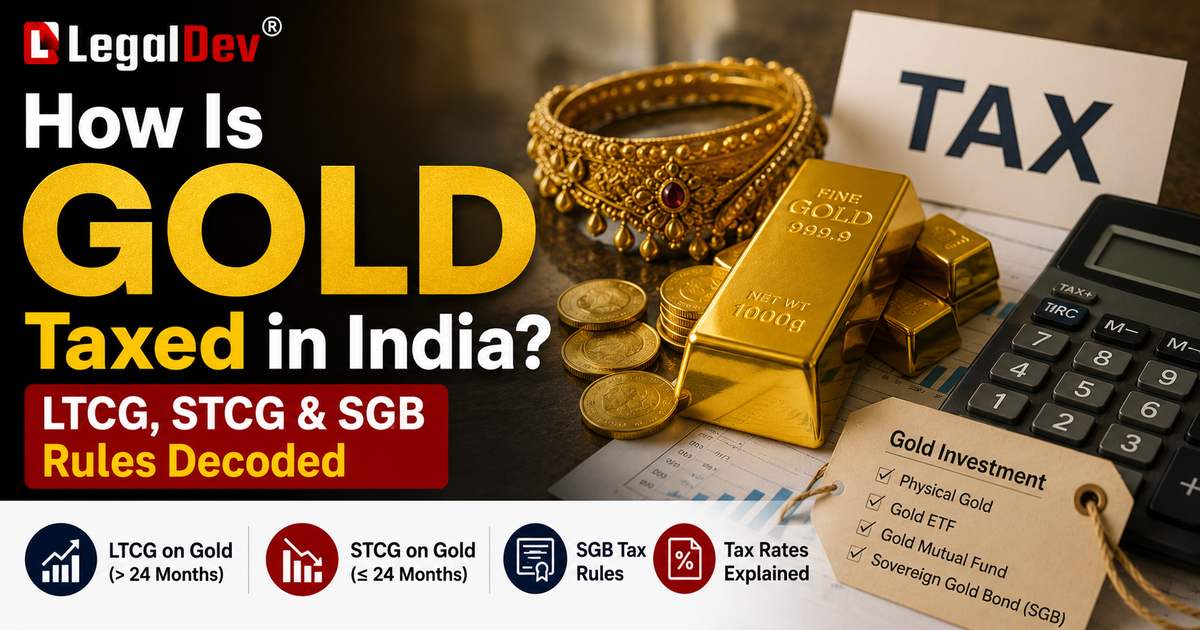
Income Tax on Gold in India: Digital, Physical and Paper Gold Explained
Gold has always been the go-to investment for Indians — safe, familiar, and something you can actually hold. But when it comes to selling, the tax side tends to catch people off guard. Whether you've bought jewellery, gold ETFs, digital gold, or Sovereign Gold Bonds, each one gets taxed differently, and the holding period matters a lot.
Here's how income tax on gold in India actually works — without the confusion.
Gold Tax in India: Quick Reference Table
Before getting into the details, here's the full picture at a glance:
|
Form of Gold
|
STCG Holding Period
|
STCG Tax Rate
|
LTCG Holding Period
|
LTCG Tax Rate
|
|
Physical Gold (bars, coins, jewellery, digital gold)
|
≤ 24 months
|
Slab rates
|
> 24 months
|
12.5%
|
|
Gold ETF
|
≤ 12 months
|
Slab rates
|
> 12 months
|
12.5%
|
|
Gold Mutual Funds
|
≤ 24 months
|
Slab rates
|
> 24 months
|
12.5%
|
|
SGB (original subscriber, held till redemption)
|
—
|
Exempt
|
Exempt
|
Exempt
|
|
SGB (secondary market or sold early)
|
≤ 12 months
|
Slab rates
|
> 12 months
|
12.5%
|
The broad rule: long-term capital gains on gold are taxed at 12.5%, while short-term gains are taxed at your applicable income slab rate.
Tax on Physical Gold
Physical gold — jewellery, coins, biscuits, ornaments, bullion — has been the most popular form of gold investment in India for generations. And when you sell it, the Income Tax Act applies capital gains tax based on how long you held it.
Hold it for more than 24 months and any profit is a long-term capital gain, taxed at 12.5% plus applicable cess.
Sell before 24 months and the gain is short-term — taxed at your normal income tax slab rate. No special rate, no benefit.
One thing worth keeping in mind: the 12.5% LTCG rate on gold was revised downward from 20% in 2024, and indexation was also removed at that point. So your purchase cost doesn't get adjusted for inflation anymore.
Tax on Digital Gold
Digital gold works exactly like physical gold — just bought online, stored in vaults by the issuer on your behalf. You never touch it, but you own it.
The tax treatment is identical to physical gold. Hold for more than 24 months — LTCG at 12.5%. Sell earlier — taxed at slab rates.
One important caveat: digital gold is not regulated by RBI or SEBI. That's a risk separate from tax, but worth knowing before you put large amounts in.
Tax on Paper Gold
Paper gold covers Gold ETFs, Gold Mutual Funds, and Sovereign Gold Bonds. You hold these on paper (or digitally), with no physical delivery.
Gold ETFs
Gold ETFs are traded on stock exchanges just like shares. The holding period for LTCG here is 12 months — shorter than physical gold. Hold longer than a year and pay 12.5% LTCG. Sell within 12 months and it's taxed at your slab rate.
The income you earn when selling ETF units is treated as capital gains, not income from other sources.
Gold Mutual Funds
Gold mutual funds invest in Gold ETFs and follow the same NAV-based structure. The holding period threshold for LTCG is 24 months — same as physical gold. LTCG is taxed at 12.5%, STCG at slab rates.
Sovereign Gold Bonds (SGBs)
SGBs deserve special attention because the tax treatment is the most favourable — if you play by the rules.
If you are the original subscriber and hold the bond until redemption (8 years), the capital gains are completely exempt from tax. That's a significant advantage over every other form of gold.
But if you buy SGBs from the secondary market, or sell before the redemption date, you lose that exemption. In that case, LTCG (held beyond 12 months) is taxed at 12.5%, and STCG at slab rates.
Also — interest earned on SGBs is fully taxable regardless of how you hold them. The exemption only covers capital gains on redemption.
Budget 2026 has added one more condition worth noting: the tax-free redemption benefit now requires that the bonds were originally subscribed (not just held till maturity). Secondary market buyers cannot claim this exemption even if they hold until maturity.
Tax on Gold Derivatives
Gold derivatives are contracts traded on the commodities market, where the underlying asset is gold itself.
The tax treatment here is different from all the above. Profits from gold derivatives are treated as business income — specifically non-speculative business income — and taxed at your applicable slab rate. There's no flat 12.5% rate here.
The upside: you can claim business expenses against this income, prepare a profit and loss account, and reduce your taxable amount accordingly. That flexibility is something physical or paper gold doesn't offer.
Some tax advisors also suggest that if you want to apply Section 44AD (presumptive taxation), you'd need to maintain proper books of accounts. Worth discussing with a CA if derivatives are a significant part of your gold exposure.
Tax on Gifted or Inherited Gold
Gold gifted within families is one of those areas where the Income Tax Act is actually reasonable.
Under Section 56(2), gold received as a gift from parents, spouse, siblings, or other specified relatives is fully exempt from income tax. Gold given at the time of a wedding is also not taxable — regardless of the amount or who gives it.
The threshold kicks in only when gold is received from non-relatives. If the aggregate value of such gifts exceeds ₹50,000 in a financial year, the entire amount becomes taxable under "Income from Other Sources."
One thing that often gets missed: even if the original gift was tax-free, the sale of that gifted gold is a separate event. Capital gains tax applies when you sell it. The acquisition cost is taken as the original purchase price of the previous owner, and the holding period is calculated from when that owner acquired it.
Tax on Gold for NRIs
NRIs can invest in physical gold, digital gold, and paper gold in India. The tax rates on capital gains are the same as for resident Indians — no separate rate for NRIs on gold.
However, NRIs cannot invest in Sovereign Gold Bonds as per RBI and FEMA regulations. That exemption remains out of reach for them.
How to Save Tax on Long-Term Capital Gains from Gold
If you've sold gold and made a long-term capital gain, there are two sections under the Income Tax Act that can help reduce your tax outgo.
Section 54F allows you to claim an exemption on LTCG if you invest the sale proceeds into a residential house property. The exemption is proportionate to the amount invested. Sell gold, put the money into a home, and the capital gains are correspondingly reduced.
Section 54EC allows you to invest LTCG into specified bonds (like NHAI or REC bonds) within 6 months of the sale and claim an exemption up to ₹50 lakh.
These aren't loopholes — they're specifically written into the law for this purpose.
A Note on Reporting Gold Income in Your ITR
Capital gains from gold whether physical, digital, ETF, or SGB are reported under the Capital Gains schedule in your Income Tax Return. If your gold gains are being treated as business income (derivatives), they go under the business income schedule.
If in doubt, a chartered accountant can help you figure out which ITR form applies and how to fill it correctly.
Key Takeaways for Gold Investors
Gold is not a risk-free investment. Prices move with global economic conditions, currency fluctuations, and geopolitical events — just like equities or bonds. What makes gold unique is the emotional weight it carries in Indian households, and that's not going away anytime soon.
Understanding how each form of gold is taxed helps you structure your holdings better — whether that means shifting from digital gold to SGBs for the tax exemption, or keeping track of holding periods before selling.
The numbers aren't complicated. It's mostly about knowing which category your gold falls into.
FAQs
Q: What is the tax rate on selling gold in India in 2025?
A: Long-term capital gains on gold — for holdings above 24 months (or 12 months for Gold ETFs) — are taxed at 12.5% without indexation. Short-term capital gains are taxed at your applicable income slab rate. This rate applies to physical gold, digital gold, and gold mutual funds alike.
Q: Is digital gold taxed differently from physical gold?
A: No, digital gold and physical gold are taxed identically. Both attract 12.5% LTCG tax if held for more than 24 months, and slab-rate STCG tax if sold within 24 months. The only difference is how you hold it — digital gold is stored in vaults by the issuer while physical gold stays with you.
Q: Are Sovereign Gold Bonds completely tax-free?
A: Only if you are the original subscriber and hold the SGB until RBI's redemption date (8 years). In that case, capital gains are fully exempt. If you buy SGBs from the secondary market or sell before maturity, normal capital gains tax applies. Interest earned on SGBs is always taxable regardless.
Q: How is inherited gold taxed when I sell it?
A: Gold received through inheritance is not taxed at the time of inheritance. But when you sell it, capital gains tax applies. The cost of acquisition is taken as the original purchase price paid by the previous owner, and the holding period is counted from when they acquired it.
Q: Can I save tax on long-term capital gains from selling gold?
A: Yes — under Section 54F, you can claim an exemption by investing the sale proceeds into a residential house property. Under Section 54EC, investing up to ₹50 lakh in specified bonds within 6 months of the sale also reduces your tax liability. Both provisions are specifically available for LTCG from gold sales.
Q: What is the holding period for Gold ETFs to qualify for LTCG?
A: For Gold ETFs, the holding period for long-term capital gains is 12 months — shorter than the 24-month threshold for physical gold and gold mutual funds. If you sell after more than 12 months, gains are taxed at 12.5%. Sell within 12 months and it's taxed at your income slab rate.
Q: Do NRIs pay the same gold tax rate as Indian residents?
A: Yes, the capital gains tax rates on gold for NRIs are the same as for resident Indians. However, NRIs are not permitted to invest in Sovereign Gold Bonds under RBI and FEMA regulations, so that tax exemption option is not available to them.
Q: How are profits from gold derivatives taxed?
A: Profits from gold derivatives are treated as non-speculative business income and taxed at slab rates — not at the flat 12.5% LTCG rate. The advantage is that you can claim business expenses and prepare a P&L account to reduce taxable income.
Q: Is gold received as a wedding gift taxable in India?
A: No. Gold received as a gift on the occasion of a wedding is not taxable, regardless of the amount or who gives it. Gold gifted by specified relatives — parents, spouse, siblings — is also tax-exempt. Only gold received from non-relatives exceeding ₹50,000 in a year becomes taxable.
Q: What changed in gold taxation after Budget 2024?
A: In Budget 2024, the LTCG rate on gold was reduced from 20% to 12.5%, but indexation benefit was simultaneously removed. This means your purchase price is no longer adjusted for inflation when calculating gains. Whether this is better or worse depends on your holding period and the rate of inflation during that period.