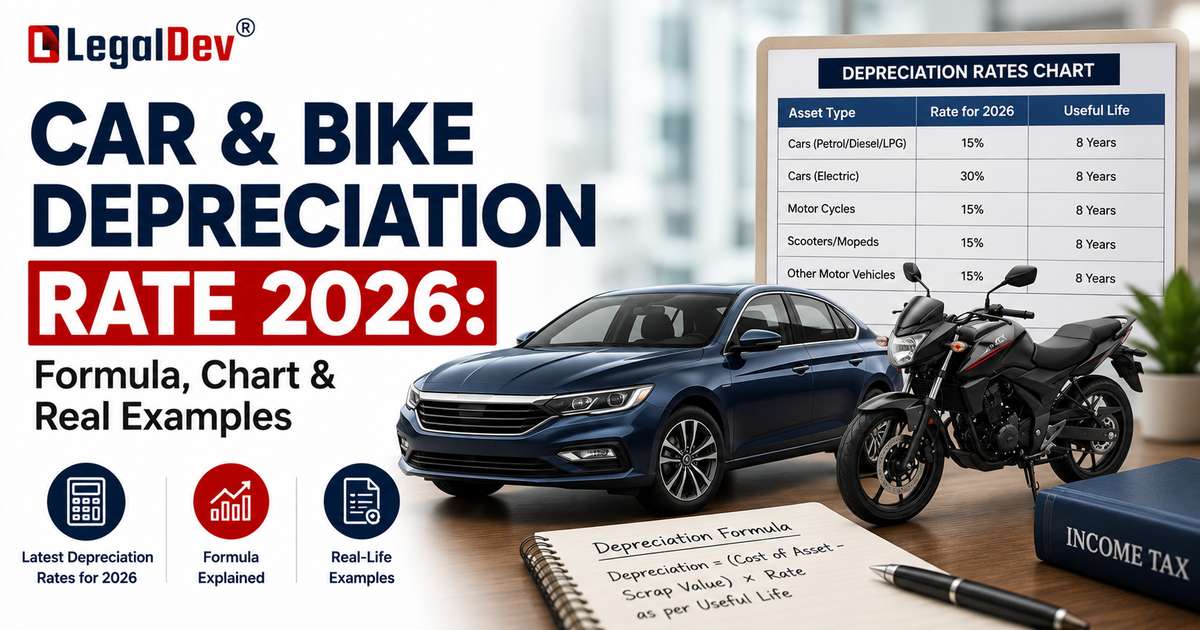
Car And Bike Depreciation Rate: Formula, Chart & Real Examples (2026)
The moment you drive your new car or ride your new bike out of the showroom, its value starts dropping. That is just how it works. This gradual reduction in value because of wear, age, and usage is called depreciation. And if you plan to sell your vehicle or make an insurance claim, the car and bike depreciation rate is one number you really cannot afford to ignore.
Here is everything you need to know the rates, the formulas, the charts, and some real examples to make it all click.
Depreciation Rate For Cars And Bikes As Per Income Tax Act
Under the Income Tax Act, a 15% depreciation rate applies to vehicles including cars, motorcycles, and scooters that are not used for commercial hire purposes. This rate is applied using the Written Down Value (WDV) method, meaning depreciation is calculated on the remaining book value each year, not the original purchase price.
Here is how the classification looks:
|
Asset Class
|
Asset Type
|
Depreciation Rate
|
|
Plant & Machinery
|
Motorcycle, scooter, motor car (not used for hire)
|
15%
|
|
Plant & Machinery
|
Motor car acquired between 23rd Aug 2019 – 1st Apr 2020, used before 1st Apr 2020
|
30%
|
The bike depreciation rate as per the Income Tax Act follows the same classification. So whether you own a sedan or a sports bike, the baseline is 15% WDV unless your vehicle falls under the special acquisition window that bumps it to 30%.
Depreciation Rate For Cars As Per Companies Act 2013
The Companies Act 2013 takes a slightly different approach. Depreciation here is linked to the asset's useful life rather than a flat percentage. For motor cars, that useful life is set at 6 to 8 years.
Vehicles used for hiring (taxis, motor buses, lorries):
-
15.83% as per Straight Line Method (SLM)
-
39.30% as per Written Down Value (WDV)
Vehicles not used for hiring:
-
11.88% as per SLM
-
31.23% as per WDV
The car depreciation rate as per the Companies Act matters primarily for businesses that own vehicles and need to show accurate asset values in their balance sheets.
Depreciation Rate For Bikes As Per Companies Act
For two-wheelers mopeds, scooters, and motorcycles the Companies Act assigns a useful life of 10 years, which is longer than cars. That longer life translates to a lower annual depreciation rate.
Bike depreciation rate (Companies Act):
-
9.50% as per SLM
-
25.89% as per WDV
If you run a business and own bikes as assets, these are the numbers your accountant will work with.
Depreciation Rate Chart For Cars And Bikes (Vehicle Insurance / IDV)
For insurance purposes, depreciation is calculated differently. Here, the age of your vehicle determines the applicable rate, which is then used to compute the Insured Declared Value (IDV) the figure your insurer uses to settle claims.
|
Age of Vehicle
|
Depreciation Rate (for IDV)
|
|
Less than 6 months
|
5%
|
|
6 months to 1 year
|
15%
|
|
1 year to 2 years
|
20%
|
|
2 years to 3 years
|
30%
|
|
3 years to 4 years
|
40%
|
|
4 years to 5 years
|
50%
|
The bike depreciation rate chart for insurance purposes is identical to the one above. After five years, there is no fixed percentage the vehicle IDV is mutually decided between you and your insurer.
What Is IDV And Why Does It Matter?
IDV Insured Declared Value is essentially what your vehicle is worth in the eyes of your insurance company. It is the maximum amount the insurer will pay if your car or bike is stolen or declared a total loss.
Bike depreciation is calculated by starting with the current ex-showroom price, applying the depreciation rate based on the bike's age, and subtracting that figure to arrive at the IDV.
One thing worth knowing: a lower IDV means a cheaper premium. But it also means a smaller payout if something goes wrong. A higher IDV costs slightly more but gives you better protection. The sweet spot? Keep your IDV as close to the actual market value of your vehicle as possible.
Car And Bike Depreciation Rate After 5 Years
After five years, your vehicle enters a grey zone no fixed depreciation percentage applies. The insurer and owner sit down and agree on a rate that reflects the vehicle's current condition, serviceability, and market demand.
This is actually where negotiation matters. An older car that has been well-maintained is worth more than a neglected one of the same age. Do not let the insurer undervalue your vehicle just because of the age bracket.
What Is Zero Depreciation In Car Insurance?
Zero depreciation also called nil depreciation or bumper-to-bumper cover is an add-on to your standard car insurance policy. With this cover, the insurer does not deduct any depreciation amount when settling your claim.
Without it, if your car's bumper gets damaged and needs replacement, the insurer pays only a portion after applying depreciation on the part's value. With zero depreciation cover, you get the full replacement cost.
A few things it helps with:
-
Higher claim payouts, since no depreciation is deducted from part costs
-
No out-of-pocket expense for depreciation during claim settlement
-
The premium for this add-on is relatively low compared to what it saves you
Worth it? Absolutely especially for new vehicles in the first three to four years.
How To Calculate Car Depreciation
Indian insurers provide online IDV calculators on their websites. You enter your vehicle's registration number, year of manufacture, brand, model, and city and the tool does the rest.
But if you want to calculate it manually, there are two standard methods:
Diminishing Value Method:
Purchase value × (days owned ÷ 365) × (effective life in years ÷ 200%)
Depreciation here is calculated on the base value of the car.
Prime Cost Method:
Cost of running the car × (days owned ÷ 365) × (100% ÷ effective life in years)
This method calculates depreciation as a fixed percentage of the total cost not the declining balance.
How To Calculate Bike Depreciation
For two-wheelers, the formula centers on IDV:
If you have accessories fitted:
IDV = [Current market value − Depreciation] + [Accessories cost − Depreciation on accessories]
If no accessories:
IDV = Manufacturer's registered price − Depreciation value
The IDV for your bike is not based on what you paid originally. It reflects the bike's current market value from the date the policy starts which changes every year.
Using this formula with your bike's age and the applicable depreciation rate, you can estimate your IDV every year to understand your coverage and plan your premium accordingly.
Real Example: Car Depreciation Calculation
Say you bought a car for ₹5,50,000. After two years, the applicable depreciation rate is 20%.
-
IDV = ₹5,50,000 × 80% = ₹4,40,000
That is the maximum your insurer will pay if your car is totaled or stolen in year two of ownership. Worth knowing before you sign the policy.
Real Example: Bike Depreciation Calculation
Your bike's current market value at the time of buying insurance is ₹1,00,000. It is 3 years old, so the depreciation rate is 40%.
-
Depreciation amount = ₹1,00,000 × 40% = ₹40,000
-
IDV = ₹1,00,000 − ₹40,000 = ₹60,000
This is the amount your insurer would pay in case of theft or total loss not the original purchase price.
Closing Thought
The depreciation rate for cars and bikes affects more than just your resale value it shapes your insurance premium, your claim settlement, and ultimately how much financial protection you actually have. Whether you are about to sell your vehicle, renew your insurance, or just want to know what your bike is worth right now, running the numbers yourself takes only a few minutes. And now you have everything you need to do exactly that.
FAQs
Q1: What is the car depreciation rate as per Income Tax Act for FY 2024-25?
A: The depreciation rate on cars under the Income Tax Act is 15% using the Written Down Value (WDV) method applicable to personal and non-hire vehicles. For vehicles acquired between August 23, 2019 and April 1, 2020 and used before April 1, 2020, the rate was 30%. This rate applies to both cars and bikes under the plant and machinery category.
Q2: How is IDV different from the market value of my car or bike?
A: IDV is the insured declared value the figure your insurer uses to calculate premiums and settle total loss or theft claims. It is based on the current market value minus applicable depreciation. Your actual resale value may differ, since it also factors in demand, brand reputation, condition, and negotiation.
Q3: Does zero depreciation cover make sense for older bikes and cars?
A: Zero depreciation cover is most cost-effective for vehicles that are under three to four years old, since new parts have higher depreciation deductions. For vehicles older than five years, most insurers do not offer this add-on, or the premium becomes too high relative to the benefit. Check with your insurer on eligibility before renewing.
Q4: Can I claim more than the IDV from my vehicle insurance?
A: No IDV is the upper limit of what an insurer will pay in case of a total loss or theft. Some insurers allow you to declare a higher IDV voluntarily, but this increases your premium. It is generally recommended to keep IDV as close to actual market value as possible to avoid overpaying on premium or being underinsured.
Q5: What happens to car and bike depreciation rate after 5 years of ownership?
A: After five years, no standard depreciation percentage applies. The vehicle IDV is negotiated between the owner and the insurer, taking into account the vehicle's current condition, usage history, and market value. If your vehicle is well-maintained, you can push for a higher IDV which directly protects you in case of a major claim.