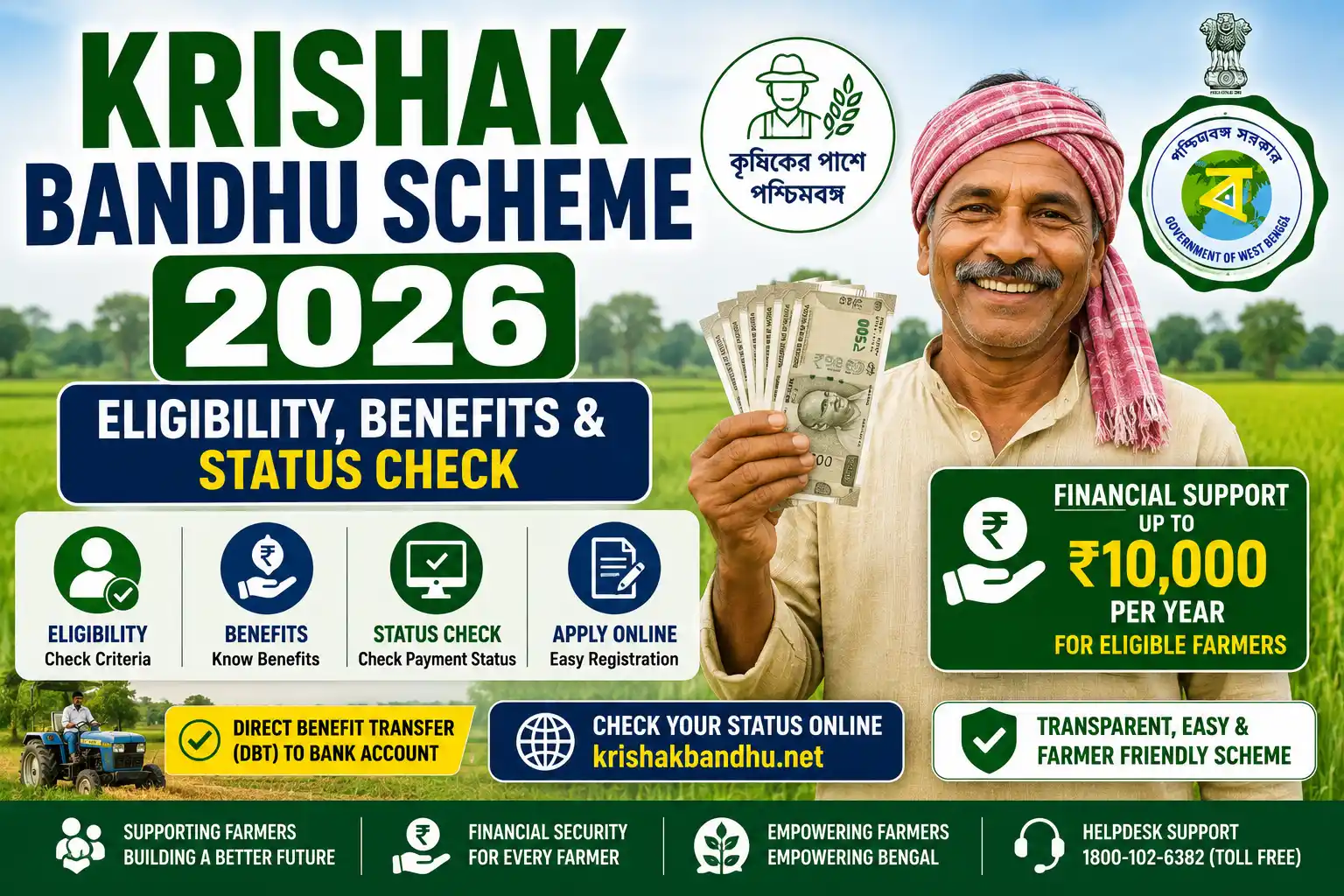
Krishak Bandhu Scheme: Complete Guide to Eligibility, Benefits and Status Check
If you are a farmer in West Bengal or a family member trying to track a payment, here is the short answer first: Krishak Bandhu is the state government's farmer welfare scheme that gives eligible farmers up to ₹10,000 a year in two seasonal instalments, plus a ₹2 lakh death benefit for the farmer's family if the worst happens between the ages of 18 and 60. You can check your status anytime on krishakbandhu.wb.gov.in using your Voter ID, Aadhaar number, or application ID. The rest of this guide walks through everything else you actually need — who qualifies, what papers to keep ready, how the money reaches your account, and how to fix a stuck application.
Some people search for this scheme as "Kisan Bandhu" instead of Krishak Bandhu. Both point to the same West Bengal programme; Kisan Bandhu is just the more common phrasing outside Bengal, since kisan is the Hindi word for farmer and krishak is the Bengali equivalent.
Krishak Bandhu Scheme 2026
Check eligibility, benefits, apply online and track your Krishak Bandhu application status.
Apply Now → Check Status →
What Is the Krishak Bandhu Scheme
The Krishak Bandhu scheme was launched by the Government of West Bengal's Department of Agriculture on 30 January 2019, and it was expanded in June 2021 under the name "Krishak Bandhu (Natun)" with a wider coverage and a simpler registration process. The scheme was built to solve a very specific problem: farmers in West Bengal often go into debt buying seeds, fertiliser, and diesel for irrigation before a single crop is sold. Krishak Bandhu puts money in their hands ahead of the two main cropping seasons instead of after.
It has two parts that work independently of each other.
Assured Income component: every registered farmer, including recorded bhagchasis (sharecroppers), gets seasonal financial support twice a year — once before Kharif (the June to September rainy season crop) and once before Rabi (the October to March winter crop).
Death Benefit component: if a registered farmer between 18 and 60 years old dies, for any reason including natural death, the nominated family member receives a one-time payout of ₹2 lakh. There is no premium to pay for this cover; it comes bundled into the scheme.
Krishak Bandhu Scheme Benefits: How Much Money Do You Get
For farmers owning one acre or more of cultivable land, the assured income works out to ₹10,000 a year, split into two instalments of ₹5,000 each — one for Kharif, one for Rabi.
Farmers who own less than one acre still qualify, just on a pro-rata basis. Depending on the exact landholding, this can range from around ₹2,000 to ₹4,000 a year, with the government's original notification setting a floor of ₹1,000 per instalment so that even very small plots aren't left out.
The death benefit stays fixed at ₹2 lakh regardless of landholding size, paid as a single lump sum to the registered nominee.
One thing worth knowing if you're also on PM Kisan: the two schemes don't cancel each other out. A West Bengal farmer who qualifies for both can receive ₹10,000 from Krishak Bandhu and ₹6,000 from PM Kisan in the same year, taking combined support to around ₹16,000 annually.
Who Is Eligible for Krishak Bandhu
The eligibility rules are fairly wide by design, since the scheme was meant to cover working farmers rather than just landowners on paper.
-
You must be a permanent resident of West Bengal.
-
You must be a farmer or a recorded bargadar (sharecropper) cultivating land in the state.
-
You need valid land records in your name — Record of Rights (RoR), a Patta, Forest Patta, or a registered Bargadar certificate. Unrecorded sharecroppers have in the past been allowed a panchayat-certified self-declaration in place of formal records, though it's worth confirming current acceptance at your local Krishi Office before relying on this route.
-
For the assured income part, there's no upper age limit on the farmer.
-
For the death benefit part specifically, the farmer's age at the time of death must fall between 18 and 60 years, and eligibility for the payout doesn't depend on the family's monthly income.
Documents Required for Krishak Bandhu Registration
Keep these ready before you start the application, whether you're doing it online or through a Duare Sarkar camp:
-
Aadhaar card
-
Voter ID card (EPIC)
-
Land ownership documents — Khatian, Patta, Porcha, or Bargadar certificate
-
First page of your bank passbook or a cancelled cheque, with the account linked to Aadhaar for direct benefit transfer
-
Mobile number registered against your Aadhaar and bank account
-
A recent passport-size photograph
If you're applying under the death benefit component for a deceased family member, you'll additionally need the farmer's death certificate, their identification documents, the Record of Rights in their name, and an eligibility certificate from the Block Development Officer confirming the claimant's relationship to the deceased.
How to Apply for Krishak Bandhu Scheme
There are two ways to register, and both lead to the same database.
Online, through the official portal:
-
Go to krishakbandhu.wb.gov.in.
-
Look for the registration or sign-in option on the homepage.
-
Fill in your personal details, Voter ID and Aadhaar numbers, land information, and bank account details.
-
Upload scanned copies of the documents listed above.
-
Submit the form and note down the ID number you're given — you'll need it for every future status check.
Offline, through a government camp or office:
-
Collect the Krishak Bandhu application form from your nearest Duare Sarkar camp or the local Block Development Office (agriculture desk).
-
Fill it out by hand, attach the required documents, and submit it at the same counter.
-
Ask for an acknowledgment slip with your reference number.
Offline applications usually take a little longer to reflect online, so if you've applied at a camp, give it a few weeks before you start checking status.
How to Check Krishak Bandhu Status Online
Once you're registered, checking your status takes about a minute. The portal gives you three ways to search — pick whichever ID you have handy.
Using Voter ID (EPIC number):
-
Open krishakbandhu.wb.gov.in.
-
Find the "Status Check" or "Beneficiary Status" section on the homepage.
-
Select the option to search by Voter ID.
-
Type in your EPIC number exactly as it appears on the card, with no extra spaces.
-
Submit the form to view your current status.
Using Application ID or Aadhaar: the same status page lets you switch the search method — just pick Application ID or Aadhaar instead of Voter ID and enter the relevant number.
A successful status check tells you whether your application is approved, pending, or rejected, whether your documents have cleared verification, your Krishak Bandhu ID for future reference, and your payment history, including which instalments have already been credited to your account.
If your status shows "Rejected," the portal or your local agriculture office should tell you which document or detail didn't match. The most common reasons are a mismatch between the name on your land record and your Aadhaar, or an unlinked bank account. Fix that specific issue and reapply rather than starting over from scratch.
Krishak Bandhu Helpline
If the online status check doesn't resolve your query, or your payment hasn't arrived after both seasonal windows have passed, you can reach the scheme's helpline directly:
Frequently Asked Questions
Is Krishak Bandhu the same as Kisan Bandhu?
Yes. Krishak Bandhu is the official name used by the West Bengal government; Kisan Bandhu is simply the Hindi-language version people commonly search for. Both refer to the same scheme, same portal, and same benefits.
Can a sharecropper apply for Krishak Bandhu?
Yes, recorded bargadars are explicitly covered under the scheme, and their financial support is calculated the same way as for landowning farmers, based on the land they cultivate.
How long does it take for Krishak Bandhu payment to arrive after registration?
There's no fixed guaranteed timeline, since it depends on document verification at the block level, but payments are generally released ahead of each cropping season once an application clears verification. If a season passes with no credit, checking status online and then following up at your Krishi Office is the practical next step.
Can I get both PM Kisan and Krishak Bandhu at the same time?
Yes. The two schemes run independently, and a West Bengal farmer who qualifies for both can receive support from each without one affecting the other.
What happens if my Krishak Bandhu application is rejected?
The rejection is usually tied to a specific document mismatch, most often between land records and identity proof, or an unlinked bank account. Correct that issue and resubmit rather than treating the rejection as final.
Is there any fee to apply for Krishak Bandhu?
No. Registration, verification, and the death benefit cover are all free. You never need to pay anyone to register or to "speed up" your application.
In Short
Krishak Bandhu exists to put predictable money into a farmer's hands before the costs of a new season start piling up, and to give families some financial cushion in the worst case. If you're eligible, the effort of registering once — with your land papers, Aadhaar, and a linked bank account in order — pays off twice a year going forward. And if you've already applied, checking your status online with your Voter ID takes far less time than a trip to the block office.