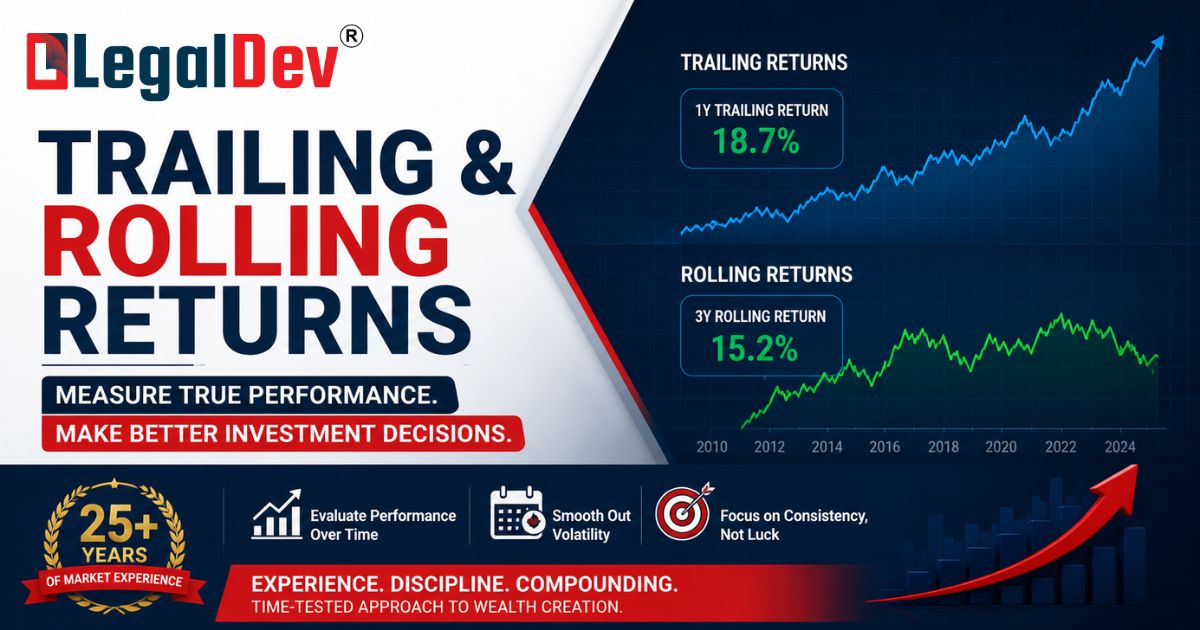
Trailing and Rolling Returns in Mutual Funds Meaning, Calculation & Which One to Trust
Most people check a mutual fund's 1-year or 3-year return and call it research. That number the one prominently displayed on every fund factsheet is a trailing return. Clean, simple, easy to compare. But does it tell you the whole story? Not really. That is where rolling returns come in. And once you understand both, you will never look at fund performance the same way again.
What Are Trailing Returns?
Trailing returns measure how a mutual fund has performed between two fixed points in time a start date and an end date. You will also hear them called point-to-point returns. The 1-year return, 3-year return, 5-year return figures you see on platforms like Groww, Zerodha, or ET Money all of those are trailing returns. They are calculated as CAGR (Compounded Annual Growth Rate) for periods longer than one year.
Formula:
Trailing Return (CAGR) = [(Ending Value ÷ Beginning Value) ^ (1 ÷ n)] − 1
Example:
Say you invested ₹1,00,000 in a mutual fund on June 1, 2023. By June 1, 2026, that investment has grown to ₹1,40,000. Plug those numbers in:
CAGR = [(1,40,000 / 1,00,000) ^ (1/3)] − 1 CAGR = 11.87%
So over 3 years, the fund delivered an average annual return of roughly 11.87%. That is what trailing returns tell you.
Features of Trailing Returns
-
Mutual funds use trailing returns to publish performance data across standard time blocks (3 months, 1 year, 3 years, 5 years)
-
The data is based on historical NAVs and is readily available at any point in time
-
It is the most widely used and easily understood return measure
Trailing Returns Example ELSS Funds
The table below shows trailing returns for popular ELSS mutual funds across different fixed periods:
|
Scheme Name
|
3 Months
|
1 Year
|
3 Years
|
5 Years
|
|
Axis ELSS Tax Saver Fund
|
2.1%
|
18.5%
|
14.2%
|
17.8%
|
|
SBI Long Term Equity Fund
|
1.4%
|
15.3%
|
12.1%
|
16.4%
|
|
Aditya Birla SL ELSS Tax Relief 96
|
2.8%
|
20.1%
|
15.6%
|
18.9%
|
|
ICICI Prudential ELSS Tax Saver Fund
|
1.1%
|
13.8%
|
11.4%
|
15.7%
|
|
HDFC ELSS Tax Saver Fund
|
1.9%
|
17.2%
|
13.5%
|
17.1%
|
Note: Data is for educational purposes only. Do not treat this as investment advice.
Now here is the limitation no one talks about enough trailing returns are heavily influenced by when you check them. A fund that looks brilliant in a bull market can look ordinary two years later, even if nothing about the fund itself changed. The endpoint matters a lot. That is called recency bias, and trailing returns are vulnerable to it.
What Are Rolling Returns?
Rolling returns solve the problem trailing returns create.
Instead of measuring performance between just one pair of dates, rolling returns calculate a fund's performance across multiple overlapping time windows shifting forward by a day, week, or month each time. The result is not one number but a distribution average, median, best case, worst case across many different market conditions.
Rolling returns measure a fund's absolute and relative performance across all timescales, without the bias that comes from looking at a single fixed period.
Example:
Suppose you want to check the 3-year rolling returns of a mutual fund from January 2015 to January 2025.
-
First window: January 2015 → January 2018. Calculate CAGR.
-
Shift forward one month. Second window: February 2015 → February 2018. Calculate CAGR.
-
Continue this for every month until January 2025.
By the end, you have roughly 84 data points (one per month, over 7 years of shifting windows). Now you can see the average return, the best 3-year stretch, the worst, and how often the fund delivered above or below a target return. That is a far richer picture than a single trailing figure.
Advantages of Rolling Returns
-
Shows consistency you can see how the fund performs across bull runs, corrections, and sideways markets
-
Reduces period bias the endpoint does not disproportionately skew the result
-
Better for SIP investors since SIP investors are investing across multiple market cycles, rolling returns reflect their actual experience far better than a single trailing figure
-
Enables genuine long-term comparison comparing two funds on rolling returns tells you which one is reliably better, not just lucky at a particular endpoint
Rolling Returns Example ELSS Funds
The table below shows rolling returns for the same ELSS funds across multiple time periods, showing consistency of performance:
|
Scheme Name
|
Average (%)
|
Median (%)
|
Maximum (%)
|
Minimum (%)
|
Less than 0%
|
0–5%
|
5–10%
|
10–15%
|
15–20%
|
>20%
|
|
Axis ELSS Tax Saver Fund
|
16.8
|
16.1
|
24.5
|
9.4
|
0
|
0
|
6
|
38
|
42
|
14
|
|
SBI Long Term Equity Fund
|
14.2
|
13.7
|
21.3
|
7.8
|
0
|
2
|
18
|
52
|
24
|
4
|
|
Aditya Birla SL ELSS Tax Relief 96
|
17.9
|
17.2
|
25.8
|
10.6
|
0
|
0
|
4
|
32
|
48
|
16
|
|
ICICI Prudential ELSS Tax Saver Fund
|
13.6
|
13.1
|
20.4
|
6.9
|
0
|
4
|
24
|
50
|
20
|
2
|
|
HDFC ELSS Tax Saver Fund
|
15.1
|
14.6
|
22.7
|
8.3
|
0
|
1
|
14
|
49
|
30
|
6
|
Note: Data is for educational purposes only. Do not treat this as investment advice.
Look at Aditya Birla SL ELSS the rolling data shows it delivered returns above 15% for roughly 64% of all 3-year windows measured. Zero periods where it gave negative returns. That kind of consistency is invisible in a trailing return snapshot.
The trailing return tells you where the fund ended up. The rolling return tells you how it got there and whether it was a smooth ride or a lucky finish.
Difference Between Trailing Returns and Rolling Returns
|
Basis
|
Trailing Returns
|
Rolling Returns
|
|
Meaning
|
Tracks return between one fixed start date and end date
|
Looks at returns across several overlapping time periods
|
|
Focus
|
How the fund performed over a particular period
|
Whether the fund delivered steady performance over time
|
|
Best For
|
Quick snapshot of historical returns
|
Understanding fund behaviour across different market cycles
|
|
Accuracy
|
Can look better or worse depending on dates chosen
|
Broader and more realistic picture of performance
|
|
Suitable For
|
Lump sum investors reviewing past performance
|
Long-term investors and SIP investors
|
Trailing vs Rolling Returns Which Is Better?
Trailing returns have a recency bias they are specific to the period chosen. Rolling returns, by contrast, measure performance across all timescales without bias.
That said, neither is useless. Trailing returns are fast and easy they give you a quick read on how a fund has done recently, and almost every platform shows them. If you are doing a first-pass filter across ten funds, trailing returns get the job done.
But for any serious evaluation especially before a long-term SIP commitment rolling returns are the metric that matters. Rolling returns are more indicative of a fund's true performance because they factor in different periods, allowing you to measure the return consistency of a fund.
Think of it this way. Trailing returns answer: "How did this fund do?" Rolling returns answer: "Can I trust this fund to keep doing it?"
For most investors building wealth over 10 to 20 years, the second question is the one that actually counts.
A Quick Note on Recency Bias
One thing worth flagging trailing returns are especially misleading when markets have just had an unusually strong or weak run.
If you check a fund's 1-year trailing return in January 2024, after the Nifty's strong 2023 rally, almost every fund looks excellent. Check the same funds in June 2022, after a sharp correction, and they all look terrible. The fund did not change the endpoint did. Rolling returns smooth out this distortion by averaging performance across many such endpoints.
The trailing return may look excellent in a bull market and pathetic in a bear market but the fund itself may not have changed at all. Rolling returns remove this endpoint dependency from the equation.
Which Return Measure Should You Use?
Use trailing returns when you want a fast comparison across funds especially for a first pass. They are widely available, standardised, and easy to read.
Use rolling returns when you are deciding between two similar funds, evaluating a fund for a long-term SIP, or trying to understand how a fund actually behaves when markets get rough.
Ideally, use both. Trailing returns for the shortlist. Rolling returns for the final call.
FAQs
Q1: What is the difference between trailing returns and rolling returns in mutual funds?
A: Trailing returns measure performance between two fixed dates say, exactly 3 years ago to today. Rolling returns measure performance across multiple overlapping time windows, shifting forward period by period. Trailing returns give you one data point; rolling returns give you a distribution, showing average, best, and worst outcomes across different market conditions.
Q2: Which is better trailing returns or rolling returns for evaluating a mutual fund?
A: Rolling returns are generally considered more reliable because they reduce recency bias and show how consistently a fund performs across different market cycles. Trailing returns are useful for quick comparisons, but rolling returns are better for any serious long-term evaluation especially before starting a SIP.
Q3: Why do trailing returns look different depending on when you check them?
A: Because they are point-to-point measurements. The endpoint heavily influences the result. A fund checked after a bull market looks great; the same fund checked after a correction looks weak even if the fund's quality has not changed. This is called recency bias, and it is the main limitation of trailing returns.
Q4: How are rolling returns calculated for a mutual fund?
A: Choose a fixed holding period say, 3 years. Calculate the CAGR from the start date to 3 years later. Then shift the start date forward by one month and recalculate. Repeat this for every monthly window across the entire available data period. The result is a set of returns that shows average performance, peak performance, worst performance, and how often the fund delivered above or below a target return.
Q5: Are trailing returns the same as CAGR?
A: For periods longer than one year, trailing returns are expressed as CAGR (Compounded Annual Growth Rate). For shorter periods, they are expressed as absolute returns. The formula is: CAGR = [(Ending Value ÷ Beginning Value) ^ (1 ÷ number of years)] − 1. So yes a 3-year or 5-year trailing return is effectively the 3-year or 5-year CAGR of the fund.
Q6: Do SIP investors benefit more from rolling returns than trailing returns?
A: Yes. SIP investors buy units across multiple market conditions they are not investing at one fixed date. Rolling returns reflect performance across many different entry points and time periods, which mirrors a SIP investor's experience far better than a single trailing return figure does.
Q7: Can a fund have a good trailing return but poor rolling returns?
A: Absolutely and this is one of the most important things rolling returns reveal. A fund might have a strong 3-year trailing return because markets happened to peak near the end of that window. But its rolling returns might show it was inconsistent delivering high returns in some periods and mediocre returns in others. That inconsistency is a real risk for investors.
Q8: What does it mean if a fund has a high rolling return average but a low minimum rolling return?
A: It means the fund's average performance is strong, but it has had some weak stretches. The wider the gap between maximum and minimum rolling returns, the more volatile and inconsistent the fund. A fund with a lower average but tighter range is often a safer choice especially for risk-averse investors or those nearing their financial goal.
Q9: Where can I find rolling return data for Indian mutual funds?
A: Rolling return data is not as widely published as trailing returns. You can find it on platforms like AdvisorKhoj (which has a dedicated rolling returns tool), Morningstar India, and some advanced features on Kuvera and Scripbox. Most fund factsheets only show trailing returns.
Q10: Do mutual fund factsheets in India show trailing or rolling returns?
A: Mutual fund factsheets in India primarily show trailing returns across standard periods like 1 month, 3 months, 6 months, 1 year, 3 years, and 5 years. Rolling return data requires separate tools or research platforms. SEBI mandates specific performance disclosure formats, and trailing returns are the current standard for factsheet reporting.