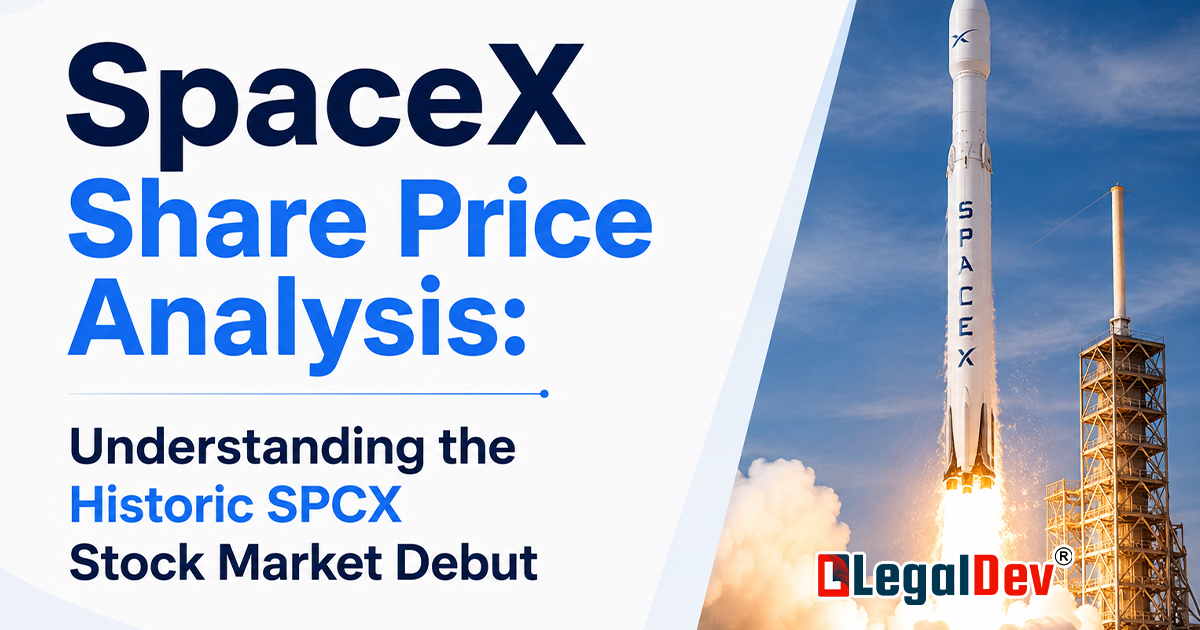
On June 12, 2026, SpaceX made a huge impact in the Global Financial System as they shifted from being a privately held company with very strict security, to a very large publicly traded company on the Nasdaq Exchange. Their initial public offering (IPO), completed under the ticker symbol SPCX, immediately broke every record in history for capital and value of a company when they went public.
The IPO is driven by founder Elon Musk's longer-term vision and represents much more than a traditional technology IPO. The SpaceX IPO links the traditionally separate industries of frontier aerospace and the immense number of computational resources needed to supply the artificial intelligence infrastructure of the 21st century.
Thus, monitoring the SpaceX stock price is an essential component for retail and institutional investors around the world to assess the future of the Global Technology and Satellite industry.
The Historic Debut of SPCX Stock Price by the Numbers
The sheer scale of the listing has permanently rewritten the Wall Street playbook for mega-cap corporate debuts. By bypassing traditional price-discovery negotiations, the company set an unconventional path that completely altered initial trading dynamics. This structural choice eliminated conventional pre-opening adjustments, forcing open markets to bear the direct brunt of massive global purchasing orders immediately.
Key Listing Metrics at Launch
The actual baseline data collected during the first session of public exchange trading is displayed within the tracking matrix below:
|
Valuation and Price Metrics
|
Official Public Offering Data
|
|
Base IPO Share Price (Fixed)
|
$135.00 USD
|
|
Nasdaq Opening Trade Price
|
$150.00 USD
|
|
Peak Intraday Share Value
|
$176.52 USD
|
|
Final Day One Closing Price
|
$160.95 USD
|
|
Total Initial Capital Raised
|
$75 Billion USD
|
|
Starting Market Capitalization
|
$1.77 Trillion USD
|
|
Peak Intraday Market Cap
|
Over $2.20 Trillion USD
|
|
Total Public Shares Offered
|
555.6 million Shares
|
Breaking Down the Day One Trading Surge
When trading officially commenced at 9:30 AM Eastern Time on the Nasdaq, the space x stock price immediately leaped out of the gate at $150.00 per share. This initial 11% premium over the $135.00 fixed reference point signaled massive, unfulfilled institutional demand. Brokerages were instantly hit with waves of orders that traditional market-making channels struggled to process systematically.
Throughout the session, intense buying pressure pushed the SpaceX share price to an intraday high of $176.52. This spike briefly drove the company's total market valuation past the $2.2 trillion milestone. As early buyers took profits later in the afternoon, the price stabilized to close its first official day of public trading at $160.95 per share. This represented a one-day gain of 19.34% for those fortunate enough to secure allocations at the base offering rate.
[DAY ONE PRICE DISCOVERY FLOW]
Base Offering Allocation: $135.00 ──► Nasdaq Opening Bell: $150.00 ──► Intraday Apex: $176.52
│
┌─────────────────────────────────────────────────────────────────────────┘
▼
Afternoon Profit Extraction ──► Stabilized Settlement ──► Day One Market Close: $160.95
How Elon Musk Transformed Global Wealth via the SpaceX Stock Launch
The financial ripple effects of the public offering have drastically reshaped the global wealth hierarchy. The unique ownership structure of the aerospace giant ensures that its founder retains absolute operational command despite answering to public shareholders. By crafting distinct tiers of corporate equity, the internal hierarchy remains completely top-down in its structural decision-making processes.
The Rise of the World's First Trillionaire
Prior to June 2026, personal wealth calculations were firmly capped in the multi-hundred-billion-dollar range. However, the closing performance of the SPCX stock price officially pushed Elon Musk into uncharted financial territory, making him the world's first verified trillionaire. This milestone places an unprecedented concentration of private capital under the stewardship of a single industrial leader.
Because Musk owns roughly 42% of the total equity, the immediate surge past the $2 trillion market cap threshold cemented his historic personal financial milestone. This direct correlation between public valuation metrics and individual asset holdings highlights the immense wealth generation unlocked by the Nasdaq launch.
Voting Control and Corporate Governance
Many corporate entities face activist investor pressure immediately after a public listing, but Musk insulated his management team from outside interference.
-
Dual-Class Share Structure: The equity structure utilizes specialized Class B shares that carry super-voting rights.
-
Absolute Voting Concentration: Post-IPO filings reveal that Musk controls 82.4% of the total voting power within the public company.
-
Operational Protection: This concentrated control ensures that long-term strategic plans—such as deep-space exploration and heavy capital reinvestment—cannot be derailed by short-term shareholder demands.
The Core Assets Driving the SpaceX Valuation
To understand why the stock fetched such a massive valuation on opening day, it is essential to look at the commercial units driving its current and future revenue. Here’s the thing: the market is evaluating this enterprise not merely as a traditional transportation provider, but as a dual-engine infrastructural monopoly. The modern business model relies on two core pillars that generate reliable recurring cash flows.
Starlink: The Commercial Foundation
While rocket launches capture global attention, the Starlink satellite broadband mega-constellation serves as the company's financial engine. This global network circumvents local telecom ground restrictions seamlessly.
-
Global Footprint: Starlink currently delivers high-speed internet across 164 countries and territories.
-
User Base: The platform has scaled to support approximately 10 million actives, paying subscribers globally.
-
Reliable Cash Flow: Last year, the business generated $18.67 billion in total revenue, driven largely by predictable monthly subscription fees. This steady income stream helps balance the high costs of rocket development.
The Strategic Merger with xAI
A key driver behind the timing of the IPO was the strategic integration of Musk's artificial intelligence venture, xAI, into the core corporate structure. This move repositioned the enterprise from a pure aerospace player into a foundational technology company.
[REVENUE GENERATION ENGINE]
└──Starlink Consumer Subscriptions ──► $18.67 Billion Baseline Income
└── xAI Supercomputing Data Centers ──► Anthropic ($1.25B/mo) & Google ($920M/mo) Cloud Contracts
The business operates the legendary Colossus supercomputing data center in Memphis, Tennessee, which features an unprecedented deployment of 1 million graphics processing units (GPUs). High-profile technology firms have signed massive data-center agreements. Anthropic secured a cloud computing contract worth $1.25 billion per month, while Google signed a secondary agreement valued at $920 million per month to support its own advanced AI models. This combination of space assets and massive data centers allowed the firm to add an astonishing $26 billion in annual run rate (ARR) between its initial SEC filing and its first public trade.
Institutional Demand and the Race for Public Allocation
The lead underwriting team, managed by Goldman Sachs, faced an unprecedented wave of buy orders leading up to the public debut. The sheer scale of capital trying to secure a piece of the space x listing created a highly competitive bidding environment. Financial networks faced enormous structural strain processing the sheer volume of preliminary registration applications.
Over-Subscription Realities
Total institutional orders before the launch reportedly climbed past $250 billion. This meant the overall offering was heavily oversubscribed across multiple investor categories. Heavyweight institutional asset managers, including BlackRock, placed massive block orders of $5 billion or more just to guarantee a starting baseline position. These firms recognized that failing to secure day-one entry would leave them deeply under-indexed against a new multi-trillion-dollar sector leader.
Unconventional Retail Allocations
In a rare move for an IPO of this size, the underwriters carved out an unusually high retail allocation of 20% to 30%. This structure gave everyday individual investors an unprecedented chance to participate directly in the initial wealth creation, rather than waiting for shares to hit the secondary market.
To help meet this wave of public interest, several consumer brokerages took the rare step of lowering their standard account participation minimums. This adjustment allowed smaller retail accounts to buy into the fixed $135.00 entry price. By expanding pool access, the listing avoided becoming an entirely institutional playground, fostering immense popularity across standard consumer trading platforms.
Core Index Controversies and Future Investment Horizons
While the debut was a clear commercial success, the stock's inclusion in major market indexes remains a point of intense debate among Wall Street regulators and retirement fund managers. The structural placement of a corporation this massive reshapes passive allocation rules fundamentally.
Index Status Indicator
The current regulatory landscape governing the asset's inclusion across premier United States market bars is outlined within the table below:
|
Index Registry Type
|
Current Regulatory Position (2026)
|
|
Nasdaq Composite Status
|
Immediately Integrated via Direct Listing
|
|
S&P 500 Eligibility
|
Currently Deferred due to GAAP Profit Rules
|
|
2025 Financial Baseline
|
Reported GAAP Net Loss of $4.94 Billion USD
|
|
Core Regulatory Hurdle
|
Requires 4 Consecutive Quarters of Net Profit
|
The S&P 500 Profitability Hurdle
Despite a total market capitalization that easily places it among the top 10 most valuable corporations listed in the United States, SPCX is currently barred from entering the prestigious S&P 500 Index. S&P Dow Jones Indices reaffirmed that it will not alter its strict requirements for early inclusion. Under these rules, a company must demonstrate positive cumulative net earnings over its most recent four quarters, while also remaining net-profitable in its most recent standalone quarter.
Because the enterprise recorded a net loss of $4.94 billion in 2025 due to massive capital expenditures on AI data centers and next-generation heavy rocket testing, passive mutual funds and mainstream retirement portfolios cannot automatically purchase the stock just yet. This structural barrier creates a stark divergence between the actual size of the business and its representation inside standard index funds.
[INDEX INCLUSION BARRIER]
Aerospace Market Cap ──► Top 10 National Scale ($1.77T Baseline)
│
└──►Nasdaq Composite ──► Integrated Immediately
│
└──► S&P 500 Index ───► BARRED (Fails 4-Quarter GAAP Net Profit Rule due to $4.94B Outlay)
The Debate Over Retirement Fund Exposure
This delay has sparked a fierce debate among institutional observers. Organizations like the American Federation of Teachers have publicly urged the SEC to maintain strict oversight on how the asset is commercialized.
Skeptics point out that the company's valuation multiple is exceptionally high relative to its current revenue, making the SpaceX share price highly sensitive to future testing milestones. They argue that moving the stock into major indexes too quickly could expose millions of ordinary Americans' retirement accounts to high volatility before the underlying company achieves stable, long-term profitability across all business units. This perspective highlights the tension between embracing high-growth technology frontiers and protecting foundational retirement assets from structural testing failures.
Long-Term Outlook for Global Tech Investors
The successful launch of the spcx stock price has clear structural implications for the broader capital markets. By proving that public investors are willing to fund multi-billion-dollar capital expenditure cycles for frontier space and AI infrastructure, the company has set a new precedent for how major technology firm’s scale. For the everyday investor, the core question is whether the current SpaceX share price represents a stable entry point or a short-term peak.
The business now operates as a unique hybrid asset class: part steady telecommunications utility (via Starlink's massive subscription base) and part high-upside technology bet (via its orbital AI ambitions and heavy transport capabilities). As the market processes the historic numbers from this launch, tracking the daily movements of SPCX will serve as a reliable gauge for global investor confidence in high-risk, high-reward technology projects.
Conclusion
SpaceX's historic launch into the Nasdaq's public trading arena has changed the way public capital markets view investments in large infrastructure projects, both in the aerospace and AI industries, as the company has raised $75 billion in funding to fund its long-term growth trajectory. Starlink is creating a predictable, multi-billion dollars subscription revenue stream for the company. However, the company has a huge capital outlay for building its infrastructure, which is adversely impacting its short-term GAAP profitability metrics. Therefore, the current financial situation is what keeps the stock from being included in major passive retirement index's such as the S&P 500. Thus, the ongoing debate on Wall Street over valuation and safety/volatility will continue with respect to this stock. As such, individual technology investors need to closely track the daily price movements of this stock to determine the overall global market sentiment related to high-risk, high-reward technology engineering. If you would like the best possible opportunity to maximize your long-term financial portfolio in light of these emerging technology trends, contact LegalDev an independent financial advisor to assist you with developing a capital allocation strategy today.
Frequently Asked Questions
Q1: What was the official opening trade price of SPCX on the Nasdaq exchange? While the fixed base reference price was set at $135.00 before launch, intense institutional buying pressure drove the official opening trade price to $150.00 per share when trading began on the Nasdaq.
Q2: How did the public listing affect the personal net worth of founder Elon Musk? The closing performance of the stock officially pushed Elon Musk's personal fortune past the twelve-digit barrier, making him the world's first verified trillionaire. This milestone occurred because Musk owns roughly 42% of the total equity, which surged past the $2 trillion market cap threshold on day one.
Q3: What are the main business units driving the financial valuation of the company? The corporate valuation relies on two primary revenue engines: the Starlink satellite internet network, which supports 10 million paying global subscribers, and the xAI division, which operates the 1-million GPU Colossus supercomputer data center.
Q4: Why is the stock currently excluded from the S&P 500 Index despite its massive market cap? The company is barred from entering the S&P 500 because it recorded a GAAP net loss of $4.94 billion in 2025 due to heavy capital spending on AI infrastructure and rocket development. Index rules strictly require four consecutive quarters of cumulative net profits for entry.
Q5: How much capital did the company raise during its initial public offering? The enterprise generated a total of $75 billion in new capital on its first day of public trading, offering 555.6 million public shares to both institutional funds and retail brokerages.