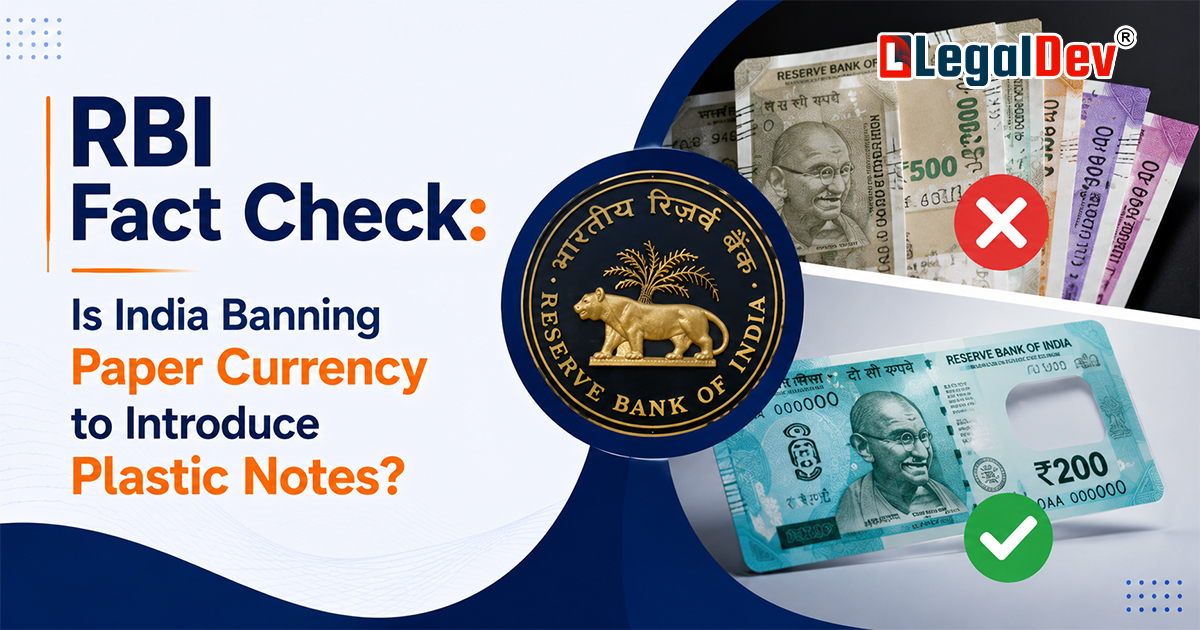
 The Indian financial system has been known to be the source of virulent rumors in respect of currency updates. Recently, a flood of supposed information regarding the Reserve Bank of India will replace all traditional paper currency with plastic currency before 30 June 2026 appeared on various social media platforms and created a great deal of panic amongst many people, similar to the situation that arose from the demonetized notes of 2016. In order to dispel any confusion on this issue, authorities have intervened. This analysis provides an overview of the truth or otherwise, as well as what the Reserve Bank of India thinks of polymer currencies and how India is changing its method of managing modern day currencies.
The Viral Social Media Claim: June 30 Deadline for Paper Currency Ban
A major wave of public concern was triggered across multiple online platforms by a specific video layout. Outlets like X (which was previously known as Twitter), Facebook, and WhatsApp groups became hotbeds for a fast-spreading claim. This viral update confidently told viewers that a complete paper currency ban would be enforced after June 30, 2026, by the central banking authority. According to the video, the government wants to completely replace our current cotton-bamboo blend bills with clean, unspoilable polymer options.
[VIRAL PROPAGATION TIMELINE]
Unverified Video Uploaded ──► Shared on X, WhatsApp & Facebook ──► Timeline Deadline Added
│
┌──────────────────────────────────────────────────────────────────────┘
▼
Public Panic Spreads ──► Retailers Reject Cash ──► Business Savings Feared Obsolete
Because these online posts included specific compliance deadlines, the misinformation felt authentic to casual viewers. Panic spread rapidly through local supply chains as neighborhood shopkeepers and small business owners worried their stored cash reserves would become useless overnight. The fear of a sudden cash invalidation caused people to wonder if they needed to rush to financial institutions to protect their savings. This panic shows how quickly unverified financial claims can disrupt public confidence when people don't cross-check official announcements.
PIB Fact Check: Government Declares Currency Ban Claims as Fake News
To address the growing public panic, the Press Information Bureau stepped in to review the situation. Operating as the official media and communication branch of the government, its dedicated fact-checking department launched a thorough investigation into the video's claims.
The final verification results from the review board are completely clear:
-
100% Total Misinformation: The specialized PIB Fact Check branch officially flagged the viral video and its text captions as completely fake news.
-
No Approaching Deadlines: The Reserve Bank of India has not issued any directives, schedules, or hidden plans to phase out, withdraw, or ban traditional paper banknotes by June 30, 2026, or any other date.
-
Official Compliance Advice: Public citizens are strictly urged by administrative authorities to stop sharing unverified text links or unsourced media clips. To find accurate, reliable updates on national legal tender, always look directly at the official announcements page on the Reserve Bank of India website.
The Real Story: What Is the RBI Saying About Polymer Notes?
While the rumor of an immediate ban is entirely false, the concept of introducing plastic currency in India isn't completely made up. Instead, it is based on real, long-term institutional discussions that have been taken out of context by social media channels. Here's what most people get wrong: they mistake early-stage research for an active policy change.
The Governor of the Reserve Bank of India recently clarified that a proposal to introduce polymer banknotes is under active consideration. However, the project is strictly in its preliminary evaluation stage. The central bank is conducting rigorous feasibility studies and cost-benefit analyses. No definitive implementation date has been set, and any transition would take years of structural planning rather than a sudden, panicked deadline.
Evolution of Plastic Banknotes: A Decade-Long Institutional Evaluation
India's exploration of modern banknote materials is not a sudden development. The central bank and the central government have been evaluating alternative materials for more than a decade to address the wear and tear of low-denomination bills.
First Parliament Announcement (February 2014)
The government formally presented a plan to Parliament to test alternative materials for national banknotes. This initial plan outlined a proposal to introduce 1 billion pieces of Rs 10 polymer notes on a temporary trial basis to see how they performed in everyday circulation.
Geographic Selection for Field Trials (Late 2014)
To gather accurate performance data, officials selected five cities with vastly different regional climates: Kochi, Mysore, Jaipur, Shimla, and Bhubaneswar. Testing the bills in these specific areas allowed researchers to observe how alternative materials handled extreme heat, intense humidity, freezing cold, and everyday wear and tear.
[REGIONAL TRIAL LOCATIONS]
└── Kochi ──────► High Atmospheric Coastal Humidity
└── Mysore ─────► Moderate Southern Peninsula Climate
└──Jaipur ─────► Arid Desert Heat Volatility
└── Shimla ─────► Sub-Zero Elevation Cold
└── Bhubaneswar ──► Tropical Eastern Rainy Zones
Technical Evaluation and Postponement (2015 - 2016)
During the field trials, the pilot program ran into unexpected printing, technical, and supply chain difficulties. These operational challenges led the RBI to temporarily pause the rollout to focus on deeper technical assessments and material improvements.
Renewed Structural Assessment (June 2026)
The central banking authority officially confirms that evaluating polymer note technology remains an active long-term project. The research teams have restarted early-stage feasibility studies to find modern, durable ways to strengthen physical bank bills.
Why Central Banks Look Beyond Traditional Paper Money
Traditional Indian banknotes are primarily made from a blend of cotton and linen. While this gives the currency its distinct feel and crisp texture, paper notes face significant durability issues in a high-circulation economy like India.
Structural Comparison: Paper vs. Advanced Polymer
To understand why the RBI continues to study this shift, we can look at how standard paper notes compare to advanced polymer alternatives used in countries like Australia, the UK, Canada, and Singapore:
|
Feature
|
Traditional Paper Notes
|
Advanced Polymer Notes
|
|
Primary Base Material
|
Cotton and linen fiber blend
|
Thin, flexible polypropylene plastic film
|
|
Average Lifespan
|
Relatively short; prone to tearing and continuous friction wear
|
Up to 3 to 5 times longer than standard paper bills
|
|
Environmental Resilience
|
Absorbs moisture; easily damaged by water, sweat, or accidental washing
|
Completely waterproof; resistant to dirt, oil, and liquid spills
|
|
Counterfeit Protection
|
Uses embedded threads, watermarks, and specialized security inks
|
Allows for advanced security features like transparent holographic windows
|
|
Hygiene Factor
|
Collects bacteria and microbes easily through surface absorption
|
Non-porous surface that is much cleaner and easier to wipe down
|
Key Takeaways for Indian Citizens and Businesses
As the financial ecosystem stabilizes following these viral rumors, here is what you need to keep in mind regarding your cash assets:
-
Business as Usual: All existing paper banknotes remain fully legal tender. There is absolutely no reason to rush to banks to exchange or deposit your cash based on social media videos.
-
Gradual Innovation: If the RBI decides to launch polymer notes in the future, they will likely start with low-denomination bills (like Rs 10 or Rs 20) as a supplementary trial alongside existing paper money.
-
Verify Before Sharing: Protect yourself and your network from financial misinformation. Always check the official RBI communications portal or the PIB Fact Check channel before forwarding structural updates about India's banking system.
Factual Summary: Paper Cash Remains Safely Valid
There are false claims online that paper money will no longer be used in India after 06/30/2020. The official Reserve Bank of India (RBI) statement confirms that your current paper currency is safe, valid, and protected by law. There are no sudden currency suspensions or recalls coming anytime soon. To get reliable updates regarding your bank account(s) always go directly to the official website of your financial institution. You can trust that your cash will always be safe --both physically and digitally. Get in touch with Legaldev today to find out how we can help you optimize your tax structure so that when new laws are created, your business continues to operate successfully.
Frequently Asked Questions
Q1: Is the Reserve Bank of India really banning paper currency notes by June 30, 2026?
No, the claim is completely false. An official investigation by the PIB Fact Check unit confirmed that the viral videos are fake news. The RBI has issued no directives or deadlines to ban or replace paper currency notes by June 30, 2026, or any other date.
Q2: What is the true status of plastic currency in India right now?
The introduction of polymer banknotes is currently in an early evaluation stage. The RBI is conducting feasibility studies and cost-benefit analyses to see if alternative materials make sense for long-term use. No official launch date or replacement timeline has been set.
Q3: Why did the government choose cities like Shimla, Jaipur, and Kochi for the original currency trials?
The five chosen cities Kochi, Mysore, Jaipur, Shimla, and Bhubaneswar were selected to test the banknotes across diverse geographic climates. This allowed researchers to see how alternative materials held up against extreme heat, coastal humidity, and freezing winter cold.
Q4: How do polymer banknotes compare to traditional paper currency notes in terms of overall durability?
Polymer banknotes are made from a thin, flexible plastic film that lasts three to five times longer than traditional paper notes. They are completely waterproof, highly resistant to dirt and oils, and much harder to tear during daily circulation.
Q5: Where should citizens go to verify changes to Indian banknotes and banking regulations?
To protect yourself from financial rumors, always verify updates through official government channels. Check the official Reserve Bank of India website notifications page or look for verified updates on the Press Information Bureau (PIB) Fact Check portal.