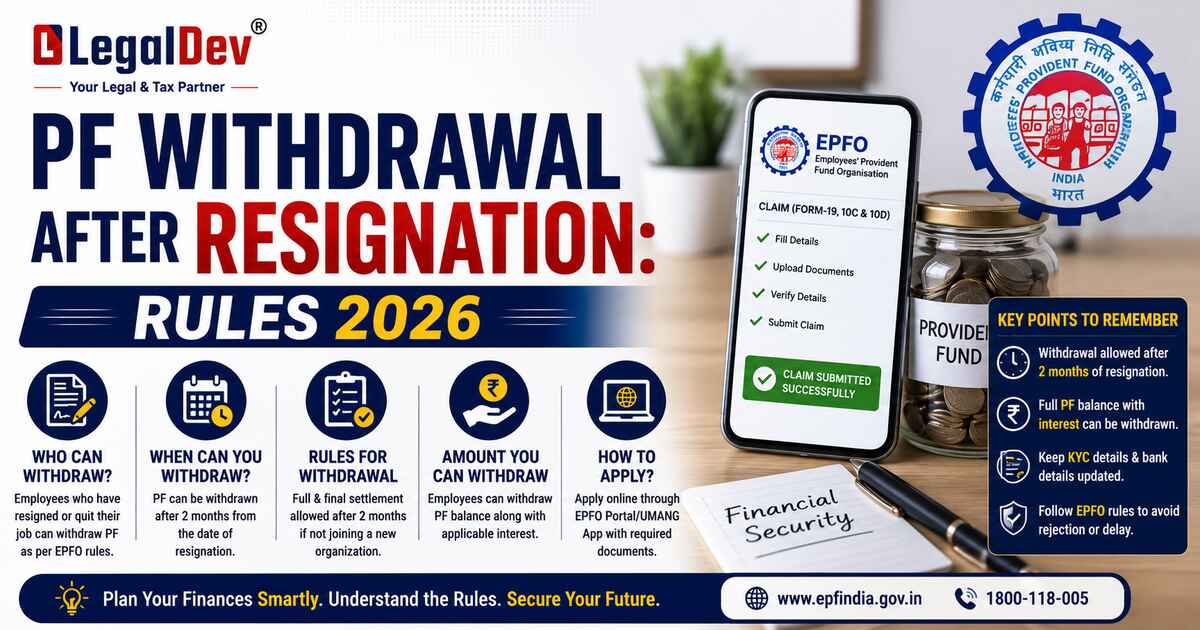
PF Withdrawal After Resignation: The Complete Guide to Claiming Your EPF Online
You've resigned. The notice period is done, the farewell lunch is over — and now you're wondering what happens to all that PF money sitting in your EPFO account. Can you take it out immediately? Will you owe tax on it? What if you've already started a new job?
These are the questions most people Google at 11 PM after their last working day. This guide answers all of them.
Are You Eligible to Withdraw Your PF After Resignation?
Not everyone who resigns can walk straight to the EPFO portal and claim their money. There are a few conditions you need to meet first.
You should have served out your notice period — or paid the equivalent amount to your employer. Your personal details (name, date of birth, Aadhaar) must be updated and verified on the EPFO portal. And critically, you must not have joined another employer by the time you make the withdrawal claim.
The timeline works like this: after resignation, you can withdraw 75% of your EPF balance after one month of unemployment. The remaining 25% — your full amount — becomes accessible after two months of continuous unemployment.
If you've started a new job, withdrawal is off the table. But transfer is very much an option. More on that shortly.
How to Withdraw PF Online After Leaving Your Job — Step by Step
EPF withdrawal online has become genuinely straightforward. You don't need to visit an EPFO office or chase your ex-employer for signatures in most cases. Here's the full EPF withdrawal online process using your UAN:
Step 1: Go to the EPFO member portal (unifiedportal-mem.epfindia.gov.in) and log in with your UAN and password.
Step 2: Click on "Online Services" from the top menu. From the dropdown, select "Claim (Form-31, 19, 10C & 10D)."
Step 3: Your bank account details will appear. Enter your account number and click "Verify." The system cross-checks it against what's registered.
Step 4: Click "Yes" to the certificate of undertaking, then hit "Proceed for Online Claim."
Step 5: Under "I Want to Apply For," choose the type of claim. For full settlement after resignation, you'll select "PF Full Settlement."
Step 6: Select Form 19 — this is the PF settlement form for final withdrawal. Fill in the reason and upload any supporting documents if prompted.
Step 7: Submit your claim. After your employer approves it (or after the auto-approval window), the money is credited directly to your bank account.
The entire process — from submission to credit — typically takes 15 to 20 working days.
What If You're Switching Jobs, Not Quitting Entirely?
If you're moving to a new company rather than staying unemployed, don't withdraw. Transfer instead.
When you transfer your EPF account from the old employer to the new one using Form 13, your years of service stay continuous. That matters a lot for tax purposes and for the five-year rule that determines whether your withdrawal will be taxed.
Submit Form 13 through the EPFO portal under your new employer's establishment. Your old employer verifies the details, and the transfer typically completes within 20 days. Your accumulated PF balance moves over, and you don't lose anything — including the interest.
The Tax Part — Read This Before You Click "Withdraw"
PF withdrawal is not always tax-free. The taxability depends entirely on how long you've been contributing.
Withdrawn before 5 years of continuous service? The entire amount — both the principal contributions and the interest — is taxable. It's added to your income for that financial year and taxed at your applicable slab rate. TDS is also deducted if the amount exceeds ₹50,000.
Withdrawn after 5 years of continuous service? The full amount is tax-free. No TDS, no income tax liability — nothing to declare.
There are two situations where even an early withdrawal escapes tax. First, if your employer shut down their business and you had no choice but to leave. Second, if you stopped working due to a medical emergency or disability. These are treated as exceptions under EPFO rules.
One thing people miss — if you've changed jobs but transferred your PF each time, the five-year clock runs across your total continuous employment, not just your last job. So a person who worked two years at one company and four at another (and transferred their PF) qualifies for the tax-free withdrawal.
How Does Early PF Withdrawal Affect You Long-Term?
The retirement argument for leaving your EPF untouched is a real one. EPF currently offers around 8% annual interest, fully tax-free after five years — that's a hard return to beat with most other safe investment options.
When you withdraw early, you lose compounding. You also add the amount to your taxable income for that year — which, if you're in the 30% bracket, means you could lose nearly a third of it to tax.
There's no rule saying you must withdraw your PF after resignation. If you leave it invested, the account stays active and keeps earning interest for a period. The wiser move, especially if you're rejoining the workforce, is to transfer it — not cash it out.
Common Reasons Your PF Withdrawal Gets Rejected
EPFO rejections are frustrating — especially when you need the money urgently. The most common reasons:
Your name, date of birth, or Aadhaar details on the EPFO portal don't match your employer's records. Even a single character difference in your name causes a mismatch rejection. Your bank account number or IFSC is incorrectly entered. You've filed a duplicate claim while one is still being processed. Or your KYC isn't complete — Aadhaar linking and bank seeding are both mandatory before online claims are accepted.
Fix these before you apply. Log in to your UAN portal, go to the KYC section, and confirm that everything is verified.
Which Form Do You Need?
Two forms come up most often in EPF claims:
Form 19 — used for full and final PF settlement after resignation or retirement. This is what you'll use if you want to close out your EPF account completely.
Form 31 — used for partial withdrawals while you're still employed. Eligible reasons include medical emergencies, weddings, education expenses, home purchase, home construction, home renovation, or repayment of a home loan.
Both can be submitted online through the EPFO unified portal. Physical submission is still possible at EPFO offices, but the online route is faster by a significant margin.
FAQs
Q: Can I withdraw 100% of my PF immediately after resignation?
A: Not immediately — you need to wait. After one month of unemployment post-resignation, you can withdraw 75% of your EPF balance. The full 100% is accessible after two continuous months of unemployment. If you've started a new job before that, you're no longer eligible for withdrawal — only transfer.
Q: How long does EPF withdrawal take after claim submission?
A: Online EPF claims are typically processed within 15 to 20 working days from the date of submission. The timeline includes employer verification and EPFO processing. After approval, the amount is credited to your registered bank account. Delays usually happen due to KYC mismatches or employer approval pending.
Q: Is PF withdrawal taxable if I resign before 5 years?
A: Yes. If you withdraw your EPF balance before completing five years of continuous service, the entire amount — contributions and interest both — is taxable as income. TDS at 10% is deducted at source if the total exceeds ₹50,000. You should declare it while filing your ITR for that year.
Q: What happens to my PF if I don't withdraw after resignation?
A: Your EPF account remains active and continues to earn interest. There is no obligation to withdraw. You can either transfer it to your new employer when you join, or leave it invested and claim it later. Keeping it invested is often the better financial decision, especially if you're close to the 5-year tax-free threshold.
Q: Can I do my PF withdrawal without my previous employer's help?
A: In most cases, yes — if your UAN is activated, Aadhaar is linked, and KYC is complete, you can file an online claim without your employer's involvement. For older accounts or cases where UAN wasn't seeded with Aadhaar, employer attestation may still be required. EPFO has been progressively reducing employer dependency in the claim process.
Q: Can I withdraw PF while still employed for a medical emergency?
A: Yes. Under Form 31 (partial withdrawal), you can withdraw from your EPF while employed for specific reasons including medical treatment for yourself or a family member. The withdrawal is partial — not a full settlement — and there are limits based on your salary and years of service.
Q: What is Form 19 in EPF, and when do I need it?
A: Form 19 is the EPF Final Settlement form — it's what you submit when you want to withdraw your entire provident fund balance after leaving a job. It can be filed online through the EPFO portal under the "Online Claim" section after logging in with your UAN. Don't confuse it with Form 31, which is for partial withdrawals while still employed.
Q: Will TDS be deducted on my PF withdrawal?
A: TDS is deducted at 10% (or 20% without PAN) if you withdraw before five years of service and the total amount exceeds ₹50,000. If you've completed five years of continuous service, there is no TDS deduction and the withdrawal is fully exempt from income tax.
Q: Can I transfer my PF to a new employer instead of withdrawing it?
A: Yes, and it's usually the smarter move. Submit Form 13 through the EPFO portal after joining your new company. The transfer keeps your service period continuous, preserves your five-year tax-free eligibility, and avoids any tax liability. Transfers typically take around 20 days.
Q: Is it possible to remain an EPF member after retirement?
A: Yes. If you've reached retirement age but are still working, you can continue contributing to EPF and remain an active member. If you've retired and stopped working, your account stays open and keeps earning interest until you choose to withdraw.